
Summary
Editor's rating
Is it worth the money compared to bottles and bigger kegs?
Tall, skinny, and mostly practical… with a few quirks
Stainless steel build that feels decent, but mind the seals
Built to last in theory, but watch the small parts
How it pours, how it keeps carbonation, and what’s annoying
What you actually get in the box and how it goes together
Pros
- Keeps beer pressurized and fresh for at least a couple of weeks when set up correctly
- Compact, tall design fits easily in most fridges and coolers
- Self-closing faucet reduces accidental drips and wasted beer
Cons
- Narrow opening and tall body make filling and cleaning awkward, with lots of foam if you rush it
- System is sensitive to seal and tightening issues, which can cause leaks or pressure loss

Specifications
View full product page →| Brand | Gancowise |
A compact draft setup for people who are tired of bottles
I picked up the Gancowise 128oz mini keg growler because I was tired of dealing with piles of bottles and flat growlers. I wanted something I could fill with homebrew or a local craft beer, keep it under pressure, and pour like a real tap at home. Nothing fancy, just something that works and fits in a normal fridge. On paper, this one ticked the boxes: 128oz capacity (basically a gallon), stainless steel, CO2 regulator, and a self-closing tap so you don’t accidentally dump beer everywhere.
Out of the box, it feels like a straightforward kit: the stainless keg, spear/tap assembly, a basic regulator for 16g CO2 cartridges, and the self-closing faucet. No electronics, no cables, just a manual setup. I’m not a kegging pro, but I’ve used Corny kegs before, and I wanted something smaller and easier to move around for small batches and parties. This looked like a decent middle ground between a full kegerator and those cheap non-pressurized growlers that let your beer go flat after a day.
After a couple of weeks of on-and-off use, I’d say this isn’t perfect, but it does what it says if you’re willing to fiddle with it a bit. There’s a bit of a learning curve for filling it without turning half your beer into foam, and you need to be careful with seals and connections. But once dialed in, it pours pretty nicely and keeps beer tasting fresh for more than just a weekend. You just can’t treat it like a plug-and-play gadget; you have to actually pay attention to how you set it up.
If you’re expecting a professional bar system, you’ll be disappointed. If you’re okay with a small, manual setup that takes a little tweaking but gives you draft beer from your fridge, it’s pretty solid. I’ll walk through what I noticed: how it’s built, how it pours, how well it keeps carbonation, and whether I think it’s worth the money compared to just sticking with bottles or a basic growler.
Is it worth the money compared to bottles and bigger kegs?
Price-wise, this sits in that middle zone: more expensive than basic glass growlers or plastic kegs, but cheaper than a full kegerator setup with Corny kegs, big regulators, and CO2 tanks. For what you get—a stainless keg, tap, spear, and mini regulator—it’s a pretty fair deal, especially if you’re just getting into kegging and don’t want to spend a ton right away. You do need to factor in ongoing CO2 cartridge costs, though. If you’re using it a lot, those 16g cartridges will add up compared to a full-size CO2 tank.
Compared to sticking with bottles, this is more about convenience and the draft experience than raw savings. You’re paying for the ability to pour beer from a tap, keep it under pressure, and move it around easily. If you only occasionally drink beer at home, it might feel like overkill. If you brew small batches or like to buy beer in larger quantities and keep it fresh on tap for a couple of weeks, then it starts to feel like reasonable value. It also makes more sense if you actually use the full 128oz over time, not just once in a while.
Against other mini-keg systems, it holds up pretty well. You can find cheaper pressurized growlers, but they often cut corners on materials or don’t include a proper regulator. You can also find more expensive ones that look fancier or have brand names plastered on them. This one lands in the “nothing flashy but effective” zone. The one-year warranty and the fact that the seller seems responsive in reviews add some value, because if you do run into a leak issue, they appear willing to sort it out.
In short, if your goal is to get a small, portable draft setup without dropping kegerator money, the value is good. It’s not some crazy bargain, but it’s also not overpriced for what it offers. It makes the most sense for homebrewers and people who regularly drink draft-style beer at home. If you’re just an occasional beer drinker, your money is probably better spent on a couple of decent regular growlers and calling it a day.
Tall, skinny, and mostly practical… with a few quirks
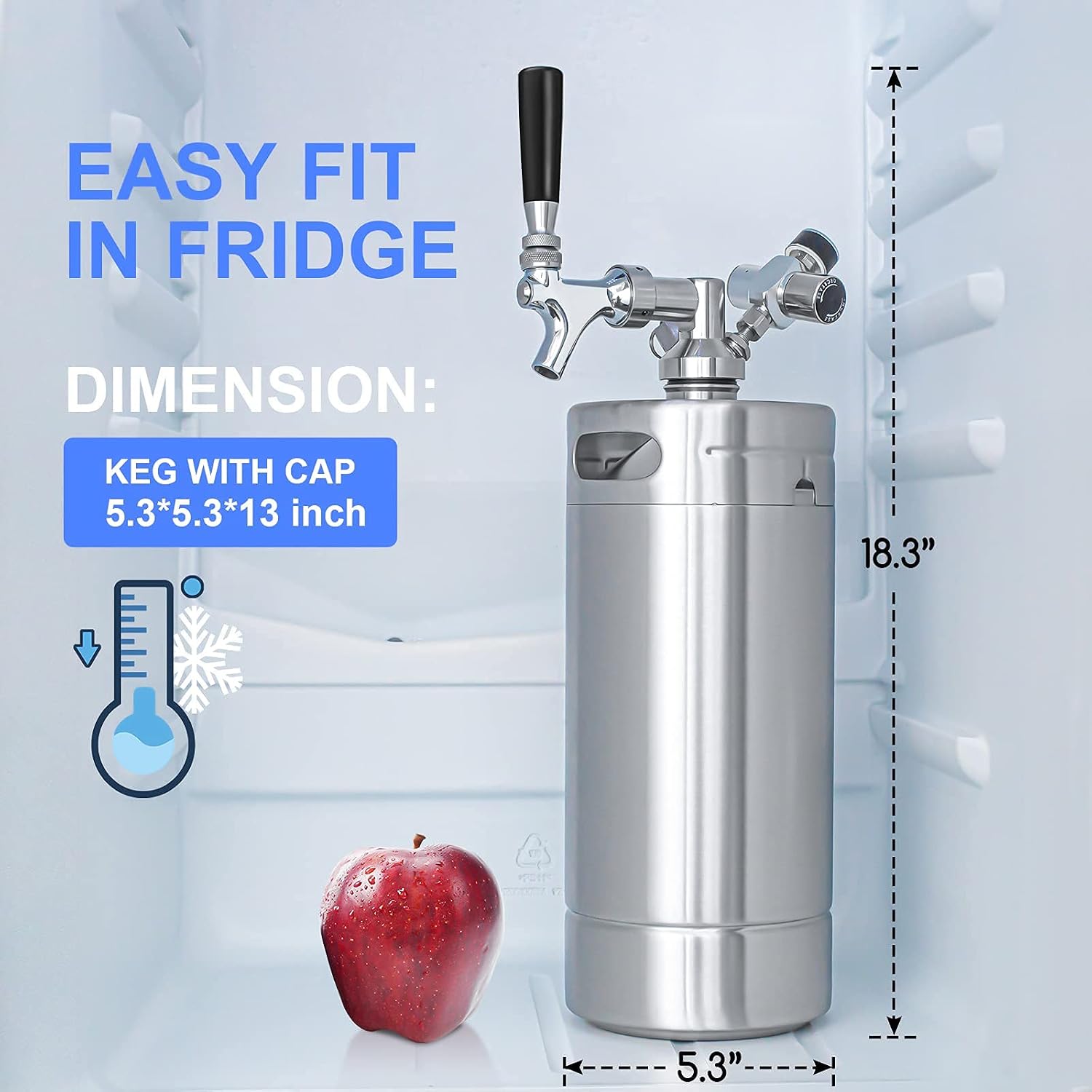
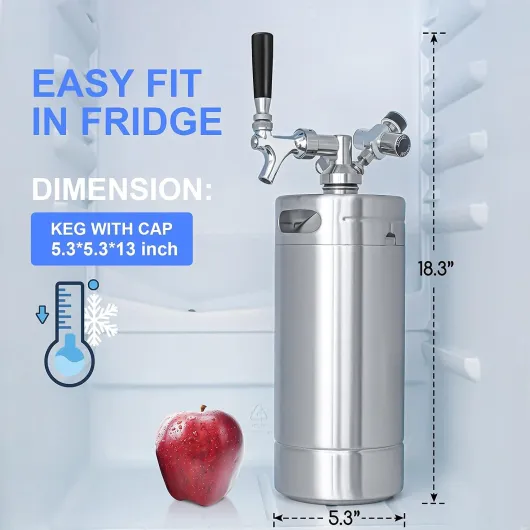
Design-wise, this is a tall, slim stainless steel cylinder with a tap sticking out the top. The dimensions are around 13.5 x 13.5 x 46.5 cm, so it’s more like a tall bottle than a squat keg. The upside is it fits into most standard fridges and coolers without much trouble. I had no issue sliding it into the door shelf of my fridge after removing one smaller shelf. The downside is the height makes filling and cleaning a bit more awkward, especially because the top opening is not very wide.
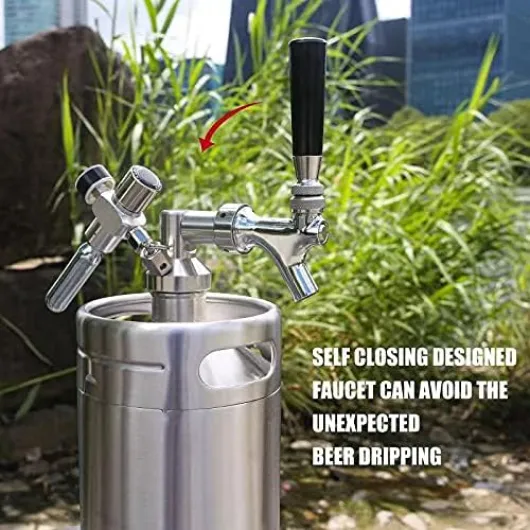
The faucet has a self-closing spring built in, which I actually liked more than I expected. You pull the tap forward to pour, and when you let go, it snaps back shut. That sounds basic, but it saves you from accidental drips or a slow trickle if you forget to close it fully. I didn’t have issues with random leaking from the tap when it was properly tightened. A couple of Amazon reviews mention leaks, and I can see how that would happen if the faucet or spear isn’t seated right, but in my case, once I checked the o-rings and snugged everything up, it stayed dry.
The regulator is small and sits right on top, which keeps the whole thing compact. You can see and adjust the pressure pretty easily. It’s not the most precise regulator I’ve used, but for a mini keg, it’s fine. The pressure relief valve on the spear is also a good safety feature; you can vent excess pressure if you overdo it with the CO2. I had to bleed it once after over-pressurizing, and it worked like it should—no drama, just a quick hiss and back to normal.
In practice, the main design trade-offs are: good fridge fit and a clean look versus narrow opening and tall body. The narrow opening makes filling and scrubbing harder. You’re not getting your whole hand in there, so you’ll probably want a bottle brush or cleaning tablets. If you’re okay with that and you want something that looks neat and doesn’t take over your fridge, the design is pretty solid. If easy cleaning and filling are more important to you than compact shape, a shorter, wider mini keg might suit you better.
Stainless steel build that feels decent, but mind the seals
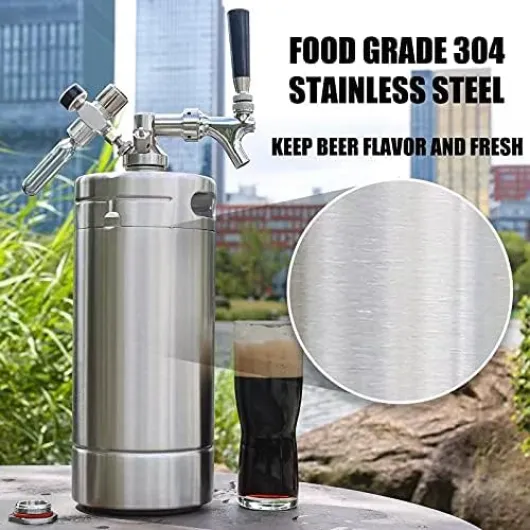
The keg itself is stainless steel with a polished finish. It feels sturdy enough for home use. I didn’t baby it—I bumped it around a bit in the sink while washing, slid it in and out of the fridge, and it didn’t dent or scratch easily. It’s not super heavy at around 4.5 pounds empty, so it’s easy to move around even when full. The finish is smooth and doesn’t pick up fingerprints as badly as I expected, which is a small plus if you care about how it looks sitting on a counter.
The spear and faucet are also metal, with the tap handle made from black bakelite. The handle itself is basic but fine; it doesn’t feel premium, but it doesn’t feel cheap to the point of breaking either. The important parts are the internal seals and o-rings. That’s where most of the leak complaints on Amazon likely come from. If a seal is slightly off, or if you don’t tighten something enough, you’ll lose pressure overnight and think the whole system is crap. I checked mine carefully before first use, and everything seemed seated properly, but I still did a quick water pressure test before putting beer in, just to be safe.
The CO2 regulator is lightweight and feels more like mid-range hardware, not pro-grade. It’s mostly metal, but it doesn’t give that heavy-duty impression that a full-size regulator would. That said, it did its job: it held pressure and didn’t feel like it was about to fall apart. The threading for the 3/8" CO2 cartridges is clean, so the cartridges screwed in smoothly. Just remember it only supports that specific type, so you can’t just throw in any random cartridge you find.
Overall, the materials are what I’d call “pretty solid for home use.” Not luxury bar equipment, but not junk either. If you treat the gaskets and threads with a bit of care, you should be fine. I’d just recommend checking the o-rings when you get it, maybe keeping a little food-grade lubricant on hand if you’re going to be assembling and disassembling it a lot. The stainless steel body itself feels like it will last a long time; the only thing I’d keep an eye on over time is the seals and the regulator.
Built to last in theory, but watch the small parts
I haven’t had this for years, obviously, but based on a few weeks of regular use and the way it’s built, I’d say the stainless keg itself should last a long time. It’s thick enough that normal bumps and fridge use aren’t going to hurt it. No signs of rust, no weird discoloration, and the polished finish still looks pretty clean after multiple washes. As long as you don’t drop it off a counter or slam it into something sharp, the body seems solid.
The parts that concern me more in the long run are the seals and the regulator. O-rings and gaskets are wear items; they dry out, get nicked, or compressed over time. If you’re assembling and disassembling the spear and faucet often, I’d expect to eventually need replacements. The product doesn’t come with spare seals, which is a bit of a downside. The good news is the shapes aren’t exotic, so you could probably match them with generic food-safe o-rings if needed, but it would be easier if the kit included a small bag of spares.
The regulator feels okay now, but it’s not industrial-grade. I wouldn’t throw it loose in a toolbox or let it rattle around in a car trunk. Treat it like a small instrument: don’t overtighten, don’t drop it, and it should be fine. Reviews mention that when there was a faulty faucet or a leaking part, the seller replaced it quickly, which is reassuring. It doesn’t fix the annoyance of a bad unit, but it at least means you’re not stuck with a useless keg.
So in terms of durability, I’d split it like this: the keg body: very good; the hardware: decent with some care. If you rinse it after each use, don’t leave beer residue sitting in there for weeks, and you’re not rough with the regulator and tap, I don’t see any big reason it wouldn’t last several years. Just be mentally prepared that at some point you might need to replace a gasket or get a part swapped if you get unlucky with a bad batch.
How it pours, how it keeps carbonation, and what’s annoying
Performance-wise, I tested it with a small batch of homebrew and then with a local IPA that I transferred from bottles. Once I got past the filling issues (foam city if you rush it), the actual pouring experience was decent. With the regulator set to a reasonable pressure, I was getting a steady pour and a nice head without it shooting out like a fire hose. The self-closing tap helps keep things tidy; no slow drips down the side, which I’ve had with cheaper picnic taps.
On carbonation, it does what it claims as long as your seals are good. My homebrew stayed nicely carbonated over about two weeks of on-and-off pouring. It didn’t taste flat or oxidized, which is usually what kills beer in regular non-pressurized growlers after a couple of days. I wouldn’t say it magically keeps beer perfect for “months” in a real-world sense—most people will drink 128oz faster than that anyway—but for a couple of weeks, it held up well. You can tweak the regulator a bit if the pour slows down or the head looks weak.
Where it can get frustrating is when something is slightly off and you lose pressure overnight. I had one incident where I didn’t tighten the regulator enough, and the next day the pressure was basically gone. The beer was still drinkable, but the pour was sad and I had to swap in a new CO2 cartridge and snug everything down. After that, it held just fine. This matches what some other users say: if there’s a leak, it’s often a simple hardware or assembly issue, not the whole concept being broken. The plus side is that the manufacturer seems to replace faulty parts quickly, judging from reviews, but obviously it’s better if it works right the first time.
In practice, I’d rate the performance as: good once dialed in, but not foolproof. If you like tinkering a bit and don’t mind adjusting pressure and checking seals, you’ll be happy with how it pours and holds carbonation. If you want something completely brainless and never want to think about it, you might find the occasional leak or pressure quirk annoying. Compared to full-size Corny kegs with a big regulator and lines, this is more compact and simpler, but also a bit more sensitive to small setup mistakes.
What you actually get in the box and how it goes together
The kit is fairly complete for a basic mini-keg system. You get the 128oz stainless steel keg, the spear with an integrated pressure relief valve, the faucet, a small CO2 regulator that takes 3/8" threaded 16g CO2 cartridges, a black bakelite tap handle, and a little wrench for installing the faucet. There’s also a user manual, which is usable but not exactly detailed. Just note: CO2 cartridges are not included, so if you don’t have any lying around, you’ll be stuck staring at it instead of pouring beer on day one.
Assembly is pretty straightforward if you’ve ever seen a draft system. You clean everything with warm water and mild soap, screw the faucet into the spear, attach the regulator to the spear, then screw the whole thing onto the keg once it’s filled. After that, you thread a CO2 cartridge into the regulator, crack it open, and you’re pressurized. The first time took me maybe 15–20 minutes because I kept double-checking the seals and making sure I wasn’t cross-threading anything. Now it takes 5 minutes tops.
Where it can get annoying is the filling step. The opening on top isn’t huge, and the keg is pretty tall, so you can’t just dump beer in quickly. If you do, you’ll get a ton of foam, like other users mentioned. I ended up tilting the keg on its side and pouring slowly along the wall, which helped. Using a siphon or a bottling wand from a fermenter works even better. It’s not a deal-breaker, but it’s not as casual as topping up a big-mouth growler.
Overall, the presentation is decent: everything needed to pour is there, the parts fit together reasonably well, and nothing felt flimsy out of the box. Just be aware that there’s a bit of setup and learning involved. It’s not complicated, but it’s also not something you just slap together without paying attention to gaskets, tightening, and how you fill it if you want to avoid leaks and foam.
Pros
- Keeps beer pressurized and fresh for at least a couple of weeks when set up correctly
- Compact, tall design fits easily in most fridges and coolers
- Self-closing faucet reduces accidental drips and wasted beer
Cons
- Narrow opening and tall body make filling and cleaning awkward, with lots of foam if you rush it
- System is sensitive to seal and tightening issues, which can cause leaks or pressure loss
Conclusion
Editor's rating
After actually using the Gancowise 128oz mini keg growler, I’d summarize it like this: it’s a pretty solid little draft system if you’re willing to spend a bit of time learning how to fill it, set the pressure, and check the seals. The stainless keg feels durable, the self-closing tap is genuinely handy, and once everything is dialed in, it pours nicely and keeps beer carbonated for at least a couple of weeks. It’s not flashy, but it does the job it’s supposed to do.
It’s not perfect. The tall, narrow design makes filling and cleaning more annoying than it needs to be, and the whole system is sensitive to how well you tighten and seat the parts. If you get a faulty faucet or a bad seal, you’ll see leaks or pressure loss, which is frustrating. The upside is that the brand seems to stand behind it and replace problematic parts, judging by user reviews. Still, you have to accept that this isn’t a zero-maintenance gadget—there’s a bit of tinkering involved.
I’d recommend it for homebrewers doing small batches, or anyone who likes having a gallon of beer on tap in the fridge without committing to a full kegerator. If you enjoy the process and don’t mind minor adjustments, you’ll probably like it. If you want something totally effortless, or you hardly drink beer at home, you’re better off skipping this and sticking to bottles or simple growlers.