
Summary
Editor's rating
Value for money: who should actually buy this
Design: smart ideas, a few clumsy details
Materials and build: solid keg, average fittings
Durability and maintenance after several uses
Performance: pour quality and pressure in real use
What you actually get out of the box
Does it actually improve the drinking experience?
Pros
- Sturdy 5L stainless steel keg that keeps beer carbonated for several days
- Built-in pressure gauge makes it easier to control pour and avoid guessing
- Compact size is practical for fridges, small parties, and transport
Cons
- Tap and small fittings feel a bit cheap and may wear faster than the keg body
- Requires some trial-and-error to avoid foam and get a good pour
- Cleaning and disassembly take time compared to just using bottles or cans

Specifications
View full product page →| Brand | Ysislybin |
A small keg for people who are tired of flat bottles
I picked up this 5L Ysislybin mini beer keg because I was tired of opening 50 cl bottles and having them go flat halfway through a barbecue. I mainly used it for draft-style lagers and a couple of IPAs over a few weekends. No fancy brand name here, it’s basically a stainless steel cylinder with a tap and a pressure gauge, so I went in with fairly low expectations and just hoped it wouldn’t leak everywhere.
In practice, it’s a simple pressure keg with faucet and gauge, nothing more. You fill it, you pressurize, you pour. I tested it with friends during a small house party (we went through about 9–10 liters total, so two full fills) and also kept one fill in the fridge for 4 days to see how well it held carbonation. That gave me a decent idea of how it behaves in normal use: filling, moving it around, cleaning, and pouring several glasses in a row.
Right away, the main thing I noticed is that it’s not plug-and-play. You need to be a bit handy and patient. The manual is pretty basic, and if you’ve never used a pressurized mini keg before, you’ll probably spend your first 20–30 minutes fiddling with pressure and flow until you get a pour that isn’t all foam. Once I found the sweet spot, it worked fairly well, but there is definitely a learning curve.
Overall, my first impression after a couple of uses is: it’s decent and functional, not fancy. It keeps beer under pressure, the gauge helps avoid guessing, and the tap is okay once you get the hang of it. On the downside, details like the finishing, the fittings, and the ergonomics remind you this is not a high-end draft system. If you want something polished and idiot-proof, this is probably not it. If you’re fine with a bit of tweaking and just want cold beer on tap at home, it does the job.
Value for money: who should actually buy this
In terms of value for money, this sits in that middle zone: not dirt cheap, not premium. You’re mainly paying for a 5L stainless steel tank and the convenience of a built-in pressure gauge and tap. Compared to some branded mini keg systems that cost quite a bit more, this one cuts corners on finishing and packaging, but you still get the core function: pressurized storage and tap service.
If you often host small gatherings, drink craft beer in larger quantities, or like to bring beer to barbecues and want something more practical than hauling a bunch of bottles, this starts to make sense. Five liters is a usable capacity: roughly 10 pints or so, enough for a small group without being a pain to move or store. For that use, the price feels fair: you get decent materials and okay performance, and you’re not paying for a fancy brand name.
On the other hand, if you only drink a couple of beers a week, or you mostly drink canned beer alone on the couch, this is probably overkill. You’ll spend money and time on something that doesn’t really change your life. Also, if you’re very picky about build quality and want something that feels high-end in every detail, you might be better off saving up for a more expensive draft system. This one is more, “it works and it’s good enough,” not “wow, this is super polished.”
So for me, value is decent but not mind-blowing. It’s a practical tool for people who actually use it regularly: homebrewers, folks who buy beer in bulk, or those who like having draft-style service at parties. For casual drinkers, the money might be better spent on better beer rather than on the hardware.
Design: smart ideas, a few clumsy details
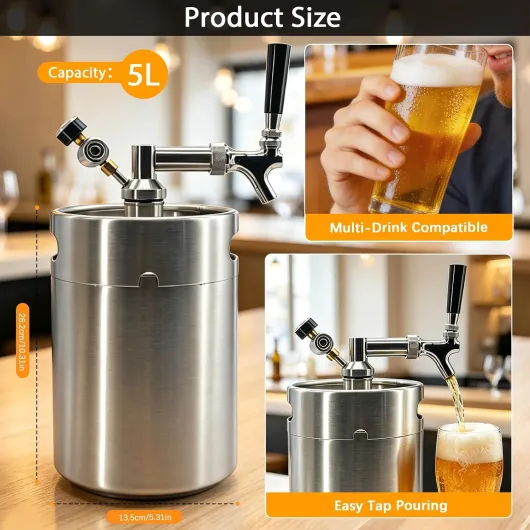
The general design is simple and compact. It’s a straight stainless steel cylinder with a wide opening at the top, where you screw on the lid that holds the pressure system and tap. I like that it’s short enough to fit in a normal fridge on a shelf if you remove the top assembly while cooling the beer first, or in a larger fridge door if you’re lucky. For serving, I usually kept it on a table and brought cold beer from the fridge, then topped up the keg as needed.
The advertised “adjustable, tailless small water outlet valve” is basically a small flow-control valve. In practice, it’s handy: you can fine-tune the flow to reduce foam, especially if you’re running at slightly higher pressure to keep more carbonation. The downside is that the adjustment is a bit fiddly, and the knob is small. With wet hands or after a couple of beers, it’s not the most pleasant thing to tweak. A bigger, more grippy knob would have been better.
The 150 PSI pressure gauge is probably overkill for beer, since you’ll usually be somewhere between 10 and 30 PSI depending on style and temperature. But it’s readable enough, and I liked having an actual number instead of guessing. On the unit I got, the gauge wasn’t perfectly straight when screwed in, which is cosmetic but shows that the finishing is not super precise. It doesn’t affect use, but you notice it. Also, don’t expect any fancy quick-connect system; it’s simple threads and seals.
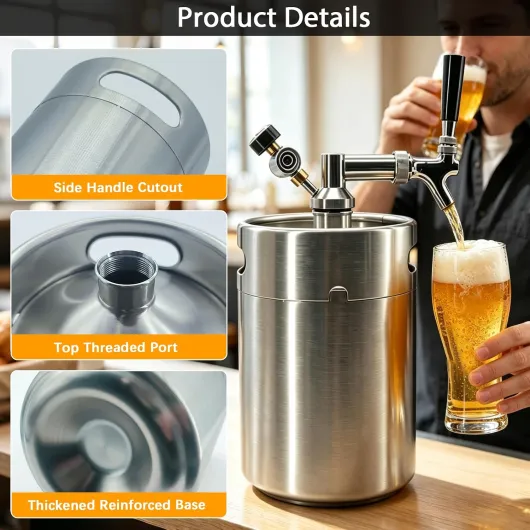
In terms of ergonomics, it’s okay but not great. There are no handles on the keg, so moving it when full is a bit awkward. You end up hugging the cylinder with both hands or grabbing it by the tap assembly, which I don’t really trust long-term. A small side handle or rubber grip would have made a big difference. Visually, it’s just brushed stainless steel with minimal branding, so it looks neutral on a table. In short: the design makes sense, but it feels like a first or second iteration, not something that’s been refined for years.
Materials and build: solid keg, average fittings
The main keg body is food-grade stainless steel, and it feels pretty solid. The walls are not super thick like a commercial keg, but thick enough that it doesn’t flex when you press on it. After a few weeks of use, including moving it in and out of the fridge and rinsing it with hot water, I didn’t see any dents or deformation. The surface finish is fairly smooth and easy to wipe down, which is important because beer drips will happen.
The top assembly (lid, fittings, valve, and gauge) is a mix of metal and plastic. The threads on the lid are metal and screw into the keg firmly, with a large gasket underneath. This part feels reliable, and I never had a leak here as long as I tightened it properly. The smaller fittings and the faucet, though, feel more budget. The tap lever has a bit of play, and the plastic parts don’t give the same confidence as something from a higher-end draft kit. They held up fine during my tests, but I wouldn’t be shocked if in a year or two you had to replace a seal or a small part.
I tested it with both cold beer and some slightly warmer liquid (around room temperature) just to see if any taste or smell would transfer. The stainless steel didn’t add any noticeable taste, which is good. As long as you clean it properly after each use, it shouldn’t affect the beer. Cleaning is straightforward: rinse with warm water, a bit of mild detergent, then rinse again. The inside welds are not perfectly polished, but there are no sharp edges or obvious rust spots.
Overall, the materials are decent for the price range: a sturdy steel tank and acceptable accessories. It doesn’t feel like a premium bar tap, but it also doesn’t feel like a toy. If you treat it with some care and don’t overtighten everything like crazy, it should last. Just be aware that the weak point is more likely the small fittings and seals than the keg body itself, so keep an eye on those and maybe plan to replace them if you use it heavily.
Durability and maintenance after several uses
After a few weeks of on-and-off use, the keg body itself still looks almost new. No dents, no rust spots, and the brushed finish hasn’t marked easily, even after going in and out of the fridge and being handled with slightly greasy hands during barbecues. That’s the strong point of this product: the main stainless steel container feels like it will last for years if you don’t actively abuse it.
The more fragile part is definitely the top assembly and seals. The large main gasket under the lid is fine so far, but I can see it being a wear part in the long run. The smaller seals around the valve and gauge look more basic. I didn’t have leaks during my tests, but you can feel that if you overtighten or twist things often, you might eventually deform something. If you plan to use this very regularly, I’d consider looking for compatible spare seals in advance or at least keeping an eye on them.
On the maintenance side, cleaning is not difficult but it’s not instant either. You need to disassemble the tap, rinse the inside, maybe run some cleaning solution if you’re picky, and then rinse again. The design is simple enough that you can reach most parts, but the small internal passages in the faucet can trap residue if you don’t rinse well. If you’re disciplined and clean it right after use, it should stay in good shape. If you let beer dry inside for a week, you’ll hate yourself later.
Overall, I’d rate durability as pretty solid for casual use. For someone using it every weekend, you’ll probably end up replacing small parts over time, but the core keg should hold up. For occasional parties and barbecues, I don’t see it failing anytime soon as long as you don’t drop it or crank everything down like you’re tightening car parts.
Performance: pour quality and pressure in real use
Performance-wise, I mainly looked at three things: how well it keeps beer carbonated, how easy it is to get a decent pour without 90% foam, and how stable it is over a few days. With a full 5L fill of lager, I pressurized it to a moderate level (around 12–15 PSI according to the gauge) and started pouring. The first couple of glasses were a bit foamy until I dialed in the small outlet valve and the tap opening, but after that, I could get a pretty clean pour with a normal head.
Over 4 days in the fridge, pressure loss was minimal. I checked the gauge once a day, and it dropped only slightly, which is normal when temperature fluctuates a bit. The beer stayed well carbonated and drinkable; it didn’t feel flat. So the claim about maintaining pressure over time is mostly accurate. If you’re the type who doesn’t finish 5L in one evening, this is actually a useful point: you can spread it out over a few days without ending up with sad, flat beer.
One thing to note: the system doesn’t magically fix bad pouring technique. If you crank the pressure high and yank the tap wide open, you’ll get foam. You really need to balance pressure and flow. For hoppy or more carbonated beers like some IPAs, I had to lower the pressure a bit and pour more gently. The “smooth wine divider” they mention is basically just a way to try and even out the flow inside, but it doesn’t replace learning how to pour correctly.
In continuous use at a small party, we poured about 10–12 glasses in a row, and the keg handled it. The last glasses were a bit warmer because the keg itself had warmed up on the table, so if you want consistently cold beer, you either keep it in a fridge or in an ice bucket. In short, performance is decent: it keeps beer fizzy, the gauge helps, but don’t expect pub-level perfection. It’s good enough for a home setup if you’re willing to spend a bit of time figuring out your ideal pressure and flow settings.
What you actually get out of the box
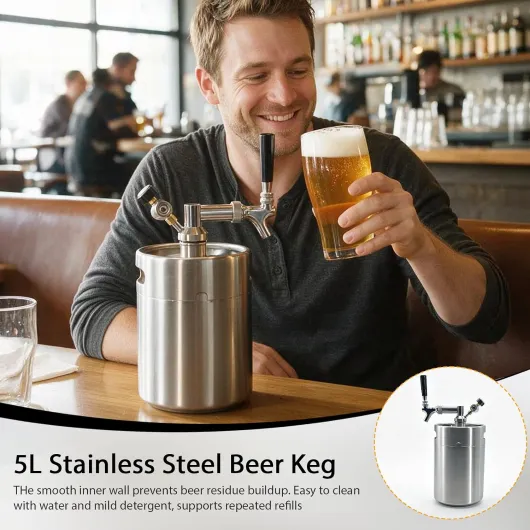
Out of the box, you get the 5L stainless steel keg, a faucet assembly, and the pressure gauge block rated up to 150 PSI. Mine arrived in a fairly plain cardboard box with molded foam inside. No fancy branding or big booklet, just a small instruction sheet with basic diagrams. It’s the sort of packaging where you immediately think, “okay, they saved money here,” which is fine as long as the product itself holds up.
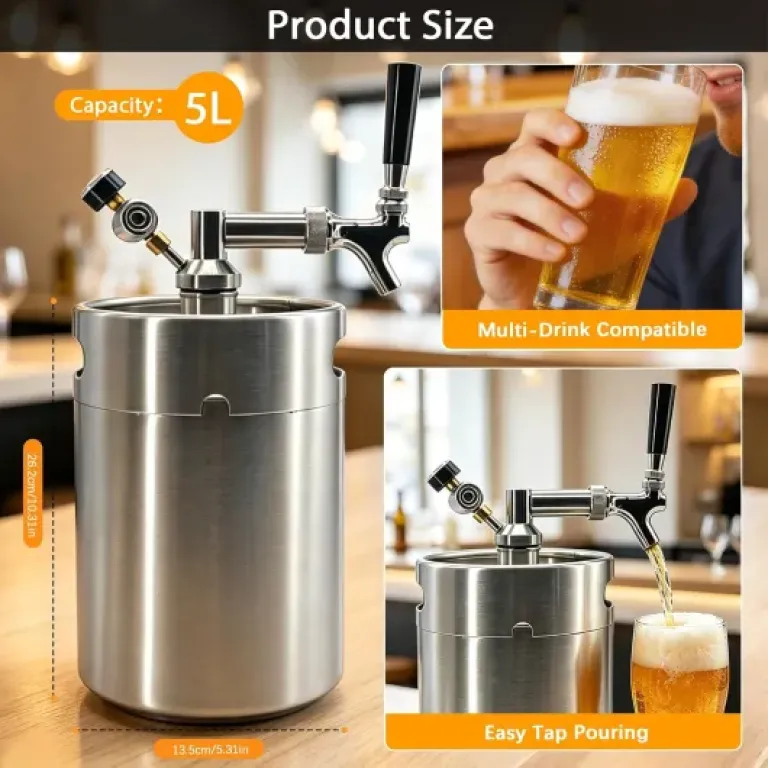
The keg is about the size of a big thermos, roughly 28 cm tall according to the specs, and it weighs around 2.4 kg empty. Once it’s filled with 5 liters of beer, it’s not feather-light, but still manageable with one hand. The gauge block and tap mount on the top, so the whole thing forms a kind of mini draft tower that you can put on a table or in the fridge. The fittings on mine were already assembled, but I still checked every joint because I don’t trust pressurized containers straight from the factory without a quick look.
One thing that’s a bit confusing is the wording: they talk about a “smooth wine divider” and “water outlet valve,” which sounds more like it’s for wine or water than beer. In practice, it’s just a small adjustable outlet valve and an internal tube that brings the liquid up. So don’t expect some magic internal system; it’s a straightforward dip tube setup. You control the flow with the little valve and the faucet, and you monitor pressure on the gauge.
My overall feeling about the presentation is: functional but basic. You get what you need to start pouring, but no extra accessories, no spare seals, and no detailed tips about pressure settings for different drinks. If you’ve never used this kind of thing, you’ll probably end up checking online videos or trial-and-error. It’s not a disaster, but it could be clearer and a bit more user-friendly out of the box.
Does it actually improve the drinking experience?
On the effectiveness side, I asked myself a simple question: is drinking from this mini keg better than just drinking from bottles or cans? For me, the answer is yes, but with some limits. The main benefit is having a tap: you can pour small glasses for friends, do refills quickly, and it feels more like draft beer. When it’s dialed in, the head is nicer than from just pouring out of a bottle into a glass, and the carbonation feels a bit more controlled.
Another plus is consistency over time. With bottles, once you open one, that’s it. Here, you can pour one or two glasses, close the tap, and the rest stays under pressure. Over a weekend, that’s pretty handy. The beer I left in the keg for 3–4 days was still in good shape, not flat or oxidized. It’s not exactly like a professional keg system, but it’s clearly better than leaving a large open bottle in the fridge.
But it’s not all positive. To get that benefit, you need to invest time in setup and cleaning. Filling the keg, purging air, adjusting pressure, and cleaning everything afterwards takes more effort than just opening a bottle. If you’re lazy about cleaning, this is not for you. Also, the “smooth wine divider for optimal drinking experience” is a bit of marketing talk. It doesn’t magically change the taste; it just helps get a more even flow. The beer will taste as good or as average as what you put in it.
So in practice, I’d say the keg does improve the overall drinking experience if you like draft-style serving and you’re okay with a bit of work. It won’t make cheap beer taste premium, but it keeps it fresh and makes serving more fun and practical for small gatherings. If you drink very occasionally or only one or two beers at a time, the benefit is smaller and might not justify the extra hassle.
Pros
- Sturdy 5L stainless steel keg that keeps beer carbonated for several days
- Built-in pressure gauge makes it easier to control pour and avoid guessing
- Compact size is practical for fridges, small parties, and transport
Cons
- Tap and small fittings feel a bit cheap and may wear faster than the keg body
- Requires some trial-and-error to avoid foam and get a good pour
- Cleaning and disassembly take time compared to just using bottles or cans
Conclusion
Editor's rating
After using this Ysislybin 5L mini beer keg for a few weeks, my overall opinion is that it’s a solid, no-frills way to get draft-style beer at home. The stainless steel keg feels sturdy, the 5L size is practical for small gatherings, and the built-in pressure gauge actually helps a lot once you learn how to use it. It keeps beer carbonated for several days, and pouring is decent once you’ve dialed in the pressure and flow. It’s not fancy, but it does what it’s supposed to do.
It’s not perfect, though. The fittings and tap feel a bit budget, there’s a learning curve to avoid foam, and you have to be disciplined about cleaning. There’s also nothing magical about the “smooth wine divider” – it doesn’t change the taste; it just helps with flow. If you want something ultra-polished, with premium components and plug-and-play use, this isn’t it. But if you’re okay with a bit of setup and maintenance, you get a practical tool that’s good for barbecues, house parties, and home use.
I’d recommend it to people who: host friends regularly, like the idea of draft beer, or are into homebrewing and want a small serving keg. If you’re a very occasional beer drinker, or you hate cleaning gear after use, you can skip it and stay with bottles and cans. For the price range, it’s good value for people who will actually use it, and just “nice to have” for everyone else.