Summary
Editor's rating
The included American Prophecy Ale: drinkable, but not mind-blowing
Is it worth the money compared to other starter kits?
Conical fermenter: smart idea, half-baked execution
Plastic build: solid enough, but feels a bit cheap in spots
How it holds up after a few batches
Fermentation, leaks, and day-to-day use
What you actually get in the box
Does it actually make brewing easier?
Pros
- Compact 2-gallon conical fermenter that reduces sediment compared to a flat-bottom bucket
- Built-in spigot makes bottling faster and avoids using a siphon
- Includes bottles and a starter recipe so you can brew right away with minimal extra gear
Cons
- Spigot and gasket can be finicky and prone to leaks if not installed perfectly
- Vent plug and lid design feel cheap and less reliable than a proper airlock system
- Price is relatively high for the build quality and you may still need to buy extra or replacement parts

Specifications
View full product page →| Brand | BrewDemon |
A compact brewing kit that looks easier than it really is
I picked up this BrewDemon 2-gallon kit because I wanted something simple I could run in the kitchen without turning the whole place into a brewery. On paper, it ticks a lot of boxes: conical fermenter, built-in spigot, bottles included, and a recipe kit to get started. It sounded like a good middle ground between the super basic bucket kits and the more serious glass carboys and stainless setups.
After actually using it a couple of times, I’d say it’s a mixed bag. It does let you brew drinkable beer with limited gear, and the 2‑gallon size is nice if you don’t want 40+ bottles of something you might not even like. But it’s not the plug‑and‑play miracle the marketing promises. You still need to pay attention to seals, cleaning, and a few design quirks if you don’t want leaks or off flavors.
What surprised me most is how different the experience is depending on how picky you are. If you just want an easy way to make some beer for fun, it mostly gets the job done. If you’ve brewed before and you’re used to better hardware, you’ll probably notice the shortcuts: the plastic feels a bit cheap, the vent plug solution is basic, and the spigot design isn’t foolproof.
So this review is from the angle of a casual but not totally clueless homebrewer. I’m not a pro, but I’ve used bucket kits, glass carboys, and Fermonster-style fermenters. Compared to those, this BrewDemon kit sits somewhere in the middle: more convenient than a bucket, but not as polished as it could be. I’ll walk through what works, what’s annoying, and whether it’s worth the money if you’re thinking of starting with this kit.
The included American Prophecy Ale: drinkable, but not mind-blowing
The kit comes with an American Prophecy Ale recipe, rated around 4.6% ABV. It’s a pre‑hopped malt extract setup, so you’re not doing full‑grain brewing here. The upside is that it really is quick: the hot side takes around 15 minutes on the stove, plus cooling and cleanup. For a first batch or a casual brew day, that’s honestly quite nice. You aren’t stuck watching a pot for an hour or more.
As for the beer itself, it’s perfectly drinkable but nothing special. The taste is what I’d call standard kit pale ale: a bit malty, some generic hop bitterness, but not a lot of character beyond that. If you’re used to craft beers from a good local brewery, this won’t blow you away. But if you just want something homebrewed that doesn’t taste like syrup or cardboard, it does the job. Mine fermented cleanly in about 7–10 days at room temperature, and after two weeks in the bottle it was fine to drink.
One Amazon reviewer pointed out that the pre‑mix didn’t really match the style claimed, and I kind of get that. If you expect a punchy American pale ale with distinct hop notes, this isn’t it. It’s more of a general "amber-ish" or "pale-ish" homebrew kit beer. If you’re serious about taste, I’d use this first batch as a way to test the fermenter, then switch to ingredients from a local homebrew shop or online recipes with better hops and specialty grains.
Carbonation with the supplied setup works reasonably well as long as you measure your priming sugar properly. I used standard priming sugar per bottle and got a decent level of fizz after two weeks. No bottle bombs, no flat beer. Overall, the taste is okay for a starter kit: it won’t impress a beer geek, but it’s good enough to drink with friends and say, "yeah, I brewed this," without being embarrassed.
Is it worth the money compared to other starter kits?
Price-wise, this kit lands in a slightly awkward spot. It’s not dirt cheap, especially once you factor in shipping (one user mentioned paying around $60 total for just the fermenter). For that money, you can get two simple Fermonster-style fermenters or a bucket kit plus some extra ingredients. So the question is really whether the conical design and included bottles justify the extra cost.
If you’re a total beginner who likes the idea of a compact 2‑gallon setup with a tap and bottles in the box, the value is reasonable but not outstanding. You do get a usable fermenter, a first recipe, and bottles you can reuse a few times. The 2‑gallon format is also less wasteful if a batch doesn’t come out how you want. And the conical shape does help with sediment compared to a flat bucket, which is a plus.
On the downside, there are clear signs of cost‑cutting: basic plastic quality, the vent plug instead of a proper airlock, and some people not receiving all accessories straight out of the box. When you compare it to something like the Coopers kit, which many users say is more complete and fully functional out of the gate, the BrewDemon kit feels a bit overpriced for what it delivers. You might end up buying extras anyway: a better spigot, an airlock, maybe more bottles, and definitely more ingredient kits if you keep brewing.
So in my opinion, the value is fine if you catch it on sale or really want the small conical fermenter. At full price plus shipping, it’s harder to justify when there are simpler, more robust options that cost the same or less. It’s not a rip‑off, but it’s also not the best bang for your buck in the homebrew world.
Conical fermenter: smart idea, half-baked execution
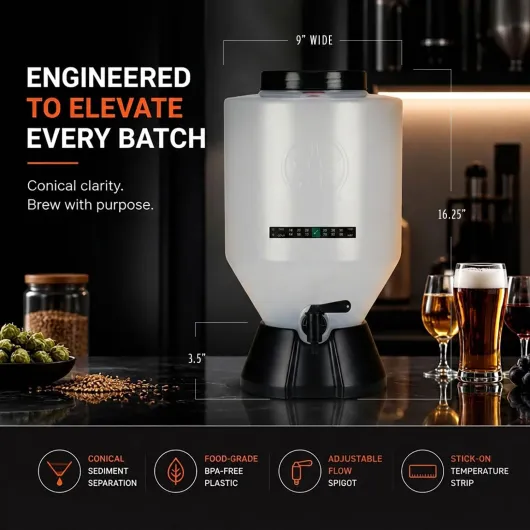
The whole selling point of this kit is the conical fermenter. The shape is similar to what you see in commercial breweries, just in plastic and smaller. In theory, the cone lets yeast and trub settle at the bottom, while you draw clearer beer from the spigot a bit higher up. That part does work reasonably well: after fermentation, most of the gunk is down in the tip of the cone, and the first part you pour from the tap is much cleaner than what you’d get from a flat-bottom bucket.
Where the design feels a bit lazy is in the details. There’s no separate dump valve at the very bottom of the cone, so you can’t easily purge sediment mid‑fermentation like with real conicals. You just let everything fall to the bottom and hope the spigot sits high enough above the crud. It’s better than a bucket, but it’s still a compromise. One Amazon reviewer is right: the conical shape could be more useful if there were a way to drain the trub separately.
The other design element is the vent plug instead of a classic airlock. On paper, it’s simple: a small plug sits in the lid and lets CO₂ push out while keeping dust out. In practice, if fermentation gets a bit vigorous or you bump the fermenter, that tiny plug can pop out and disappear, which is exactly what one unhappy user reported. The good news is the lid itself isn’t perfectly airtight, so the risk of the fermenter exploding is low, but it kind of defeats the point of a "revolutionary" vent system.
Last detail: the fermenter is clear plastic, not amber. That means you really shouldn’t leave it in direct sunlight, or you’ll mess with the beer. I just kept mine in a dark corner of a room and it was fine, but it’s worth knowing. Overall, the design is clever in concept, but not as refined as it sounds in the product description. It works, but you’ll notice the shortcuts once you start using it.
Plastic build: solid enough, but feels a bit cheap in spots
The fermenter is made from food‑grade, heat‑resistant plastic, and it feels reasonably sturdy in the hands. You can carry it full without feeling like it’s going to crack, and it doesn’t flex too much when you move it around. For a kitchen‑counter setup, the weight and size are actually pretty comfortable. It’s lighter than glass, obviously, and you don’t have the anxiety of shattering a carboy full of beer and glass shards.
That said, you can tell this isn’t premium hardware. The lid is a rough black plastic with no gasket, and you can see little imperfections and molding marks around the edges. It sits on the fermenter well enough, but it’s not truly airtight. For fermentation that’s actually fine (CO₂ will push out and a tiny leak doesn’t hurt), but it doesn’t give a feeling of tight engineering. One reviewer even mentioned needing Teflon tape to feel better about the seal, which sums up the vibe: it works, but it’s a bit crude.
The spigot and gasket are the main weak point. Some users report leaks, and I can see how that happens. The gasket is beveled and needs to be oriented correctly, and you shouldn’t overtighten the nut or it warps. If you take your time, smooth the plastic surface inside, and fit it carefully, it can be leak‑free. But it’s not idiot‑proof, and on a starter kit I’d prefer something more forgiving. The internal mechanism of the tap also feels a bit basic, and I wouldn’t be shocked if it wears out after a few batches.
The bottles are UV‑protective amber plastic. They’re fine for what they are: light, don’t break, and good enough for 2‑3 uses if you don’t scratch them badly during cleaning. They did pick up minor scuffs pretty fast, so if you’re fussy about presentation, you might end up swapping to glass later. Overall, the materials are okay for the price range, but if you’re used to thicker PET carboys or glass, this will feel a bit on the budget side.
How it holds up after a few batches
Durability-wise, I’d say the BrewDemon fermenter is okay for light to moderate use, but I wouldn’t count on it as a lifetime piece of gear. After a couple of batches, the main body still looks fine: no cracks, no warping, and it hasn’t picked up strong smells as long as I cleaned it right after racking the beer out. The plastic is thick enough that you don’t feel like you’re handling a cheap soda bottle, but it’s obviously not on the level of heavy-duty PET carboys or stainless steel.
The parts that worry me more in the long run are the spigot and the lid. The spigot is made from basic plastic and has moving parts that you twist every time you use it. If you’re brewing regularly, I could easily see it loosening up, starting to drip, or the internal seal wearing down. It’s not a disaster because you can replace the tap with a better one, but that’s extra cost and hassle. The lid, with no proper gasket, also doesn’t age in a way that improves confidence. The threads feel a bit rough and could cross‑thread if you’re not gentle.
The plastic bottles are probably the most disposable part of the kit. They’re fine for a few uses, but they pick up scratches and scuffs fairly quickly, especially if you wash them with anything more abrasive than a soft cloth. Scratches inside the bottles can trap bacteria, which is not great for beer quality over time. If you end up liking the hobby, you’ll probably move to glass bottles or higher quality PET bottles after a couple of batches.
So in terms of durability, I’d call this setup "good enough for starting out and doing a handful of batches" rather than a long‑term, heavy‑use solution. It’s not junk, but it’s also not the kind of kit you buy once and keep for a decade without swapping parts. If you accept that, it’s fine; if you want something built to last, you may want to invest a bit more in sturdier gear.

Fermentation, leaks, and day-to-day use
On the fermentation side, the kit performs well enough for casual brewing. The 2‑gallon volume is a nice sweet spot: big enough that you feel it’s worth the effort, small enough that temperature swings in a normal house don’t ruin everything. I kept mine between roughly 68–72°F (20–22°C) without any special equipment, and the yeast handled it fine. No stuck fermentations, no off smells beyond the normal yeasty aroma.
The real performance test is leaks and handling. This is where experiences differ. Some users report spigot leaks right away; others, like me, had no leaks after carefully installing the gasket the right way around. The problem is that it’s a bit finicky: if you’re new and you just crank it down or don’t clean off plastic burrs inside, you’re likely to get drips. Also, the internal mechanism of the tap can weep a tiny bit if you don’t fully close it. It’s not a flood, but for a beginner kit I’d prefer something more forgiving.
Daily use is otherwise straightforward. The fermenter is easy to move and rotate to check the krausen line or read the stick‑on thermometer (if you got one). The clear plastic lets you see fermentation progress, which is fun and useful. The downside is you have to keep it away from light, so I just threw a T‑shirt over it when it was in a brighter room. The vent plug system works, but I didn’t fully trust it, so I checked it regularly to make sure it hadn’t popped out.
For bottling, performance is actually a strong point. Bottling straight from the spigot into the 1‑liter bottles is fast and far less messy than dealing with a siphon and a dozen 12‑oz bottles. You lose a bit of precision in filling levels, but it’s good enough for home use. All in all, the performance is decent but a bit touchy: it works well if you pay attention, but it doesn’t completely remove the usual homebrewing headaches.
What you actually get in the box
Out of the box, the kit is pretty straightforward: you get the 2‑gallon conical fermenter with the spigot, eight 1‑liter plastic bottles with caps, the American Prophecy Ale ingredients, and the basic bits to get a batch going. In theory, it’s a complete starter kit: fermenter, bottles, recipe, and a simple vent plug instead of a classic airlock. That’s the idea at least.
In practice, a few things are worth noting. First, the eight 1‑liter bottles don’t fully match the advertised batch size. Two US gallons is about 7.5 liters, so you’ll fill the eight bottles pretty much to the neck with almost nothing left. If you push the fermenter to the top line with more wort or extra water, you’ll actually need extra bottles. Not a big drama if you have spares, but it’s not as tidy as "everything you need in one box" suggests.
Second, there are some complaints online about missing pieces (thermometer strip, airlock, etc.). I personally had all the basics, but seeing several users mention missing bits and dusty or scratched bottles tells me quality control on packaging isn’t perfect. The good point is that people who contacted BrewDemon say customer service reacted fast and sent replacements, which is reassuring but still annoying to have to deal with.
Overall, as a starter kit, the presentation is decent: you can brew without buying much else, apart from sanitizer and maybe a proper thermometer. But if you expect a super polished, perfectly complete kit like some of the bigger brands (Coopers, for example), this one feels a little more DIY and a bit rough around the edges. It’s functional, but you can tell they cut some corners to keep costs down.

Does it actually make brewing easier?
From a pure "does it help me brew beer with less hassle" angle, this kit is pretty solid but not magical. The conical fermenter and spigot combo do reduce some of the annoyance of siphoning. Being able to bottle straight from the tap into the 1‑liter bottles is convenient, especially if you’re brewing in a small kitchen. No need to drag out a siphon, fight with clamps, or worry about oxygen as much.
The sediment management is better than a bucket but not perfect. After fermentation, most of the yeast and trub are indeed in the bottom of the cone. When you open the spigot, the first bit may bring up a little sediment, but once that’s flushed out, the rest is fairly clear. You still want to cold‑crash if you’re picky about clarity, but for casual drinking it’s fine. It’s not the spotless clarity you get from more advanced conicals with dump valves, but for a small plastic fermenter it’s acceptable.
Where the kit stumbles is in the small design annoyances that can get in the way of that "fool‑proof" promise. A leaking spigot gasket, a vent plug that can pop out, and a lid that doesn’t feel snug all add small risks: leaks on the floor, potential contamination, or just stress while you’re trying to enjoy the process. Most of these can be managed with a bit of care and maybe some DIY (like adding Teflon tape or upgrading the spigot), but that’s not what you expect from a kit aimed at beginners.
In the end, it does what it says: you can brew around 2 gallons of beer fairly easily, and you don’t need a ton of extra gear. But it’s not as "set it and forget it" as the marketing tone suggests. If you’re okay tweaking things and learning as you go, it’s effective enough. If you want zero fuss and rock‑solid hardware from day one, you might find it a bit frustrating.
Pros
- Compact 2-gallon conical fermenter that reduces sediment compared to a flat-bottom bucket
- Built-in spigot makes bottling faster and avoids using a siphon
- Includes bottles and a starter recipe so you can brew right away with minimal extra gear
Cons
- Spigot and gasket can be finicky and prone to leaks if not installed perfectly
- Vent plug and lid design feel cheap and less reliable than a proper airlock system
- Price is relatively high for the build quality and you may still need to buy extra or replacement parts
Conclusion
Editor's rating
Overall, the BrewDemon 2‑gallon Craft Beer Brewing Kit is a decent starter option if you want something compact with a built‑in tap and you’re okay dealing with a few quirks. The conical fermenter does help keep more sediment out of your bottles, and bottling straight from the spigot into the included 1‑liter bottles is genuinely convenient. The included American Prophecy Ale kit brews into a drinkable, middle‑of‑the‑road beer that’s fine for learning the basics.
But it’s not perfect. The plastic build feels a bit cheap in places, the spigot and gasket setup can be fussy and prone to leaks if you’re not careful, and the vent plug solution is a bit of a joke compared to a proper airlock. For the price, especially with shipping, there are more robust and more complete kits out there. If you already have some brewing experience, you’ll probably notice the compromises and might prefer a standard bucket or Fermonster with a good airlock and a separate bottling wand.
I’d say this kit is best for curious beginners with limited space who like the idea of a small, countertop conical and don’t mind tweaking or upgrading a couple of parts. If you want rock‑solid equipment with no DIY fixes, or you’re planning to brew regularly and in bigger volumes, you’re better off skipping this and putting your money into sturdier gear and better ingredient kits.