
Summary
Editor's rating
Is it worth the money compared to other mini kegs?
Compact design with some quirks
Stainless steel build: sturdy but not high-end
How it holds up after a few rounds
Pour quality and pressure control in real use
What you actually get in the box
Pros
- Sturdy stainless steel keg body that feels solid and resists dents
- Compact 3.6L size fits in most fridges and is good for small gatherings
- Pressure gauge and tap work reliably once properly set up and adjusted
Cons
- Learning curve with pressure and faucet control, easy to get foamy pours at first
- Fittings and seals feel mid-range and may need care or replacement over time
- No insulation and no CO₂ cartridges included, so extra cost and not ideal for long outdoor use

Specifications
View full product page →| Brand | Buachois |
A small keg for small gatherings
I picked up this 3.6L Buachois mini beer dispenser mainly because I was tired of bringing loose bottles and cans to friends’ places. The idea of having a small stainless keg with a tap sounded practical: fill it with homebrew or beer from a local brewery, keep it pressurised, and pour like at the bar. On paper, the 60 PSI gauge, stainless body and adjustable faucet all sound decent for the price.
In practice, it’s a bit more down to earth. It works, but it’s not plug-and-play. You need to be comfortable fiddling with pressure, checking for leaks, and cleaning several small parts. If you’re expecting a polished, big-brand draft system, this is not it. If you’re a tinkerer or a homebrewer used to basic gear, you’ll probably be fine.
I tested it over a couple of weekends: once with my own kegged pale ale, once filled at a local brewery from their tap, and once with cold brew coffee. Each use showed the same pattern: when it’s set up right, pours are smooth and the drink stays carbonated (for beer) or fresh (for coffee). When you rush the setup or pressure, you get foam or dribbly pours.
Overall, I’d sum it up like this: pretty solid for casual home use, but you need to accept a bit of trial and error. It’s not perfect, but for the price and size, it does what it says, as long as you don’t expect miracles and you’re ready to get your hands slightly dirty.
Is it worth the money compared to other mini kegs?
In terms of value, I’d put this Buachois 3.6L mini keg in the “decent for budget-minded users” category. It’s not the cheapest thing on the market, but it’s clearly cheaper than some of the big-brand stainless growlers and pressurised systems that come with nicer taps and insulation. You’re basically paying for a simple stainless keg plus a functional, no-frills tap and gauge. If that’s all you need, the price feels fair.
Compared to more premium mini-keg systems I’ve seen and used, you do sacrifice some comfort: no fancy flow-control tap, no double-wall insulation, less polished finish, and a slightly clunky assembly. But those systems are often almost twice the price for the same or slightly larger capacity. If you’re just getting into home draft beer or you only occasionally fill growlers from a brewery, this set gives you the basics without blowing your budget.
On the flip side, if you’re already into homebrewing and you own proper kegs and taps, this might feel a bit limited. For the same money, you could sometimes find used Cornelius kegs or better taps, especially if you don’t need the small size. So the value is best for people who need the compact format and want an all-in-one kit, not for someone building a full kegerator setup.
Overall, I’d say the value is pretty solid if your expectations are realistic: simple stainless keg, basic but usable tap, and enough pressure control to keep beer carbonated for a few days in the fridge. There’s better gear out there, but you’ll pay more for it. If you’re okay with a bit of tinkering and you just want cold beer on tap at home in small batches, the price-to-function ratio makes sense.
Compact design with some quirks
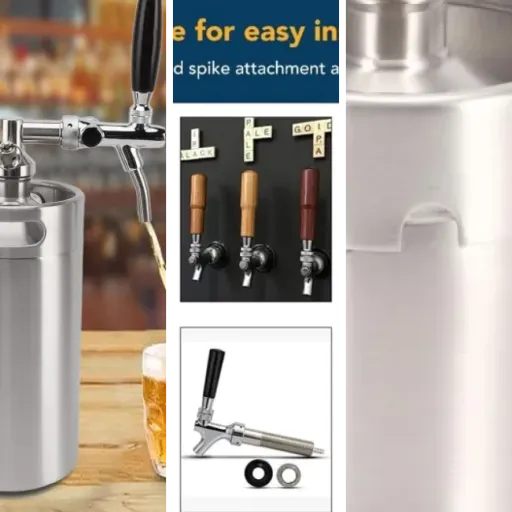
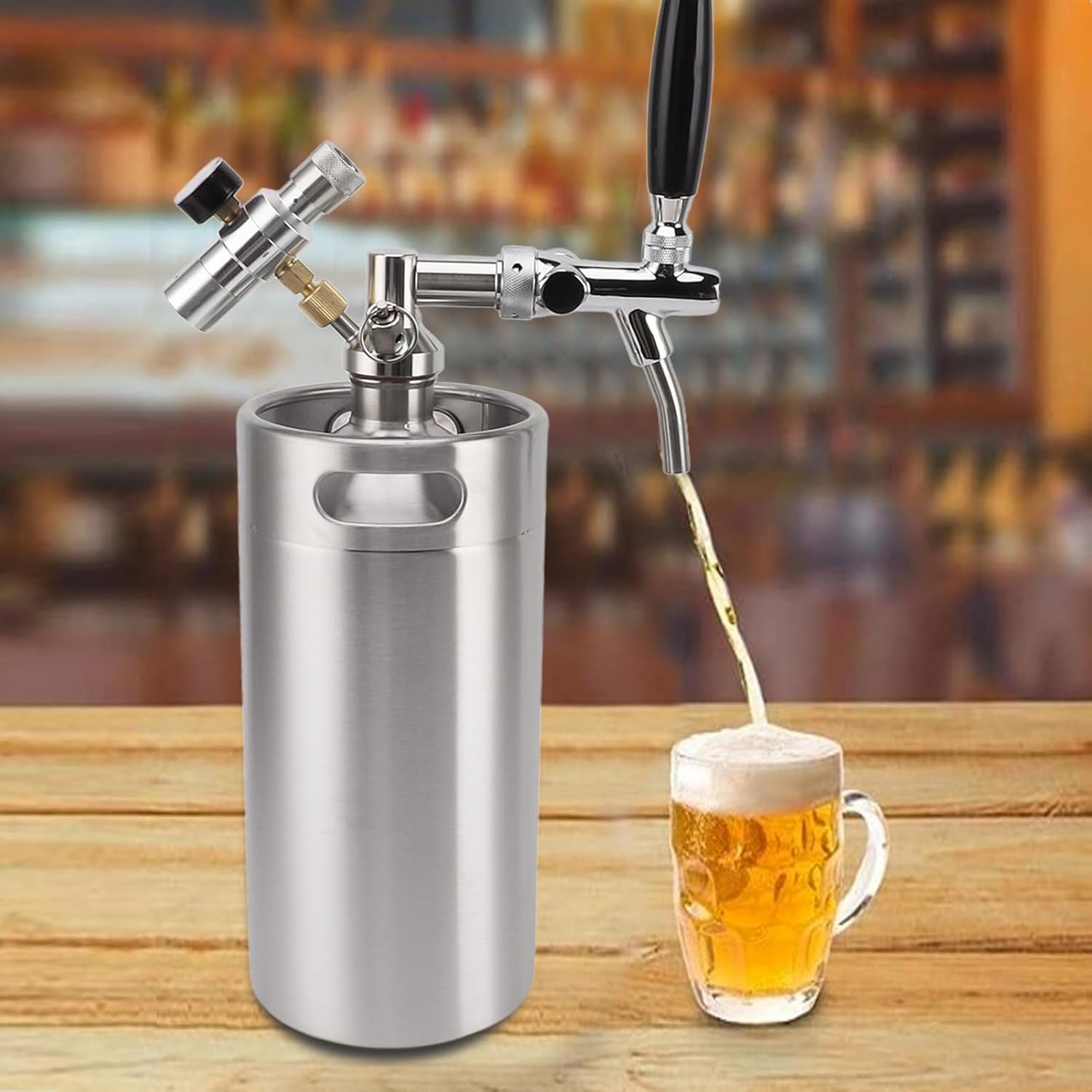
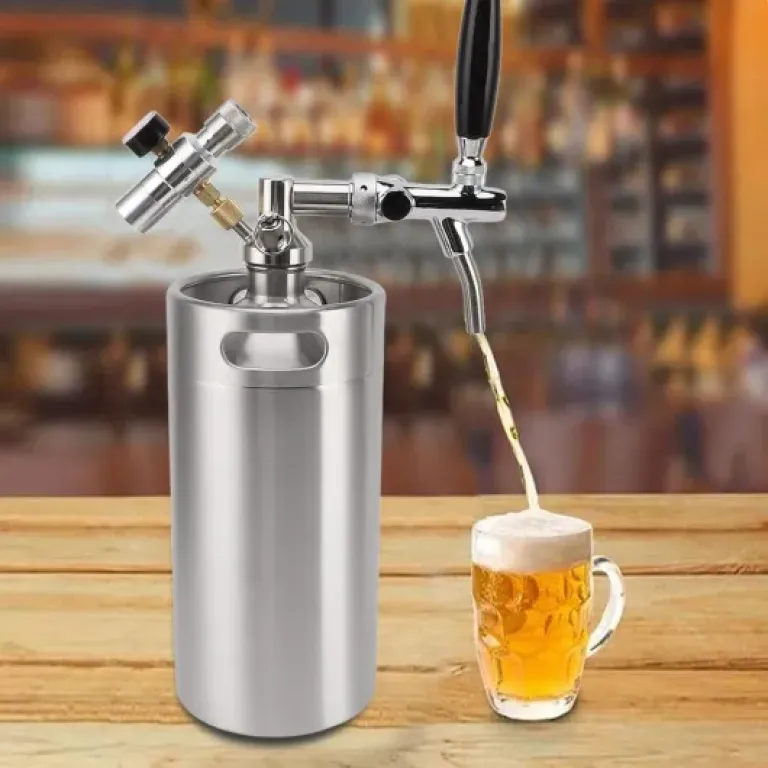
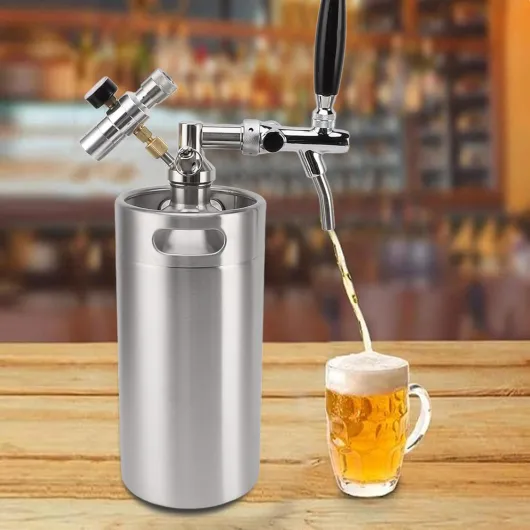
Design-wise, the Buachois 3.6L mini keg is pretty straightforward: a stainless steel cylinder with a flat bottom, threaded top, and a tap assembly sticking out. The overall footprint is compact enough to fit in a normal fridge, though you may have to remove a shelf depending on your layout. Height-wise, mine fit fine on the bottom shelf of a standard European fridge once I adjusted the shelves.
The tap and gauge sit on top and to the side, which is practical for pouring, but it does make the whole thing a bit awkward to store if your fridge is tight. I had to angle it slightly to avoid hitting the top of the fridge with the gauge. The faucet itself is a chunky, basic design – no long beer line or fancy compensator tap – so don’t expect super refined flow control. You can adjust it, but it’s more about getting a workable pour than fine-tuning like a pro draft system.
One thing I liked is that the design is clearly focused on being disassembled and cleaned. Everything unscrews: the faucet, the gauge assembly, the hose. That’s good for hygiene, especially with beer and coffee. On the downside, that also means more points where things can leak if you don’t tighten them enough or if the seals are a bit off. The first time I used it, I had a slight CO₂ leak at one joint because I didn’t tighten it enough; the design doesn’t really forgive sloppy setup.
In terms of looks, it’s just a plain silver keg. No branding that stands out, no fancy coatings. If you’re into minimal, industrial-style gear, you’ll be okay with it. If you want something that looks premium on a bar cart, this will feel a bit basic. For me, the design is functional more than pretty, and that’s fine at this price point, but it’s worth knowing what you’re getting into.
Stainless steel build: sturdy but not high-end
The whole selling point here is the stainless steel construction, and on that front it’s decent. The keg body feels solid enough, with a good weight to it (around 2.7 kg empty). The walls are not ultra thick like some premium growlers, but they don’t feel flimsy either. I knocked it around a bit in the car and on the kitchen floor, and it didn’t dent or scratch easily, which is reassuring if you plan to move it around a lot.
The stainless finish is basic brushed metal, nothing fancy. It doesn’t have any special insulation – this is not a double-walled, vacuum-insulated growler – so while the steel helps keep things cold a bit longer, you still rely mostly on your fridge or ice bucket. Don’t expect it to keep beer cold all day at a picnic without extra cooling; it’s more of a storage and serving vessel than a cooler.
The fittings (faucet, gauge housing, connectors) are a mix of metal and plastic. The metal parts look like cheaper stainless or plated metal; they do the job, but they don’t give that premium feel you get on more expensive tap systems. The plastic parts feel okay but a bit generic. I wouldn’t be shocked if you eventually need to replace a gasket or an O-ring after a while, especially if you disassemble it often. So far, after a few full clean cycles, nothing has cracked or rusted, which is a good sign.
One thing to note: because the material is bare stainless, you see fingerprints and water marks quite easily. If you care about looks, you’ll be wiping it down a lot. For me, materials-wise, it’s a practical, mid-range build: sturdy enough for home use, clearly not top of the line, but it doesn’t feel like a toy either. For the price bracket it sits in, the materials feel in line with expectations.
How it holds up after a few rounds
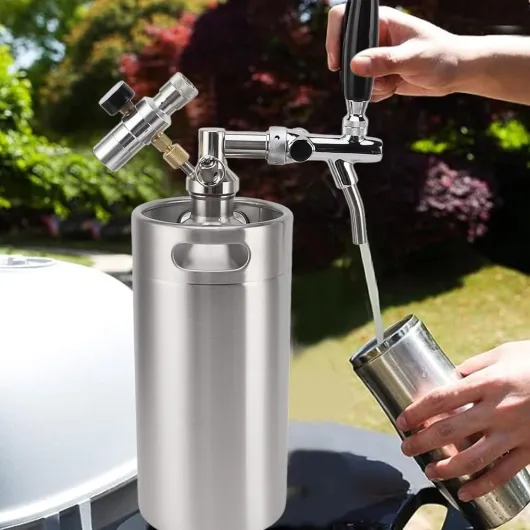
Durability is always tricky to judge in a short time, but after a few full cycles (fill, chill, serve, clean), I have a decent first impression. The keg body itself feels like it will last a long time. Stainless steel doesn’t show any early signs of rust, and there are no suspicious welds or weak spots that I can see. I banged it lightly against a metal sink and it didn’t dent, so it’s not paper-thin.
The more questionable area is the fittings and seals. After a couple of uses, the O-rings and gaskets still look fine, but these are typically the first things to wear on any cheapish keg system. I made a point of not overtightening things and using a bit of food-safe lubricant on the seals, which probably helped. So far, I’ve had one minor CO₂ leak at a connector because I didn’t seat it properly; once I reassembled it carefully, the leak stopped. I’d say the system can be reliable if you treat it gently and pay attention during assembly.
Cleaning-wise, it survived hot water and mild cleaner without any issues. The internal surface is smooth enough that beer residue doesn’t cling too badly, and I could inspect inside easily with a flashlight. The faucet and hose need more attention, but again, nothing felt like it was about to break while taking it apart. The threads on the connectors are okay, not silky smooth, but they haven’t stripped or cross-threaded on me yet.
My guess is that, over a year or two of regular use, you’ll probably want to replace some seals or maybe upgrade the tap if you’re picky. But the base keg and gauge housing should hold up fine. So from a durability standpoint, it feels like a solid medium-term investment, not a disposable gadget, as long as you’re willing to maintain it a bit and not abuse the fittings.
Pour quality and pressure control in real use
Performance is where this kind of product either works or becomes a headache. After a few uses, I’d say: it performs fine if you’re willing to fiddle with the pressure, but it’s not idiot-proof. The 60 PSI gauge is readable and lets you see what’s going on inside. For beer, I usually kept it around 10–15 PSI for serving, which gave me a decent pour once I got the faucet angle and speed right.
On my first try with a pale ale, I over-pressurised a bit and got a lot of foam. That’s partly on me, but it shows that you can’t just crank it and hope for the best. After bleeding off some pressure and letting it settle, the pours were much better: a nice head, not a glass full of foam. Compared to a more advanced mini-keg system with a compensator tap, this one is a bit more sensitive; small changes in pressure or how hard you open the faucet make a clear difference.
For cold brew coffee, performance was easier. I pressurised slightly just to help with the pour, and the flow was smooth and predictable. No carbonation to worry about, so no foam issues. The tap doesn’t drip excessively if you close it properly, though I did get a couple of small drips after pours – nothing crazy, but I kept a cloth under it just in case. The internal distribution (the so-called 4th generation knurled wine divider) is not something you really see, but I can say pours were consistent from the first glass to the last, so the pickup seems to work fine.
Overall, performance is “good once dialed in”. If you’re new to kegs and CO₂, expect a learning curve: you’ll waste a bit of beer in foam while you figure out the right settings. If you already know basic kegging, you’ll find it usable but not particularly refined. It gets the job done for home use, but don’t expect bar-level consistency without some patience and practice.
What you actually get in the box
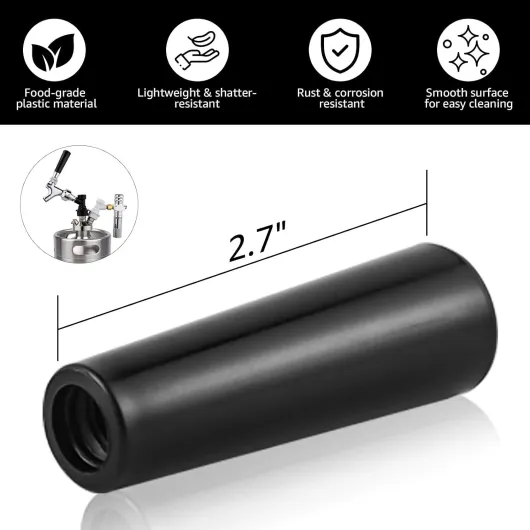
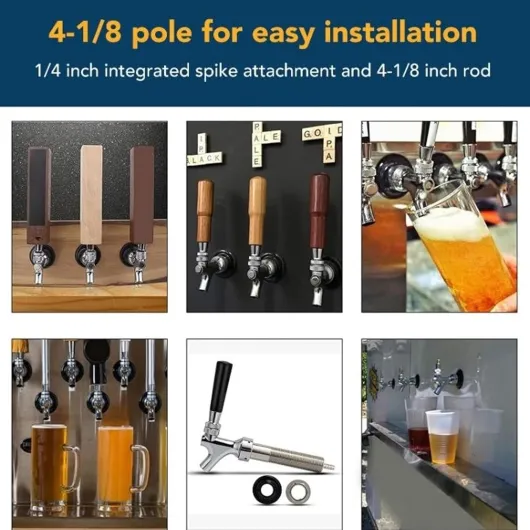
Out of the box, the kit is fairly straightforward. You get the 3.6L stainless steel keg, the pressure gauge head, an adjustable faucet (the “non-tailed large valve”), a small handle, a short hose, a couple of extra fittings, and a basic instruction manual. Nothing is fancy, but everything you need to get started is there. The manual is a bit rough, clearly translated, but you can figure things out with a bit of common sense and a quick look at photos online.
The first setup took me around 20–30 minutes because I wanted to check every connection and make sure I wasn’t cross-threading anything. The gauge screws onto the top, the hose connects the gauge assembly to the faucet, and the handle is mainly for carrying and tilting while pouring. There’s no CO₂ cartridge included, so you have to buy those separately, which is important to know before your first use. Without CO₂, you basically just have a fancy jug.
In terms of size, 3.6L is roughly the equivalent of about 10–11 small 330ml beers, or a bit under half a standard 9–10L mini-keg. It’s good for a small get-together or for keeping a personal stash in the fridge. It’s not meant for big parties; you’ll run out pretty fast if four or five people are drinking steadily. For coffee or cocktails, the size feels more generous, since people don’t usually pour full pints.
My main impression from the presentation: this is a no-frills, functional kit. It’s not gift-level pretty, the packaging is basic, and the documentation is light. But all the core parts are there, and nothing felt obviously missing or broken. It feels like something aimed at people who just want a budget way to keep beer under pressure rather than a polished gadget you’d show off on your countertop.
Pros
- Sturdy stainless steel keg body that feels solid and resists dents
- Compact 3.6L size fits in most fridges and is good for small gatherings
- Pressure gauge and tap work reliably once properly set up and adjusted
Cons
- Learning curve with pressure and faucet control, easy to get foamy pours at first
- Fittings and seals feel mid-range and may need care or replacement over time
- No insulation and no CO₂ cartridges included, so extra cost and not ideal for long outdoor use
Conclusion
Editor's rating
After a few weekends of use, I see this Buachois 3.6L mini beer dispenser as a practical, budget-friendly tool with a bit of a learning curve. It keeps beer under pressure, pours decently once you dial in the PSI, and the stainless body feels robust enough for regular home use. It’s not fancy, and nothing about it screams premium, but it does what it’s supposed to do if you’re willing to pay attention to setup and cleaning.
This kit is a good fit if you’re a casual homebrewer, someone who likes to get growlers filled at a local brewery, or you just want a compact way to serve beer, cold brew, or cocktails from a tap in your fridge. You’ll appreciate the size, the stainless construction, and the fact that you can disassemble everything for proper cleaning. You just need to accept that you might waste a bit of beer at the start while you learn how to manage the pressure and faucet.
If you’re looking for a polished, insulated, plug-and-play draft system with perfect pours every time, or if you hate tinkering with gear, I’d skip this and look at higher-end mini-kegs with better taps and insulation. But if you’re okay with something decent but not fancy, this mini keg offers fair value for the money and gets the job done for small gatherings and home use.