Summary
Analysis score
Average of the criteria rated below
Value for money compared to other brewing options
Big footprint, simple controls and a practical grain basket setup
Cleaning, maintenance and day‑to‑day practicality
Build, long‑term use and the spare parts question
Heating power, mash control and brewing performance
What the Klarstein 50L kit actually includes
How well it supports real‑world brewing results
Pros
- 3000W heating element and 50L capacity handle full 5‑gallon all‑grain batches with strong boil
- Integrated pump, grain basket and programmable mash steps simplify mashing, sparging and boiling in one unit
- Generally positive user feedback (4.4/5) on temperature stability, ease of use and cleaning
Cons
- Poor availability of spare parts and limited support reported by some buyers (e.g. replacement lid issues)
- Operating manual in English is not very clear, which can slow down first brews for beginners

Specifications
View full product page →| Brand | KLARSTEIN |
A 50L home brewery that wants to do it all for you
The Klarstein 50L Beer Making Kit positions itself as an all‑in‑one solution for people who want to brew at home without building a system from separate parts. On paper, it combines a 3000W electric boiler, integrated pump, grain basket and a programmable controller with auto‑mode. With a 50L kettle and around 60L stated capacity, it clearly targets 5‑gallon / 23L style batches with some headroom, not tiny experimental brews.
Among the published reviews, the general tone is positive: a 4.4/5 average over more than 150 ratings suggests that most buyers feel they get a solid piece of kit for the money. Several verified buyers highlight that it “does all it says for a nice price” and even compare it to more expensive rivals they almost bought. That said, there are also a few recurring criticisms around documentation quality and after‑sales support, which are important for a product aimed at beginners.
In my opinion, the interesting promise here is clear: simplify all‑grain brewing by putting mashing, sparging and boiling in one stainless steel column with automatic mash steps. For anyone who likes the idea of brewing but is put off by gas burners, coolers, and DIY plumbing, this design should look attractive. The MemoryBrew function, which can run through up to nine mash steps, is exactly the kind of feature that can reassure a newcomer.
It’s not a perfect picture though. The kit is big, heavy (12 kg empty), and clearly has some support limitations, especially when it comes to spare parts. If you want a small, ultra‑portable solution or you value long‑term serviceability above all, it may not be the right choice. But if your goal is to brew standard‑size batches with as little manual temperature babysitting as possible, this Klarstein unit looks like a serious candidate.
Value for money compared to other brewing options
In the home brewing world, you can go in many directions: cheap plastic bucket kits, classic gas burner plus stockpot, or fully integrated electric systems with app control and cloud recipes. The Klarstein 50L kit clearly aims at the mid‑range electric all‑in‑one segment. The exact price is not listed here, but multiple reviewers refer to it as “a good piece of kit at a reasonable price” and note that similar systems they considered cost more than twice as much.
On the value side, you get a 3000W stainless steel kettle with integrated pump, grain basket, programmable mash steps and enough capacity for standard 5‑gallon batches. That’s a lot of functionality in one appliance. If you tried to replicate this with separate components (stainless kettle, pump, controller, mash tun, stands), you might save a bit by going very DIY, but you’d lose the simplicity and compactness of a single unit. For many users, especially beginners, the time and hassle savings are worth paying for.
The main cost‑related downside is after‑sales support and spare parts. If a glass lid or other component breaks after the warranty period, you may end up paying for generic replacements or improvising workarounds, because the manufacturer does not appear to have a robust spare parts program. There’s also a mention of a buyer who had to spend extra to source a missing part locally, even though they did receive a partial refund. These things don’t destroy the value proposition, but they do subtract a few points compared to brands known for long‑term support.
In my opinion, the overall value is good but not flawless. If you want an all‑in‑one electric brewery that can handle real all‑grain batches, and you don’t care about Bluetooth, apps or ultra‑premium finishes, this Klarstein system delivers a lot of function for the likely asking price. If long‑term serviceability, brand prestige or advanced connectivity are priorities, you may prefer to spend more on higher‑end competitors. For most hobby brewers who just want reliable brew days and solid control without blowing the budget, this kit looks like a sensible compromise.
Big footprint, simple controls and a practical grain basket setup
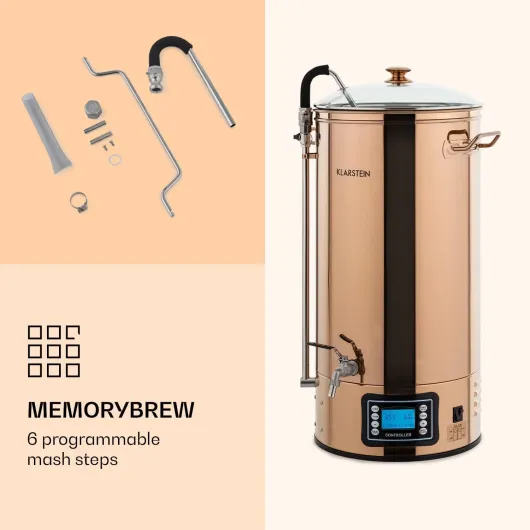
Design‑wise, the Klarstein 50L kit follows the classic “brew‑in‑a‑bag but in stainless” approach: a tall cylindrical stainless steel kettle, a removable grain basket inside, and a recirculation pipe that returns wort to the top of the mash. The colour is listed as copper, but the style name and material are stainless steel, so visually you can expect a stainless body with copper‑tone accents rather than full copper construction. With an 80 cm height and over 40 cm diameter, this is not a discreet countertop gadget; it’s more of a floor‑standing appliance that will live in a garage, shed or spacious kitchen.
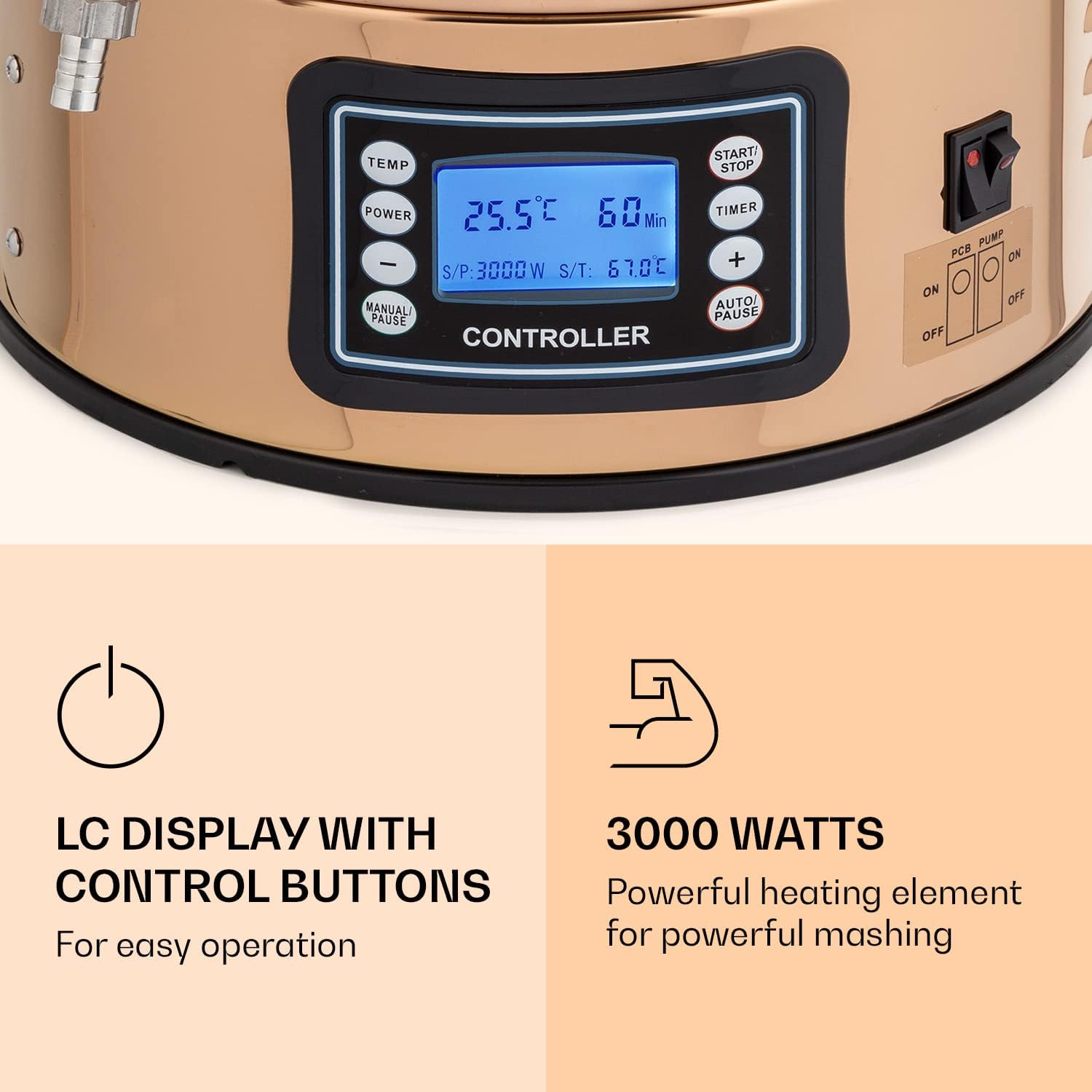
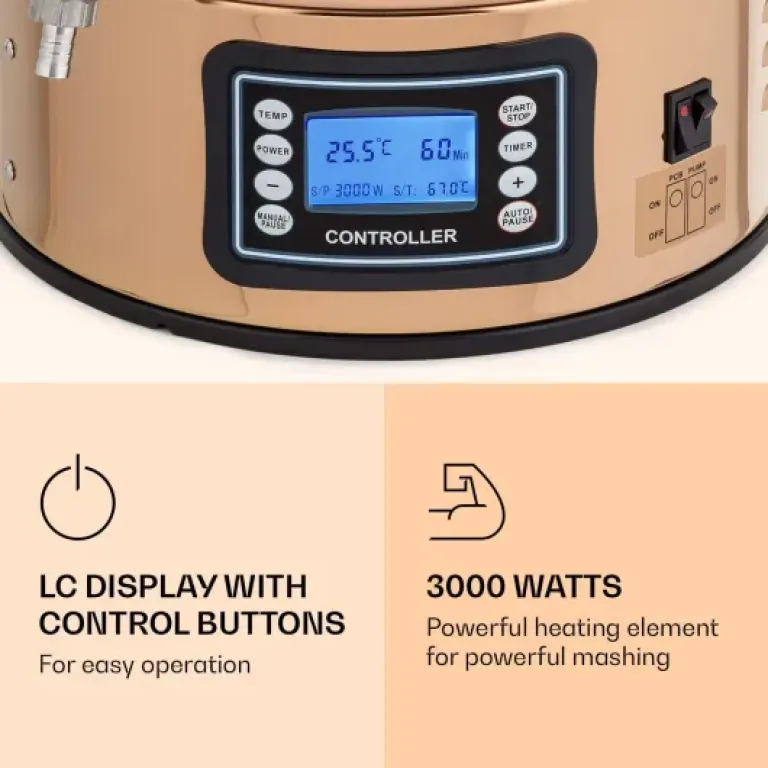
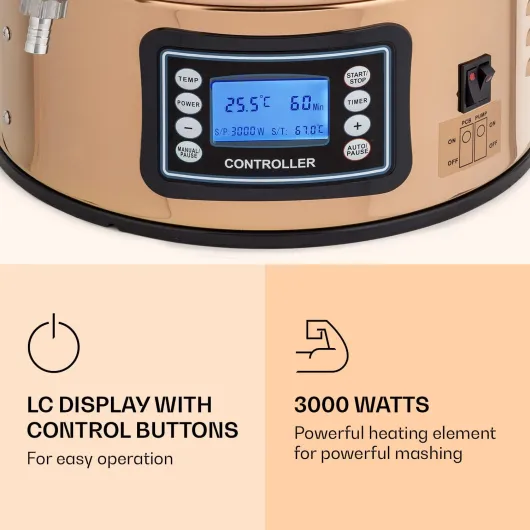
The control panel is one of the strong points mentioned in the reviews. Buyers describe it as easy to use, with straightforward buttons for temperature, time and power, plus a dedicated switch for the pump and a valve to regulate flow. One reviewer liked that power can be dialed back to avoid overshooting mash temperatures, something that can frustrate beginners. The LCD screen gives clear feedback, and the audible alarm at step changes ensures you don’t miss a transition while doing other things nearby.
The grain basket design also gets praise. When full, several litres of wet grain are obviously heavy, but one detailed review explains that once raised, the basket “clips nicely to the securing ring for sparging.” That means you don’t need an extra stand or pulley system in most cases; you can lift it, lock it, and then sparge with hot water while the wort drains back into the kettle. It’s a simple but effective way to keep the whole process contained in one vertical unit.
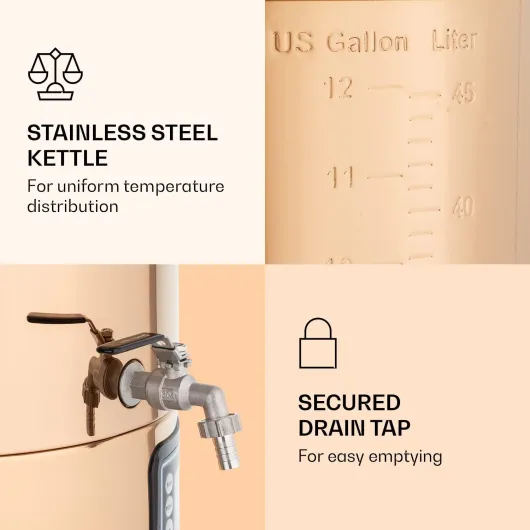
In my opinion, the overall design is functional and brewer‑oriented rather than flashy. Volume markings inside the mash tun, detachable circulation pipes, and a recirculation outlet that can take a hose for back‑flushing the pump show that someone thought about day‑to‑day brewing chores. The only clear weak point on the design side comes from one negative review about the glass lid: if you break it, getting a replacement from Klarstein seems complicated, which is something to keep in mind given the size and weight of the lid.
Cleaning, maintenance and day‑to‑day practicality
Cleaning is a big part of home brewing, and Klarstein clearly tried to address it in the design. The kit includes a removable strainer/grain bin and circulation pipes that quickly disassemble. This means spent grain is contained in a basket rather than being loose in the kettle, which buyers say makes it “easy enough to get the spent grain out.” One reviewer does point out the practical reality: 4 kg of wet grain is a lot of waste if you don’t have animals to feed it to, so you still need a plan for disposal, but that’s true of any all‑grain setup.
The integrated pump and recirculation system are also used for maintenance. A detailed review explains that the recirculation pipe accepts a hose pushed onto the end, allowing you to reverse flush the pump and clear out debris. This is a smart feature, because pumps can easily get clogged with husks and trub if they’re not cleaned properly. Being able to push cleaning solution or water backwards through the system simplifies things and should help keep the pump in good condition over time.
The manufacturer even claims that some parts are dishwasher safe. Given the size of the main components, that likely applies more to smaller fittings and maybe the grain basket than the full kettle, which is too big for a standard dishwasher. In practice, most brewers will probably rinse and scrub the inside with a soft cloth and non‑abrasive cleaner, then run some hot water through the pump. Still, the fact that pieces disassemble easily and are not full of inaccessible corners is a plus.
In my opinion, this kit is relatively friendly to clean for an all‑in‑one system of this size. You still need to respect basic brewing hygiene and spend time on post‑brew cleanup, but the removable basket, detachable pipes and pump back‑flush option mean you’re not fighting the hardware. Several owners emphasize that brew days are enjoyable as long as you leave enough energy for cleaning at the end, which is just honest advice rather than a specific flaw of this unit.
Build, long‑term use and the spare parts question
On the durability front, the Klarstein 50L kit has a few strong points and one clear weak spot. The main construction is stainless steel, which is standard for brewing gear because it resists corrosion and cleaning chemicals when treated properly. At 12 kg empty, the unit has enough weight to feel sturdy on paper, especially once filled with 30–40L of liquid. Buyers often describe it as “a well designed piece of equipment and nicely finished,” which suggests acceptable build quality for a consumer‑grade system.
Functionally, several reviewers report that the unit “does everything it claims” and holds mash temperatures reliably across multiple brew days. One owner mentions using it three times with good results and speaks positively about how it handles full grain baskets, vigorous boils and recirculation without issues. Another points out that they achieve their target original gravity from recipes, which indirectly indicates that the system maintains performance over more than a single brew.
The main red flag comes from after‑sales support and spare parts availability. One negative review explains that after dropping and damaging the glass lid slightly beyond the two‑year warranty, Klarstein refused to provide a replacement, stating that no spare lids were in stock and that they do not offer spare parts for this product. That buyer explicitly warns others that this is a Chinese‑made kettle with limited service support. Another review mentions having received a unit with a vital part missing; the buyer eventually obtained a partial refund and sourced the part locally, but it took “a lot of effort” to get a satisfactory response from customer service.
In my opinion, the physical build and materials look decent for home use, and there’s no wave of reports about leaks or catastrophic failures, which is reassuring. But the lack of easy access to spare parts means that if you break the lid, damage a component, or lose a piece after the warranty period, you may be on your own. For a beginner who plans to brew occasionally and take care of the gear, that might be an acceptable risk. For someone who values long‑term serviceability or brews very often, this point is worth factoring into the decision.
Heating power, mash control and brewing performance
For performance, the key specs are the 3000W heating element, 50L working volume, integrated pump and the MemoryBrew programmable mash steps. On paper, 3000W for this volume is solid: it should be able to bring mash water up to temperature in reasonable time and sustain a strong rolling boil for 20–30L batches. One buyer specifically mentions that the unit is “easily able to cope with a rapid boil due to the large volume,” which supports the idea that it’s not under‑powered.
Temperature control during mashing is another highlight from user feedback. A verified buyer notes that mash temperature is regulated “to within a degree or so,” which is good enough for most homebrewers and should keep enzyme activity where you want it. The pump continuously recirculates wort over the grain bed, which helps even out temperature and sugar extraction. According to several comments, this setup removes the need for manual stirring and reduces the risk of scorching, which is a common annoyance on simple electric kettles.
The MemoryBrew function deserves attention. It allows you to pre‑define up to nine mash steps with target temperatures, durations and power levels. One experienced buyer explains that in automatic mode, each step ends with an audible alarm and then waits for you to confirm before moving on. So it’s not a fully unattended system, but more an “assisted mash schedule” that helps you follow your recipe while still staying involved. Another user says they’ve mainly used manual mode so far and still found brew days “a breeze,” which suggests both modes are usable rather than one being a half‑baked gimmick.
In my opinion, the performance picture is quite solid for the price range. You get enough power for proper boils, reasonably tight temperature control for complex mash schedules, and a pump that supports both recirculation during mash and easy cleaning via reverse flush. It’s not on the same level as high‑end professional‑grade systems with ultra‑precise sensors and full app integration, but for a home brewer doing 5‑gallon all‑grain batches, it looks more than capable of getting the job done consistently.
What the Klarstein 50L kit actually includes
On paper, this Klarstein kit is an all‑in‑one electric brewing system, not a simple beginner’s bucket with extract cans. You’re looking at a 50L stainless steel boiler with a total stated capacity of 60L, powered by a 3000W heating element. It comes with a removable grain basket/strainer, circulation pipes, an integrated pump with flow control, and a control panel with LCD screen. The lid is glass, the handles are nylon or silicone, and the whole thing stands roughly 80 cm tall with a footprint of about 42 x 43 cm.
The brand markets it for IPA, ale, lager and pretty much any all‑grain beer style that fits a roughly 5‑gallon batch size. Reviews confirm that it “easily copes with a 5 gallon brew” and even allows for a vigorous boil, which is often a weak point on lower‑power systems. The mash tun is stamped with volume marks to make filling easier, a small but very practical detail that several buyers appreciate. The kit is also advertised as dishwasher‑safe for some components, even though most homebrewers will likely stick to manual cleaning due to size.
The control side is split between manual mode and MemoryBrew auto‑mode. In manual, you set temperature, time and power yourself. In auto‑mode, you can pre‑program up to nine mash steps (temperature, duration, power) and let the system walk you through them. One buyer points out that an audible alarm sounds at the end of each programmed stage, but you still need to confirm the next step, so it’s more like assisted brewing than a totally unattended process.
In my view, the positioning is pretty clear: this is for someone who wants to jump straight into all‑grain brewing with a single machine, rather than build a system from a kettle, separate mash tun, gas burner and pump. It doesn’t include fermentation gear or ingredients, so you still need a fermenter, airlock, etc. But as a hot‑side solution that covers mash, sparge (via lifting the grain basket) and boil, it’s a fairly complete package for the price bracket it competes in.
How well it supports real‑world brewing results
Effectiveness here means one thing: does this kit actually help people brew good beer without too much hassle? The published reviews give a fairly clear answer. Several verified buyers state that brew days with this unit are “a breeze” and “great fun,” especially compared to more manual setups they considered. One user even says they almost bought a more than twice‑as‑expensive competitor but are glad they didn’t, because this Klarstein unit “in my opinion is better” and they don’t see the point of paying extra for app control.
On the technical side, effectiveness shows up in details like mash efficiency and process control. One experienced brewer notes that thanks to the grain basket and recirculation system, the unit is “quite efficient” and they get the required original gravity from their recipes. That means the combination of mash temperature stability, pump circulation and basket design is doing its job. Another important point is that the pump and recirculation prevent burning of the mash, which can otherwise ruin a batch on simpler electric kettles; reviews confirm that the constant stirring effect of the pump works as intended.
Process simplification is another strong area. Being able to mash, sparge and boil in a single vessel reduces the number of transfers and potential contamination points. Buyers appreciate that the full grain basket, once raised, can be clipped to a ring for sparging directly over the kettle, avoiding extra stands or buckets. The fact that you can reverse flush the pump by attaching a hose to the recirculation pipe also contributes to smoother brew days by making it easier to clear debris and avoid clogs.
In my view, this kit is effective for its target user: someone who wants to brew all‑grain beer at home with reasonable control but without diving into DIY plumbing or electronics. It won’t automatically fix recipe mistakes or fermentation issues, and you still need to manage cleaning and fermentation separately. But as a hot‑side tool, it clearly helps many users produce consistent, drinkable beer while cutting down on manual stirring, temperature chasing and equipment juggling.
Pros
- 3000W heating element and 50L capacity handle full 5‑gallon all‑grain batches with strong boil
- Integrated pump, grain basket and programmable mash steps simplify mashing, sparging and boiling in one unit
- Generally positive user feedback (4.4/5) on temperature stability, ease of use and cleaning
Cons
- Poor availability of spare parts and limited support reported by some buyers (e.g. replacement lid issues)
- Operating manual in English is not very clear, which can slow down first brews for beginners
Conclusion
Analysis score
The Klarstein 50L Beer Making Kit is a serious all‑in‑one electric brewery aimed at beginners and intermediate homebrewers who want to do real all‑grain batches without building a DIY system. On paper, the 3000W heater, 50L stainless kettle, integrated pump, grain basket and programmable mash steps form a coherent package. The Amazon feedback backs this up: a 4.4/5 average and multiple detailed reviews describe stable mash temperatures, strong boils, decent efficiency and easier brew days compared to more manual setups.
It’s not without flaws. The main weak points are the quality of the English manual, which some find confusing, and especially the lack of accessible spare parts and limited after‑sales support. If you break the glass lid or need a replacement component after the warranty, you may have to improvise. The unit is also big and heavy, so it suits a garage or utility space more than a tiny flat kitchen.
In my opinion, this kit fits best for someone who already likes the idea of brewing 20–30L batches and wants a straightforward, mostly self‑contained solution. If you value app control, ultra‑premium build or rock‑solid long‑term service from a specialist brewing brand, you might want to look higher up the price ladder. But if your priority is getting solid, repeatable brew days with a single machine at a reasonable cost, the Klarstein 50L offers strong value and enough control to grow with you as your recipes get more ambitious.