
Summary
Editor's rating
Value for money: where it lands
Design: practical overall, with a few rough edges
Materials and build: solid stainless, weak on spare parts
Durability and long‑term worries
Performance in real brew days
What you actually get in the box
Effectiveness: does it actually brew good beer more easily?
Pros
- All‑in‑one mash, sparge and boil in a single 30 L stainless unit
- Stable temperature control and enough power for a proper rolling boil
- Built‑in pump and grain basket make recirculation and lautering simpler
Cons
- Poorly translated manual and slightly clunky user interface
- Weak availability of spare parts like the glass lid after warranty

Specifications
View full product page →| Brand | KLARSTEIN |
A full‑size all‑grain setup without rebuilding your whole kitchen
I’ve been brewing on gas and a couple of basic stock pots for a while, so getting the Klarstein Mundschenk felt like stepping up a level without going full pro. It’s a 30 L electric mash/boil kettle with a built‑in pump, grain basket and touch control panel. In theory, it replaces your mash tun, kettle and a fair bit of lifting and messing around. I’ve run a few 20–23 L (around 5 gallon) all‑grain batches through it to see if it actually simplifies brew day or just adds more stuff that can break.
My main goal was simple: less juggling of pots, less babysitting temperatures, and ideally a bit less cleaning chaos at the end. I’m not chasing competition medals, I just want consistent beer without turning the whole day into a circus. On paper, the Mundschenk hits that target: 2500 W heater, programmable mash steps, recirculation pump, and a drain tap for emptying. It sounds like a lot of machine for the price.
In practice, it’s not perfect, but it does what it says. You can mash, sparge and boil in one unit, and the temperature control is honestly the biggest upgrade over my old setup. I don’t have to hover with a thermometer every five minutes. The pump recirculation also helps a lot with even temps through the mash, which I could never really nail with coolers and kettles.
There are catches though. The unit is heavy, the full grain basket is no joke to lift, the manual is badly translated, and Klarstein doesn’t seem very interested in spare parts, judging by other buyers’ experiences. So it’s a pretty solid workhorse if you accept a few rough edges and are ready to tinker a bit and figure things out yourself.
Value for money: where it lands
In terms of value, I’d call the Mundschenk good but not unbeatable. You get a full 30 L electric all‑in‑one system with pump, programmable controller, grain basket and drain tap for a price that’s usually lower than the big name competitors with the same capacity. For a home brewer moving from basic gear, it really does compress your setup into one main appliance. That alone saves space and time, and for me that’s worth quite a bit.
On the positive side, it delivers on the core promises: it heats reliably, holds mash temps, boils strongly, and lets you mash, sparge and boil in the same vessel. The included basket and recirculation setup mean you don’t have to buy much else besides your usual fermenters and chiller. If I compare it to buying a separate stainless mash tun, kettle, burner, and pump, the Mundschenk comes out as decent value and a lot less hassle to assemble.
On the downside, the lack of spare parts and the weak manual drag the value down a notch. You’re paying for a fairly capable machine but you’re not getting strong long‑term support. Also, there are now more competitors in this space than when it launched in 2017, some with better documentation, app support, or clearer spare part policies. So it’s not the obvious best deal for everyone anymore, it’s just one solid option among several.
If your budget is tight and you’re okay with a slightly rough manual and doing your own learning, this unit offers pretty solid bang for the buck. If you want polished support, easy‑to‑read documentation, and guaranteed spares, you might be happier paying more for another brand. For me personally, the value is acceptable: I get easier brew days and consistent results without spending a small fortune, and I’m aware I’m trading that off against long‑term service and polish.

Design: practical overall, with a few rough edges
The overall design is pretty simple: a tall 30 L cylinder, double‑walled stainless steel, with the electronics and heater at the bottom. I brew in a garage and the footprint (around 40 x 40 cm) is fine – it lives on a sturdy table near a 220 V outlet. Height is about 70 cm, so keep in mind you’ll need extra overhead space to lift the grain basket out and let it rest on the rim for sparging. With a full grain bill, that basket is very heavy, so you want it at a comfortable height. I wouldn’t put this on a high countertop unless you enjoy lifting 4–5 kg of wet grain above chest level.
The integrated pump and recirculation port are a big plus in terms of design. You don’t need to rig up an external pump or extra hoses. The recirculation pipe sticks up and pours wort back on top of the grain bed, and you can throttle the flow with the valve. It’s basic but effective. One nice detail: the outlet can take a hose, which means you can backflush the pump after brewing to clear grain bits. That makes cleaning less painful and probably helps the pump last longer.
The drain tap at the bottom is one of those features you don’t think about until you’ve used it. Emptying hot wort or cleaning water is much easier than tipping the whole kettle. It’s also safer if you brew alone and don’t want to wrestle with 20+ litres of hot liquid. The tap feels decently secure, no leaks on my unit so far. Still, I always check it’s fully closed before filling, because I don’t trust any tap enough to risk a floor full of wort.
On the downside, the user interface design isn’t perfect. The touch buttons are small and a bit fiddly if your hands are wet or sticky. There’s no app or Bluetooth, which I’m actually fine with, but if you’re into remote control and logging, this won’t do that. Also, the beeper at the end of steps is not very loud – if you brew in a noisy environment, you might miss it. Overall, the design is functional and focused on getting the job done, but you can see where Klarstein cut a few corners to keep the price reasonable.
Materials and build: solid stainless, weak on spare parts
The main selling point on materials is the 304 stainless steel body and inner basket. It feels sturdy enough for home use. The walls are double‑walled, which helps with even heat distribution and holding temperature during the mash. I haven’t noticed hot spots burning the wort on the bottom, even when I forgot to stir at the start of heating. The grain basket is also stainless, with plenty of perforations so the wort flows through easily. Welds and joints on my unit look clean, no sharp edges or obvious defects.
The plastic parts – handles, pump housing, valve knob – feel pretty standard, not fancy but not flimsy either. I don’t baby my gear and nothing has cracked or warped so far. The lid is glass with a metal rim. It’s handy to see inside during heating or mash without constantly opening it. But this is also where one of the big complaints comes in: if you break that lid, Klarstein doesn’t seem to offer spare parts. There’s an Amazon review from someone who dropped the lid slightly after the 2‑year warranty and couldn’t get a replacement at all. For a product this bulky, having no official spare parts is a real downside.
The pump and heater are the bits that worry me long term. They work fine now, but if either dies in a few years and there’s no easy spare part route, you’re stuck with a big stainless cylinder that doesn’t do much. For the price, I didn’t expect pro‑level service, but at least a way to order a lid or a pump module would make sense. This is where Klarstein feels more like a badge on top of generic Chinese hardware than a brand that plans for long‑term support.
In daily use, though, the materials are easy to clean. A soft sponge, some PBW or basic brewery cleaner, and it comes up fine. The stainless doesn’t stain easily, and the internal markings stay visible. As long as you’re careful with the glass lid and don’t abuse the tap or pump, the build feels good enough for regular brew days. Just keep in mind that if you break something specific, you may have to improvise or source third‑party parts.
Durability and long‑term worries
Durability is a mix of good hardware and weak support. The stainless steel body and basket feel like they’ll last years if you don’t abuse them. After multiple brews, I don’t see rust, dents, or warped metal. The handles are still tight, and the drain tap hasn’t started leaking. The double‑walled design also means you’re less likely to burn the wort on a hot spot, which should help keep the bottom in good shape over time. So from a purely physical point of view, it looks built to handle regular brew days.
Where I’m less confident is the support for parts. There’s a clear user review saying Klarstein wouldn’t provide a replacement lid slightly after the 2‑year warranty. That’s not a small accessory; it’s a basic part you can easily break. If they won’t even sell that, I’m not optimistic about getting a replacement pump or control board in three or four years. This is the kind of product you buy knowing that if a key component dies after the warranty, you might be on your own and hunting for generic parts or DIY fixes.
Electronics and pumps are always the weak point in these systems. So far, mine have behaved fine: no strange noises, no error codes, heat and pump start every time. I always run some clean water through it after brewing and don’t leave sticky wort drying inside, which definitely helps. I also store it indoors, not in a damp shed. If you treat it like a real appliance and not like a garden tool, I think you’ll get several years out of it, but I wouldn’t count on it being a lifetime purchase.
So I’d say durability is good on the metal, average on the rest. It’s not fragile, but it’s also not backed by a strong spare parts ecosystem. If that kind of risk annoys you, you might prefer a brand that clearly lists spare parts and has better after‑sales service, even if you pay more. If you’re okay with a bit of DIY and accepting that it might eventually become a donor for some other project, then it’s an acceptable compromise.
Performance in real brew days
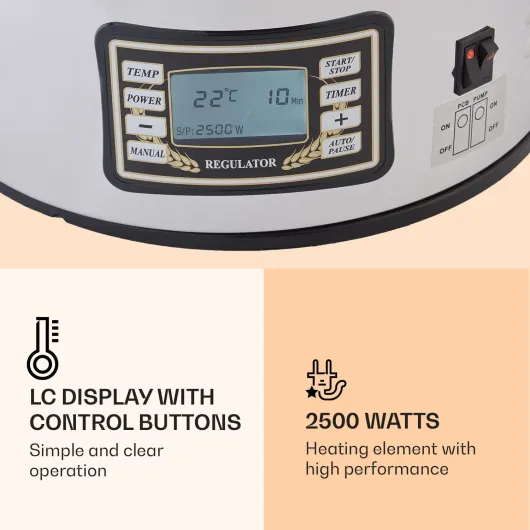
On performance, I looked at four things: heat‑up time, temperature stability, pump behaviour, and how it handles a full 5‑gallon brew. With 2500 W on 220 V, it heats strike water reasonably quickly. From tap temperature to mash‑in temperature, you’re looking at a bit of a wait, but nothing crazy – similar to other all‑in‑one systems in this size range. Once it’s at temperature, it doesn’t swing wildly. During mash, the LCD usually stayed within about a degree of the set point, and the recirculation kept the grain bed close to that as well.
The pump performance is decent but not industrial. It will happily recirculate during mash as long as you don’t crush your grain to flour. If you over‑crush or use a lot of wheat/oats, you can slow the flow and even partially clog it, but that’s true for most systems like this. The flow control valve helps: you can back it off until the top of the grain bed doesn’t compact. Being able to reverse flush the pump with a hose is handy; after each brew I push clean water backwards through it and you can see bits of grain come out. That’s probably why I haven’t had any serious clogging yet.
For boiling, the kettle has enough power to keep a rolling boil on a typical 23 L batch. I usually run it close to full power at the start, then drop it back a bit to avoid boilovers. The volume markings help you keep an eye on boil‑off rate and adjust for future brews. Noise‑wise, the pump hums but isn’t loud, and the boil is just a normal boiling sound – nothing extreme. You can brew in a garage or kitchen without feeling like you’re standing next to a jet engine.
The only performance area that annoys me is the user interface. The programming itself works, but the combination of a weak manual and slightly clunky step confirmation means you’ll probably mess up a program or two before you get comfortable. It’s not the end of the world; you can always fall back to manual mode and just adjust temp and time yourself. Once you’ve run a few brews, it becomes second nature. Overall, performance is solid for the price bracket: it won’t feel like a commercial system, but for home use it’s more than enough.
What you actually get in the box
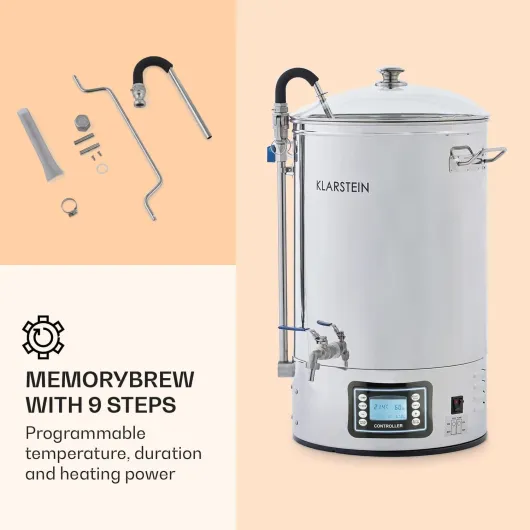
Out of the box, the Mundschenk looks like a tall stainless steel boiler with a few extras. You get the main 30 L double‑walled kettle, the internal grain basket/sieve insert, a circulation pump with its tubing and basic hose filter, and the lid. There’s the touch control panel on the front and a drain tap near the bottom. No fancy accessories, no chiller, just the core brewing hardware. For a beginner moving from kits or partial mash, it’s basically a starter all‑grain rig in one lump.
The control panel is pretty straightforward once you’ve pressed the buttons a few times. You can run it in manual mode where you just set temperature and power, or in automatic mode with up to six mash steps. Time, temperature and power are all adjustable per step. There’s a beep at the end of each step, but it doesn’t move on by itself – you have to confirm the next step. At first I found that a bit annoying, but actually it’s not bad, because you’re usually fiddling with the grain bed or sparge water at that point anyway.
The pump has a simple on/off switch and a manual valve to control the recirculation flow. Nothing smart here, but it works. The volume markings stamped inside the kettle are handy when you’re filling with strike water or adjusting pre‑boil volume. You don’t need an extra measuring jug, which is one less thing to clean. Overall, the presentation is pretty no‑nonsense: stainless steel, plastic handles, basic tubing. It doesn’t feel like a toy, but it also doesn’t feel like ultra‑premium pro gear.
My only real disappointment in the presentation side is the documentation. The manual is technically there but the English is clumsy, and some steps are vague or just badly explained. If this is your first all‑grain system ever, expect to spend some time on YouTube or forums to really understand how to use the automatic programs and set mash schedules properly. The hardware is decent; the paperwork is what feels cheapest.
Effectiveness: does it actually brew good beer more easily?
This is where the Mundschenk does pretty well. In terms of pure brewing, it gets the job done. I’ve run multiple 20–23 L batches through it and hit my target original gravity each time, within a point or two. Efficiency is decent and consistent, mainly because the temperature control is stable and the recirculation evens things out. I’m not chasing crazy high efficiency, I just want repeatable numbers, and this system delivers that better than my old cooler mash tun ever did.
The integrated thermostat and 2500 W heater are strong enough for a 30 L volume. Mash temperatures hold within about 1 °C of the target once it stabilises. Going from mash to boil is quick enough; you’re not standing there for an hour waiting for it to roll. When it hits a full boil, it keeps it going steadily. You can tweak the power level to avoid boilovers if you’re near the brim, which is handy for slightly bigger batches or high gravity brews.
The pump and grain basket combo really simplify the process compared to juggling multiple pots. You mash in the basket, circulate the wort over the top, then when the mash is done you lift the whole basket, let it rest on the support, and sparge. No separate lauter tun, no extra transfers. The downside is that lifting a full basket is heavy, so if you have back issues or brew alone, you might want a small hoist or at least a sturdy hook above your brew area. Once the grain is out, the boil is straightforward, and chilling is up to whatever system you usually use.
In terms of beer quality, everything I’ve brewed on it has come out as expected. No weird off‑flavours from scorching or plastic tastes. It doesn’t magically make your recipes better, but it removes some of the temperature swings and mistakes that can mess up a mash. So from a pure effectiveness point of view, it’s pretty solid: it won’t brew for you, but it does handle the heating and recirculation side well enough that you can focus on recipes, timings and cleaning.
Pros
- All‑in‑one mash, sparge and boil in a single 30 L stainless unit
- Stable temperature control and enough power for a proper rolling boil
- Built‑in pump and grain basket make recirculation and lautering simpler
Cons
- Poorly translated manual and slightly clunky user interface
- Weak availability of spare parts like the glass lid after warranty
Conclusion
Editor's rating
The Klarstein Mundschenk is a straightforward 30 L all‑in‑one brewing system that actually does what most home brewers expect: it simplifies all‑grain brew days. You heat, mash, recirculate, sparge and boil in the same vessel, and the built‑in pump plus grain basket make the process cleaner and less chaotic than juggling multiple pots. Temperature control is stable, the 2500 W heater has enough punch for a solid rolling boil, and hitting target gravities is much easier than with improvised setups. It’s not flashy, but it’s effective.
It’s not without flaws. The manual is poorly translated and doesn’t really teach you how to get the most out of the automatic programs, so you’ll probably rely on manual mode and online guides at first. The unit is heavy, the grain basket is a serious lift when full, and the user interface feels a bit dated compared to app‑driven competitors. The biggest red flag is spare parts: based on other buyers’ feedback, Klarstein is not great at providing replacements like lids once you’re out of warranty, which limits long‑term peace of mind.
I’d recommend this to home brewers who want to step into all‑grain with an electric system, care more about function than fancy apps, and are okay with figuring things out themselves. If you’re on a budget and want a single machine that gets the job done, it’s a solid option. If you’re picky about documentation, after‑sales service, or future upgrades, or you want tight integration with brewing software, you might be better off saving up for a higher‑end brand with clearer support and spare part options.
![93L Drinks Fridge, 126 Can Beer Fridge with Glass Door, Wine fridge with Adjustable Shelves for Soda Beer or Wine, Home/Bar/Office, Black, Steel, One-Touch Control [Energy Class F] 126 Can Black](https://www.beer-insiders.com/storage/947010/conversions/71yTIYeFRgL._AC_SL1500_-medium.webp)