Summary
Analysis score
Average of the criteria rated below
Value for money: where it sits in the drinks fridge market
Design: compact footprint, glass door bar look
Delivery, setup and first impressions from buyers
Build quality, reliability and everyday robustness
Cooling performance and noise: does it keep drinks cold enough?
What this COMFEE drinks fridge actually offers
Pros
- Strong user feedback (4.6/5 from 1,100+ ratings) on cooling performance and quiet operation
- Compact 47 cm width with 93L capacity, advertised to hold up to 115 cans
- Wide 2–15℃ temperature range with removable shelves for flexible storage
Cons
- E‑class energy rating and 154 kWh/year consumption, not the most efficient option
- Manual defrost and manual LED light switch rather than door-activated light
- Door reversal can be fiddly; at least one buyer reports difficulty removing hinge covers

Specifications
View full product page →| Brand | COMFEE' |
A compact drinks fridge that’s clearly popular
The COMFEE RCZ99BG2(E) is an under-counter beer and drinks fridge aimed at people who want a dedicated space for cans and bottles without filling the main kitchen fridge. On paper it offers 93 litres of capacity, space for up to 115 cans, and a temperature range from 2℃ to 15℃. It’s a freestanding, under-counter sized unit with a glass door, internal LED lighting and removable wire shelves, so the positioning is clear: home bars, garden rooms, offices and small kitchens that need more cold drinks storage.
The public feedback is strong. This fridge sits on a 4.6/5 average from more than 1,100 Amazon ratings, which means buyers are broadly satisfied with how it cools, how it looks, and how much it stores. Several reviewers highlight that it keeps drinks properly cold even in warm weather and that the noise level is low enough for living spaces or home offices. That matches what the spec sheet suggests, with a quoted 40 dB noise level and a compressor-based cooling system.
It’s not a high-end wine cabinet with complex humidity controls or app connectivity. There’s no smart home integration, no digital display, and it uses a simple mechanical thermostat with six levels. Energy class is E with an advertised 154 kWh/year consumption, so it’s clearly not aiming at the premium ultra-efficient segment. Instead, the focus seems to be straightforward: a practical, compact beer fridge that stays cold, fits under a counter and doesn’t cost as much as big-name bar coolers.
In my opinion, the interesting part of this model is the balance between capacity, footprint and noise. At only 47 cm wide and 44 cm deep, it’s narrower than many under-counter appliances, yet still claims 93 litres of space. Combined with the positive feedback on cooling and quietness, it looks like a solid candidate for people putting together a home bar or trying to reclaim space in the main fridge, as long as the energy rating and manual defrost are acceptable compromises.
Value for money: where it sits in the drinks fridge market
Even without a visible price tag here, it’s possible to position the RCZ99BG2(E) in terms of value by looking at its specs, ranking and buyer comments. It ranks 2nd in Beverage Refrigerators and 34th in Large Appliances on Amazon, which usually means it’s competitively priced against similar under-counter drinks fridges. Several reviewers explicitly mention “value for money”, with one calling it “greatly quality reasonable price” and another simply stating “great product value for money”. That kind of language often appears when a product undercuts the big-name brands while still performing well enough in daily use.
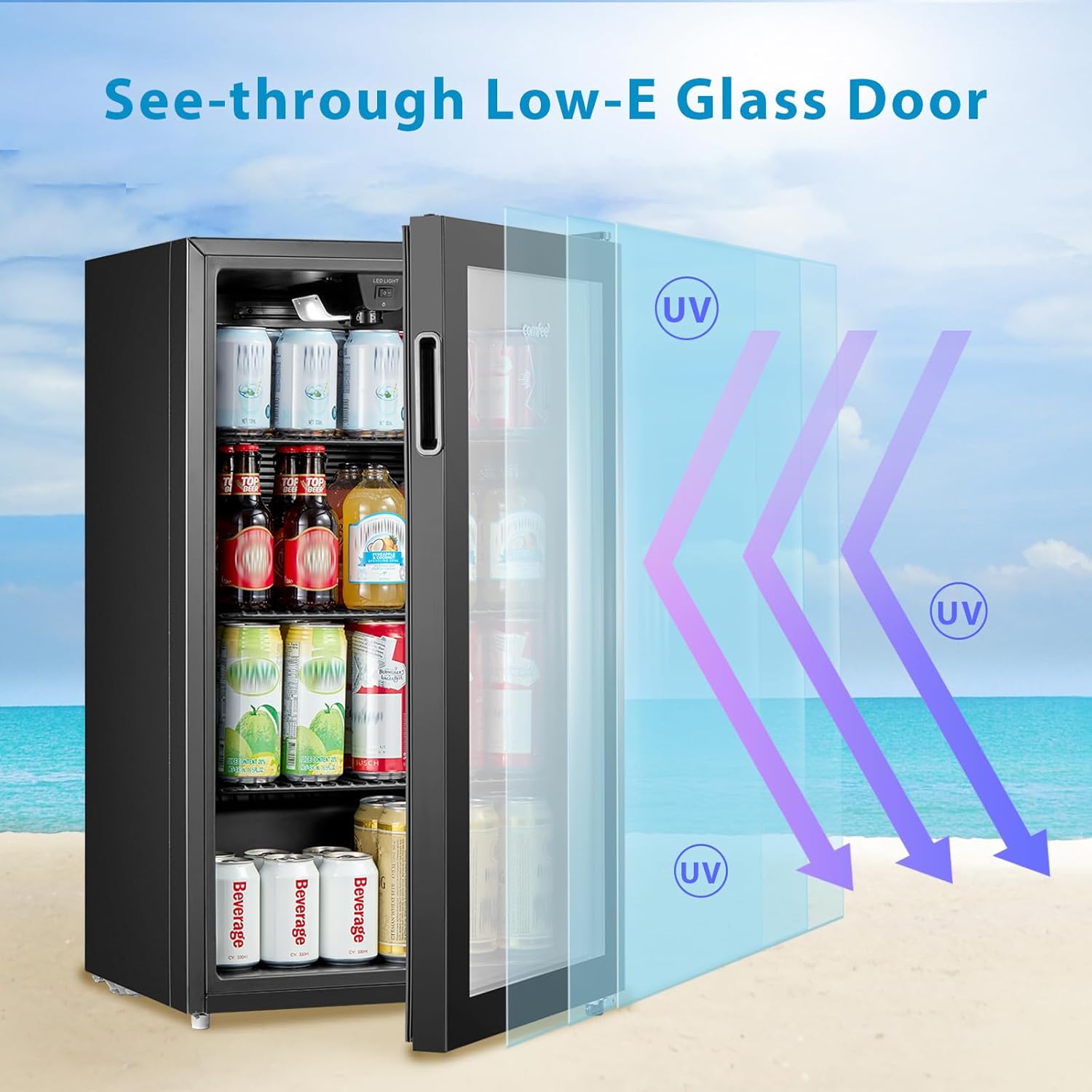
What do you actually get for that outlay? You get a 93L capacity, room for up to 115 cans, a wide 2–15℃ temperature range, low‑E glass door, internal LED light, removable shelves, and quoted low noise at 40 dB. You don’t get digital controls, a temperature display, auto-on lighting, frost‑free operation, or smart connectivity. Energy efficiency is E‑class at 154 kWh/year, which is not terrible but not cutting-edge either. So the value proposition is clear: pay for core function and capacity, not for extras.
Compared with many branded bar fridges or fancy glass-door coolers, this model trades on the combination of compact width (47 cm), decent capacity, and strong user satisfaction. When buyers say it “gives the bigger brands a run for their money”, that suggests the price-to-performance ratio is attractive. People are getting cold drinks, quiet operation and a decent look without paying for a logo or premium design touches. The 2-year warranty also adds some security without requiring extended warranty upsells.
In my opinion, the main compromises that affect value are the E energy class, manual defrost, and small usability quirks like the manual light switch and tricky hinge covers for door reversal. If you are chasing the absolute lowest running costs or want a more polished user experience with auto lights and digital controls, you might need to step up to a more expensive model. But for someone who mainly wants a reliable, cold, under-counter beer fridge with a glass door and good capacity, the balance between price and features looks strong, which is reflected in the high average rating and recurring “good value” comments.
Design: compact footprint, glass door bar look
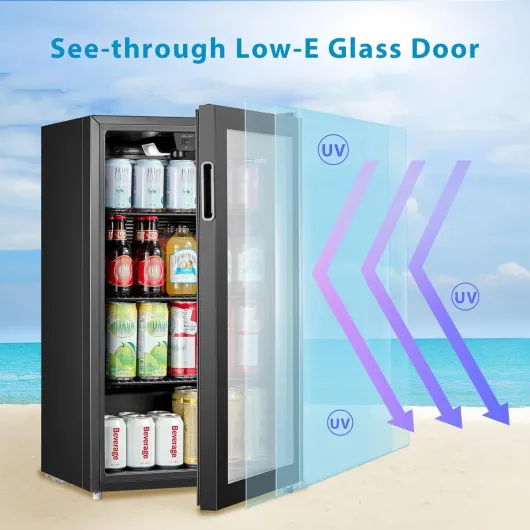
Visually, the COMFEE RCZ99BG2(E) sticks to a familiar bar-fridge formula: a black body, full-length glass door, and an internal LED light to show off the contents. The finish is described as glossy with a solid pattern, so the styling is simple and neutral rather than flashy. This makes sense for an appliance that might end up in a kitchen, office, or garden room where it has to blend with different decors. Several reviews describe it as “smart looking” or note that it “looks great with the light on”, which suggests that the basic design works well enough for a home bar vibe.
The real design strength is the size. At 47 cm wide and 44 cm deep, it’s slimmer than many under-counter appliances, which can be crucial if you’re trying to squeeze a drinks fridge into a tight gap. One buyer mentions that it “fits perfectly in the space I had available as it’s not too wide”, which matches the numbers. The 84.5 cm height is standard under-counter territory, so it should slide under most worktops, although anyone with extra-low counters should still measure carefully.
Inside, the layout is basic but functional: three wire shelves that can be removed or rearranged, plus the base area. The brand claims it holds up to 115 cans, and reviewers regularly comment that it “holds an enormous amount of cans and bottles” or “holds a good amount of drink”. There are no door shelves, which keeps the internal geometry simple and reduces the risk of bottles clashing with the glass, but it means all the storage is on the shelves and floor of the cabinet.
One design quirk that comes up is the LED light operation. Instead of turning on automatically when the door opens, it’s controlled by a manual switch. At least one buyer specifically mentions they would have preferred a door-activated light, though they still rate the product highly overall. In my opinion, that choice keeps the design simpler and cheaper but feels slightly dated compared with many modern fridges. Overall, the design is practical, compact and visually acceptable for most home setups, without any premium touches that would push the price up unnecessarily.
Delivery, setup and first impressions from buyers
While there aren’t detailed unboxing descriptions, a few recurring points emerge about how the RCZ99BG2(E) arrives and how easy it is to get going. Several reviewers mention that the fridge came “well packaged” and “well packed and speedy delivery”. That indicates the manufacturer and retailer are at least putting effort into protecting the glass door and body during transport, which is essential for a 27.5 kg appliance with a large glass front. Damage in transit is a common complaint with cheap fridges; the lack of visible patterns of such complaints here is a positive sign.
Setup is fairly typical for a freestanding fridge. You position it, adjust the feet if needed to level it, plug it in and set the thermostat. One buyer notes that they easily set the door to open from their side of choice, although they also warn to make sure you create a good seal when refitting it. That suggests that, for some people, reversing the door is manageable, but it still requires care to avoid alignment and sealing issues. Another buyer reports serious difficulty removing the plastic covering over the hinge, leading to scratched paint and broken tools, so the experience clearly varies depending on expectations and how comfortable someone is with basic DIY.
Internally, there is no complex assembly. The shelves come ready to slot into place and can be rearranged or removed to suit bottles or cans. The included components list is minimal: fridge body and power plug. There are no extra accessories like door racks, bottle holders or drip trays to manage, which simplifies initial setup but also means fewer options out of the box. The thermostat is mechanical, so there’s no need to navigate digital menus or displays; you simply pick one of six cooling levels and adjust if needed after a few hours.
In my opinion, the overall “packaging and setup” story is that of a straightforward appliance that arrives in good condition most of the time and doesn’t require special skills to get running. The only real caveat is the door reversal process, which some people manage fine and others find frustrating. If you’re planning to keep the factory hinge orientation, the process should be simple: unpack, position, plug in, set the dial, and load it with drinks once it’s cold.

Build quality, reliability and everyday robustness
Durability on a fridge like this comes down to a few things: the sturdiness of the cabinet and door, the reliability of the compressor, and how well the moving parts (hinges, shelves, seals) hold up over time. The RCZ99BG2(E) weighs 27.5 kg, which suggests a reasonably solid build for a compact unit. The use of low‑E glass for the door should help with thermal performance and may also indicate a better-insulated panel than basic glass, which is relevant for both longevity and stable cooling.
In the published reviews, there is no recurring pattern of breakdowns or early failures mentioned in the sample provided. Instead, buyers tend to focus on performance and capacity, which usually means the fridge is doing its basic job without major issues. The product is covered by a 2‑year warranty from COMFEE, which is standard but still reassuring for a small appliance in this price range. A unit with over 1,100 ratings and a 4.6/5 average typically would attract more visible complaints if there were widespread reliability problems.
One area where durability and practicality intersect is the door hinge system. Officially, the door orientation is reversible. One reviewer reports struggling badly with changing the hinge side: they mention that the plastic covering over the hinge was extremely difficult to remove, leading to scratched paint and broken non‑abrasive tools. This doesn’t mean the fridge will fail in normal use, but it does suggest that the hinge trim and coverings might be more fragile or awkward than ideal if you plan to reverse the door. For someone who never touches the hinges, this may never matter; for others, it could be a source of annoyance.
The shelves are wire rather than glass, which has pros and cons. Wire shelves are usually lighter and less likely to shatter, but they can flex slightly under heavy loads and small items may not sit as stably. That said, reviews describe the interior as capable of holding a lot of cans and bottles without complaints about shelves bending or failing. In my opinion, nothing in the available information screams “built like a tank”, but equally there are no big red flags on reliability. For typical home or office use, it appears to be a reasonably robust unit, with the main caution being the fiddly nature of the hinge covers if you need to swap the door side.
Cooling performance and noise: does it keep drinks cold enough?
On paper, the RCZ99BG2(E) aims for solid, no-nonsense performance rather than fancy features. It uses a compressor cooling system and offers an adjustable thermostat with six levels, covering a temperature range from 2℃ to 15℃. That range is wide enough for very cold soft drinks and beer at the lower end, and slightly warmer settings for some wines or less chilled beverages at the upper end. For a dedicated drinks fridge, that is a sensible spec: nothing groundbreaking, but it covers the main use cases.
The real question is whether it actually gets cold enough in day‑to‑day use. Here, the comments are fairly consistent. Multiple buyers say it keeps their beers and drinks at the “perfect temperature” and that it “keeps drinks really chilled in this hot weather on setting 5 at 2 degrees”. Another review notes that it performs well in a garden room with varying temperatures, which is usually more challenging than a stable indoor kitchen. These reports line up with what you’d expect from a compressor-based unit with a 2℃ floor: it should be capable of proper chilling, not just light cooling.
Noise is another key part of performance for a fridge that might live in a living room, office or bedroom-adjacent space. The manufacturer quotes 40 dB, which is within the typical range for small fridges. Buyers regularly describe it as “very quiet” or “quiet when in operation” and compare it to a normal fridge in terms of noise level. No pattern of noise complaints stands out, which is usually a good sign for this type of appliance. It’s still a compressor, so it will cycle on and off, but it doesn’t appear to be a frequent source of frustration in the reviews.
There is no mention of rapid-cool modes, digital readouts of the internal temperature, or fan-assisted circulation, so fine-tuning the exact temperature will rely on a bit of trial and error with the dial. In my opinion, that’s acceptable for a mid-priced beer fridge where the main objective is “cold and ready to drink” rather than precise wine storage. Overall, considering the user feedback and the specs, the performance looks solid: efficient cooling across a usable range, with noise levels that seem manageable even in quieter rooms.

What this COMFEE drinks fridge actually offers
The RCZ99BG2(E) is a 93-litre beverage fridge designed to sit under a counter or as a freestanding unit. Its dimensions are 84.5 cm high, 47 cm wide and 44 cm deep, which keeps the footprint compact while still claiming space for up to 115 standard cans. The configuration is straightforward: a single glass door, three removable wire shelves, and a simple mechanical thermostat with six cooling levels. The temperature range is advertised from 2℃ to 15℃, which covers very cold soft drinks and beer up to slightly warmer settings more suited to some wines.
The fridge uses a compressor-based cooling system with R-600A refrigerant, and the manufacturer quotes an annual energy consumption of 154 kWh. It’s rated as E-class, so it’s not the most frugal appliance on the market, but that’s fairly typical for affordable glass-door drinks fridges. Door orientation is listed as reversible, and the plug is a UK Type G, confirming its primary target market. It’s not a smart appliance: no Wi‑Fi, no Bluetooth, no app control, and it relies on manual defrosting.
In terms of equipment, you get the fridge body and the power plug, nothing fancy. The door is made of low‑E glass, which should improve insulation compared with basic glass panels and helps keep the cold inside while still letting you see the contents. An internal LED light can be switched on and off manually; it doesn’t automatically come on with the door, which a few buyers point out as a minor annoyance but not a deal-breaker. The lock type is listed as "Key", but there is no strong emphasis on this in the comments, so it’s probably more of a simple latch system than a heavy-duty bar lock.
What stands out is the product’s positioning in its category. It sits near the top of Amazon’s Beverage Refrigerators ranking (2nd in category, 34th in Large Appliances), which indicates strong sales volume. Combined with a 2-year manufacturer warranty and a 4.6/5 rating, it presents itself as a reliable mid-range option: not a luxury showpiece, but a practical, compact fridge that should handle family drinks, party supplies or office refreshments without too much fuss. In my opinion, anyone expecting advanced features will be underwhelmed, but for straightforward chilling duties, the spec sheet looks coherent.
Pros
- Strong user feedback (4.6/5 from 1,100+ ratings) on cooling performance and quiet operation
- Compact 47 cm width with 93L capacity, advertised to hold up to 115 cans
- Wide 2–15℃ temperature range with removable shelves for flexible storage
Cons
- E‑class energy rating and 154 kWh/year consumption, not the most efficient option
- Manual defrost and manual LED light switch rather than door-activated light
- Door reversal can be fiddly; at least one buyer reports difficulty removing hinge covers
Conclusion
Analysis score
The COMFEE RCZ99BG2(E) positions itself as a practical, compact drinks fridge for homes, offices and garden rooms, and the combination of specs and buyer feedback suggests it largely delivers on that goal. With 93 litres of capacity, space for up to 115 cans and a wide 2–15℃ thermostat range, it covers most everyday needs for beer, soft drinks and basic wine chilling. The 47 cm width and 44 cm depth make it easier to fit into tight under-counter gaps than many rivals, while the low‑E glass door and LED light give it a simple bar-fridge look that buyers seem to like.
Performance and noise are the main strengths: reviews repeatedly mention very cold drinks and quiet operation, which are exactly what you want from a dedicated beverage fridge. The 4.6/5 rating across more than a thousand reviews backs up the idea that it gets the core job done. On the downside, energy efficiency is only E‑class, the defrost is manual, and usability details like the manual light switch and tricky hinge cover for reversing the door show where costs have been kept down.
In my opinion, this fridge is well suited to people building a home bar, freeing space in the kitchen fridge, or equipping an office or garden room with a simple, cold drink solution. It’s not ideal for those obsessed with ultra-low running costs, advanced features, or high-end wine storage precision. Overall, as a straightforward under-counter beer and drinks fridge with good capacity, strong user satisfaction and a reasonable price-to-features balance, it earns a solid recommendation for practical buyers.