
Summary
Editor's rating
Good value if you want simple and reliable, not gadgets
Classic lab-style design, nothing fancy but readable
Glass feels decent, but still fragile, as expected
Fragile by nature, but the tube helps a lot
Consistency, ease of reading, and real-world usage
What you actually get in the box
Does it actually help you brew better? Yes, if you use it right
Pros
- Consistent and reasonably accurate readings across multiple batches
- Triple scale (SG, sugar g/l, potential alcohol) is useful once you get used to it
- Comes with a sturdy plastic tube that protects the fragile glass during storage
Cons
- Fragile glass construction – one drop on a hard floor can end it
- No included instructions, ABV table, or temperature correction guide, so beginners must look things up

Specifications
View full product page →| Brand | Stevenson Reeves |
A basic tool that every homebrewer ends up buying
I’ve been brewing at home on and off for a few years, and at some point you stop guessing and you buy a hydrometer. That’s basically how I ended up with this Triple Scale Hydrometer (S1011) from Stevenson Reeves. Nothing fancy, no flashy brand, just a glass stick in a plastic tube. I used it on a couple of beer batches and a small wine experiment to see if it’s actually useful or just another gadget that sits in a drawer.
In practice, the main thing I wanted from it was simple: tell me if my fermentation is done or stuck, and give me at least a decent idea of the final alcohol level. I’m not doing competition-level brewing, but I do want to avoid bottle bombs and half-fermented rocket fuel. So I took readings at the start, during fermentation, and at the end, exactly like they suggest in the description.
What surprised me is how quickly it became part of the routine. Instead of guessing from airlock bubbles, I now just pull a 100 ml sample, float the hydrometer, read the value, and move on. It’s not complicated, but the triple scale layout (specific gravity, sugar g/l, and potential alcohol) took me a couple of uses to read comfortably. The markings are clear enough, but it’s still small text on a thin glass tube.
Overall, my first impression after a few weeks is: it’s not exciting, but it does its job properly. If you’re expecting some smart digital thing that gives you ABV at a glance, this is not it. You still need to do a bit of math or use an online calculator. But if you want a cheap, basic way to track your brew properly instead of guessing, it already feels like a useful tool to have around.
Good value if you want simple and reliable, not gadgets
On the value for money side, this Triple Scale Hydrometer (S1011) lands in a pretty good spot. It’s not the absolute cheapest hydrometer on the market, but it’s still very affordable, and you’re buying from a known manufacturer (Stevenson Reeves) rather than a totally random no-name clone. Given how central a hydrometer is to safe brewing, I don’t mind paying a few extra euros for something that seems properly calibrated.
What you get for the price is: a functional, accurate-enough hydrometer and a protective tube. No test jar, no instructions, no bonus accessories. If you’re starting from scratch, you’ll need to add a trial jar and maybe a simple thermometer to your shopping list, plus you’ll probably end up on an online ABV calculator. Still, compared to buying a digital or fancy Bluetooth gravity monitor, this is a fraction of the cost and, frankly, less fiddly.
Compared to other basic hydrometers I’ve seen or used, this one feels a bit more trustworthy in terms of calibration. The fact that many users report it as accurate, and that my water test came in basically bang on 1.000 at 20°C, reassures me. Cheaper ones sometimes arrive slightly off and need you to mentally correct every reading, which is annoying over time. Here, you just read and log it.
If you brew only once a year, you might question whether you need it at all. But as soon as you start doing a few batches and caring about consistency (and avoiding bottle bombs), the price is easy to justify. It’s not perfect – fragile, no instructions, a bit busy on the scales – but for the money, it’s a pretty solid piece of kit that does its job without drama. I’d say it’s good value for someone who wants accuracy on a budget and doesn’t mind doing a bit of manual work.
Classic lab-style design, nothing fancy but readable
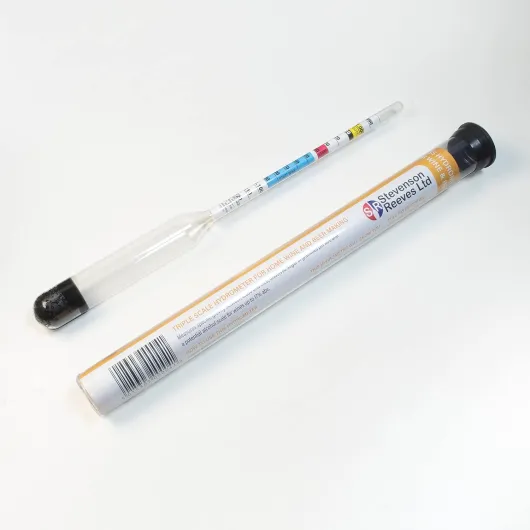
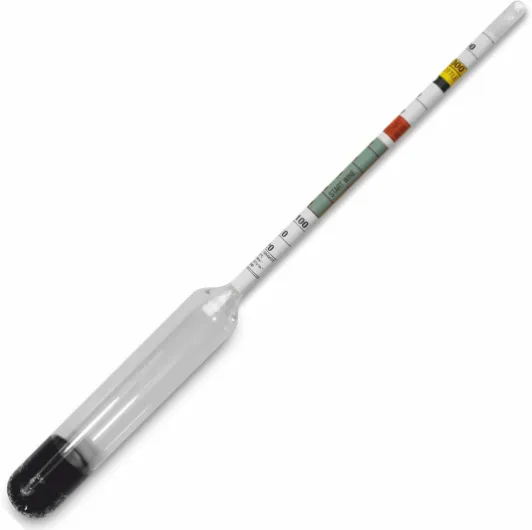
Design-wise, this Triple Scale Hydrometer is about as classic as it gets. It’s a thin glass body with a weighted bulb at the bottom so it floats upright in your sample. The overall length around 23 cm works well with a 100 ml sample jar or a tall trial jar. I used a standard plastic trial jar, and it had enough room so the hydrometer wasn’t touching the sides too much, which matters for accurate readings.
The triple scale layout is both a strength and a small annoyance. Strength because you get three pieces of info in one shot: specific gravity, sugar g/l, and potential alcohol. Annoyance because at first your eyes wander around trying to remember which line is which. After a couple of brews, I mainly focused on the specific gravity scale, then checked the potential alcohol scale just out of curiosity. Once you know where to look, it becomes natural, but the first few uses feel a bit busy.
In terms of readability, the printing quality is decent. The scale is straight, no obvious misalignment, and the lines are evenly spaced. On my unit, the zero points and numbers didn’t look smudged or off-centre, which is important for any sort of precision instrument. The colour choices (black text, red highlighted zones) help you quickly see whether you’re in a typical fermentation range or down near finished gravity.
One small design downside: no temperature correction markings or guide on the body. Many hydrometers print the calibration temperature (usually 20°C) clearly and sometimes offer a small table. Here, you don’t get any of that directly on the glass. You’re supposed to know that readings are at a reference temperature and adjust mentally or with an app if your wort is hotter or colder. Not a deal-breaker, but it would have been helpful printed somewhere obvious.
Glass feels decent, but still fragile, as expected
The materials are straightforward: glass for the hydrometer, plastic for the case. The glass itself feels like standard lab glass, not ultra-thick, not paper-thin. When you tap it gently with a fingernail, you can tell it’s hollow and delicate, but it doesn’t feel like it will shatter from normal careful use. I’ve rinsed it, dried it, and handled it over a stainless sink several times and it’s survived fine, but I’m always a bit cautious.
The weighted bulb at the bottom seems to be filled and sealed properly. There’s no loose rattle inside, and the seam where the glass is closed looks clean. That matters because if the seal fails, liquid gets inside and the calibration is ruined. After a few weeks of use in water, wort, and wine must, I haven’t seen any fogging or signs of liquid getting into the inner tube, so from that angle it looks well put together.
The plastic storage tube is simple but useful. It’s clear, so you can see the hydrometer without opening it, and the plastic is hard enough that it doesn’t bend easily. The end caps fit snugly; I can hold the tube upside down and shake it lightly without the cap flying off. This tube is honestly what will keep the hydrometer alive, because the glass on its own in a drawer would be asking for trouble. For the weight (around 30 grams total), the combo feels light but not flimsy.
Overall, materials match the price and the purpose. You’re not getting some reinforced industrial thing, you’re getting a standard glass instrument that will last as long as you don’t drop it or crush it. If you’re clumsy or brewing in a cramped space, I’d strongly suggest always putting it back in the tube between readings. There’s better protected or plastic hydrometers out there, but they also tend to cost more or be less precise. Here you get a basic glass unit that feels honest for the money.
Fragile by nature, but the tube helps a lot
Durability is where you have to be realistic: it’s a glass hydrometer, so it’s never going to be tough. That said, after several weeks of brewing sessions, rinsing, and storage, mine still looks and behaves like new. No cracks, no fogging, no loose weight in the bulb. As long as you treat it like a fragile instrument and not a spoon, it holds up fine.
The biggest factor that helps is the plastic storage tube. Without that, I’m pretty sure I’d have already chipped or smashed it by knocking it in a drawer or against a fermenter. With the tube, I can keep it in my brewing crate with other tools and not stress about it every second. I still don’t throw the crate around, but I’m not babying it either. For a 30 g item, the protection feels adequate.
Cleaning doesn’t seem to cause any issues. I rinse it under lukewarm water right after use, sometimes with a bit of mild detergent, then rinse again and let it air-dry on a towel before putting it back in the tube. No signs of the printed scale lifting or fading so far. The inside is sealed, so as long as you don’t crack the glass, the paper and ink inside should stay safe for a long time.
Overall, I’d say durability is decent but limited by the nature of the product. You drop it on a tiled floor, it’s probably gone. But used with normal care, it feels like it could easily last years. There are more rugged options out there, including plastic hydrometers or refractometers, but they also come with their own trade-offs. For the price point and type of tool, I’m fine with how robust this one feels when used sensibly.
Consistency, ease of reading, and real-world usage
On performance, I mainly looked at two things: consistency between readings and how easy it is to actually use during a brew day. Over several batches, the readings have been consistent. If I re-float it in the same sample after a quick rinse and dry, I get the same value or extremely close, within one small line. That’s exactly what I want: not perfection to the third decimal, just stability so I can trust the trend.
Using it in practice is pretty straightforward: pull a 100 ml sample into a tall jar, gently lower the hydrometer in, spin it slightly to shake off bubbles, wait a few seconds, and read at eye level. The 23 cm length is good here – it floats high enough that you’re not trying to peer into the neck of the jar. The scale between 0.980 and 1.120 covers basically everything I do: light beers, stronger ales, and typical wine must. If you’re brewing super high-gravity monsters, you might push the top end, but for normal homebrewing it’s enough.
One small thing: the multitude of numbers and scales can be confusing if you’re new. Specific gravity, sugar g/l, potential alcohol… it’s a lot on one stick. After a couple of uses, I mentally ignored the sugar g/l scale and focused on SG and, occasionally, the potential alcohol just for curiosity. If you’re brewing with recipes that specify SG, that’s all you really need anyway. So the extra scales are nice to have but not essential.
Overall, day-to-day performance is solid. It responds clearly as fermentation progresses, it doesn’t seem to drift, and the readings line up with what I expect from yeast performance and recipe calculators. It’s not going to speed up your brew day, but it will cut out a lot of guessing. The only performance downside is the usual hassle with hydrometers: you always lose a bit of wort or must for each reading, and you need a separate trial jar. That’s not this product’s fault, just the nature of the tool.
What you actually get in the box
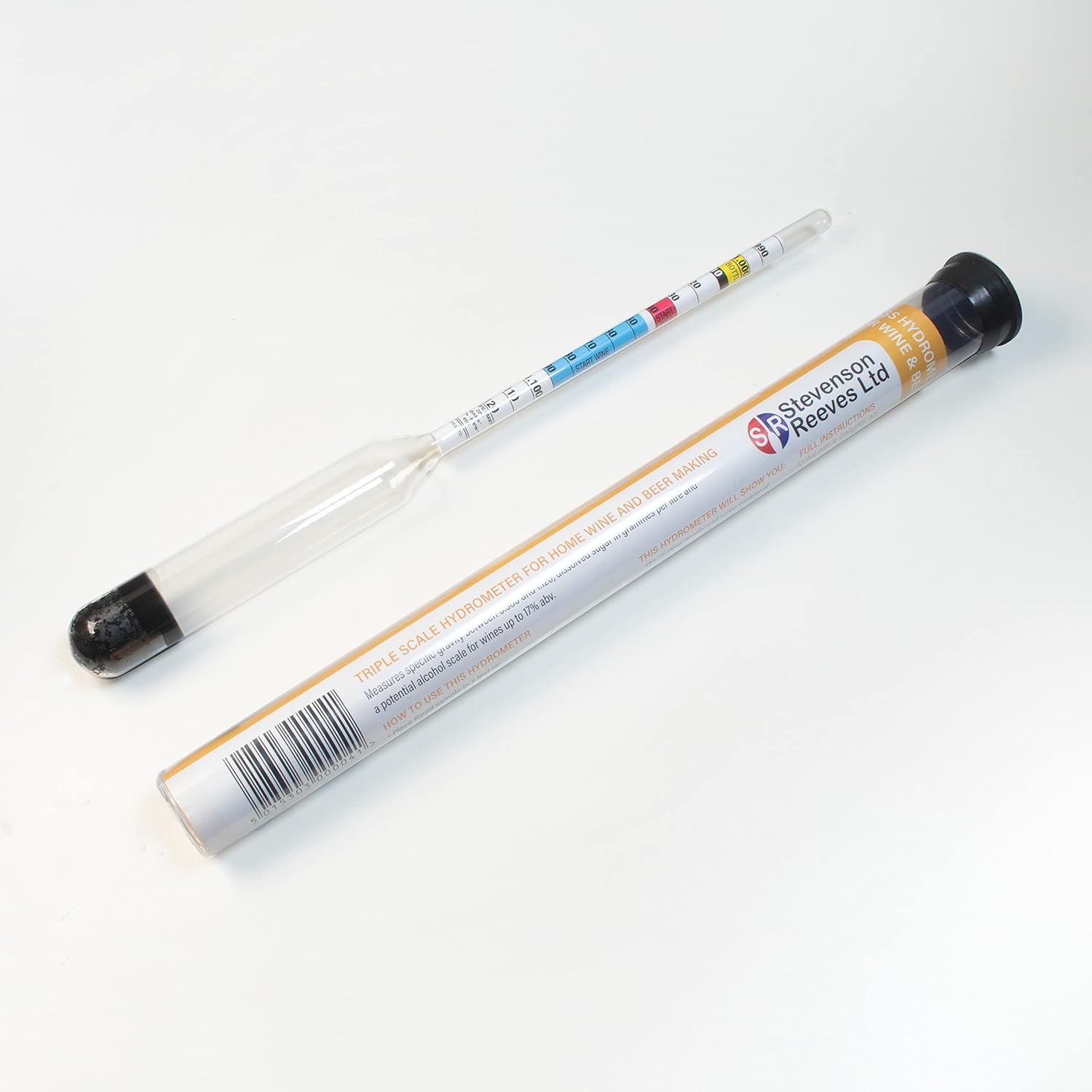
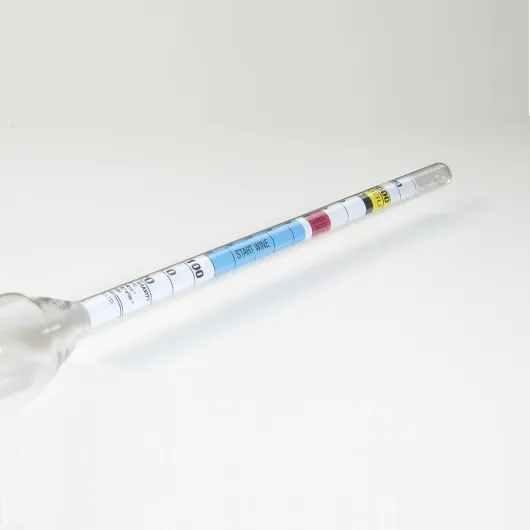
When this Triple Scale Hydrometer (S1011) arrived, the first thing I noticed is how bare-bones the whole package is. You get one glass hydrometer and a clear plastic storage tube. That’s it. No fancy box, no stand, no test jar, no long instruction booklet. It honestly looks like something straight from a lab supply cupboard, which isn’t a bad thing, just very no-frills.
The plastic tube is fairly solid and does its main job: protect the glass. It’s rigid enough that I don’t feel nervous tossing it gently into a brewing box or a drawer. The cap snaps on well and doesn’t open by itself. I wouldn’t throw it at a wall, but for normal handling it feels safe. The hydrometer itself is about 23 cm long, so it fits nicely inside with a bit of room at the ends, not rattling too much.
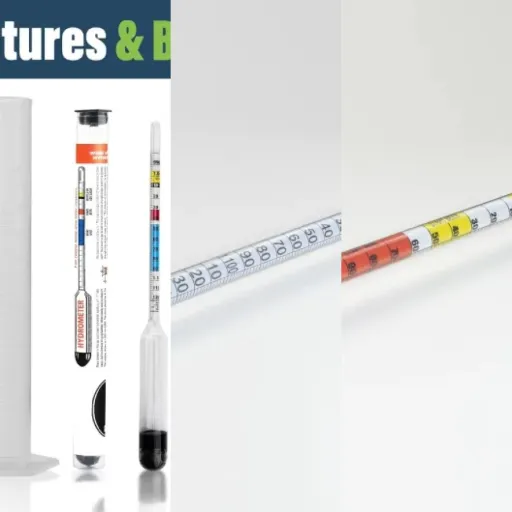
On the hydrometer, you have three scales printed on the paper inside: specific gravity (0.980 to 1.120), sugar in g/l, and a potential alcohol scale for wine. The print is clear enough to read, but if you’ve got bad eyesight you’ll probably lean in or grab your glasses. The colours on the scale (mainly red sections) help spot the ranges quickly, but it’s still a slim instrument, so don’t expect huge bold numbers.
In terms of first contact, it feels like a simple, practical lab tool, not a consumer gadget. No nonsense, no extra stuff. Personally, I’d have liked a short printed guide with example readings and a quick table for ABV calculations, because beginners will end up on Google anyway. But for the price, I wasn’t really expecting more. It’s straightforward: you get the hydrometer, a protective tube, and you’re on your own to learn how to use it.
Does it actually help you brew better? Yes, if you use it right
In terms of effectiveness, this hydrometer does what it’s supposed to: it gives you consistent readings so you can follow fermentation. On my last pale ale batch, I measured an original gravity around 1.050 and then took readings on day 4, day 7, and day 10. The values dropped smoothly down to about 1.010 and then stayed there for two days in a row. That told me fermentation was done and it was safe to bottle. No guessing from bubbles, no worrying about over-carbonation later.
I also tried it on a small mead-style experiment, where fermentation can be slower and trickier. Again, the hydrometer readings made it clear when things had stalled slightly and when they picked back up after adding nutrients. Without this, I’d probably have either racked too early or just left it sitting for ages “hoping” it was done. So for tracking progress, it’s genuinely useful and pretty much essential if you care about repeatable results.
One thing to understand: it does not spit out ABV magically. You need to record the starting gravity and the final gravity, then either plug them into an online calculator or use a simple formula. The potential alcohol scale is more aimed at wine and is more of a rough guide than a precise final ABV reading. Some reviewers complain it doesn’t tell you the alcohol directly – but that’s just how hydrometers work. Once you accept that, it’s fine.
From my tests in plain water at 20°C, it read very close to 1.000, maybe a hair off but nothing dramatic. For home brewing use, that’s plenty accurate. If you’re doing serious lab analysis, you’d want something more specialized, but for beer, wine, or mead at home, it gets the job done reliably. The main limitation is user error: not degassing the sample, reading at an angle, or not correcting for temperature. Used with a bit of care, it’s a solid tool.
Pros
- Consistent and reasonably accurate readings across multiple batches
- Triple scale (SG, sugar g/l, potential alcohol) is useful once you get used to it
- Comes with a sturdy plastic tube that protects the fragile glass during storage
Cons
- Fragile glass construction – one drop on a hard floor can end it
- No included instructions, ABV table, or temperature correction guide, so beginners must look things up
Conclusion
Editor's rating
After using the Stevenson Reeves Triple Scale Hydrometer (S1011) on several beer and mead batches, my opinion is simple: it’s a basic, reliable tool that earns its spot in a homebrewer’s kit. It doesn’t look fancy, it doesn’t give you instant ABV at the push of a button, but it gives consistent gravity readings and helps you clearly see when fermentation is done or stuck. That alone can save you from under-fermented bottles and weird, half-finished brews.
The strong points are the clear triple scale, the decent build quality for a glass instrument, and the protective storage tube that actually makes a difference for durability. On the downside, it’s fragile by nature, there’s no real instructions or temperature correction guide, and beginners may find the multiple scales a bit confusing at first. You also need to accept that you’ll be doing some math or using an online calculator to get ABV – that’s just how hydrometers work.
Who is it for? Anyone brewing beer, wine, or mead at home who wants to move past guessing and actually track fermentation properly, without spending a lot on fancy gadgets. Who should skip it? People who know they’re clumsy with glass, or who prefer digital tools and are ready to pay several times more. Overall, I’d rate it as a solid, no-nonsense choice: not perfect, but good value and reliable enough to trust your batches with.