
Summary
Editor's rating
Is it good value for money?
Simple design, readable but a bit cramped
Glass build: feels decent but still breakable
How it holds up after a few batches
Accuracy, consistency and real-world use
What you actually get in the box
Does it actually help you brew better?
Pros
- Consistent and reasonably accurate readings across multiple batches
- Triple scale (SG, Brix/Plato, alcohol estimate) in one compact tool
- Comes with a sturdy plastic storage tube that actually protects the glass
Cons
- Glass construction is still easy to break if dropped or mishandled
- Scales can feel a bit cramped and hard to read in poor lighting

Specifications
View full product page →| Brand | Stevenson Reeves |
A cheap tool that actually matters for homebrew
I’ve been brewing at home on and off for a few years, and every time I tried to cut corners on measuring tools, it came back to bite me. Either I bottled too early, or I had no real idea how strong the batch was. That’s why I picked up this Stevenson Reeves Triple Scale Hydrometer (S1310). It’s a basic glass hydrometer with three scales: specific gravity, Brix/Plato (sugar), and an alcohol estimate. Nothing fancy, no app, just an analogue stick you float in your beer or wine sample.
I used it over a couple of recent batches: one 20L pale ale and one small 5L test mead. I wanted to see if it was readable, consistent, and tough enough to survive normal clumsy homebrew use. I also compared its readings against my old cheap hydrometer and a digital refractometer a friend lent me for a weekend, just to see if it was wildly off or more or less in the same ballpark.
In practice, this thing is very straightforward. You fill a trial jar with about 100 ml of wort or must, drop the hydrometer in, spin it gently to get rid of bubbles, and read where the liquid hits the scale. The brand claims it measures from 0.990 to 1.170 in specific gravity, which covers pretty much anything you’ll do at home, from light beer to strong wine or mead. I used it at the start and end of fermentation and a couple of times in between when I wasn’t sure if the yeast had stalled.
Overall, my first impression is that it gets the job done without any drama. It’s not perfect, it’s not high-tech, and you still need to do a bit of math or use an online calculator for ABV. But if you just need a reliable way to know when your brew is actually finished and roughly how strong it is, this hydrometer does that pretty well for the price.
Is it good value for money?
Price-wise, this Stevenson Reeves hydrometer sits in that middle zone: not the cheapest thing on the market, but definitely not expensive compared to the cost of a ruined batch. When you consider how important it is to know if fermentation is finished and how strong your brew roughly is, the cost feels very reasonable. One bad batch of beer or a few exploding bottles are more expensive and annoying than just buying a decent hydrometer in the first place.
What you’re paying for here is decent calibration, clear scales, and a proper storage tube. If you go cheaper, you often lose at least one of those: either the print is dodgy, the readings are off, or you get a thin cardboard sleeve that does nothing to protect it. On the other hand, more expensive digital tools or refractometers can be nice, but they’re overkill for a lot of casual homebrewers and often need calibration fluids or batteries. This thing needs no power, no app, and basically no maintenance beyond a rinse and a wipe.
For the level of accuracy you get (good enough for 99% of homebrew use), the value is solid. You can track fermentation, avoid bottling too early, and estimate ABV with simple online calculators. If you brew even a few times a year, it earns its keep very quickly. It’s not some fancy gadget that looks cool and then sits in a drawer; you’ll probably use it every single batch.
If I’m being picky, the only value downside is that it doesn’t come with a trial jar. For a beginner, that’s an extra purchase and an extra step. Also, the alcohol scale on the hydrometer is more of a rough guide than a precise tool, so don’t buy it thinking it will show ABV directly with no math. But overall, for the price, you get a reliable measuring tool that genuinely improves your brewing process. I’d call it good value for money, especially compared to very cheap no-name hydrometers that are basically a lottery.
Simple design, readable but a bit cramped
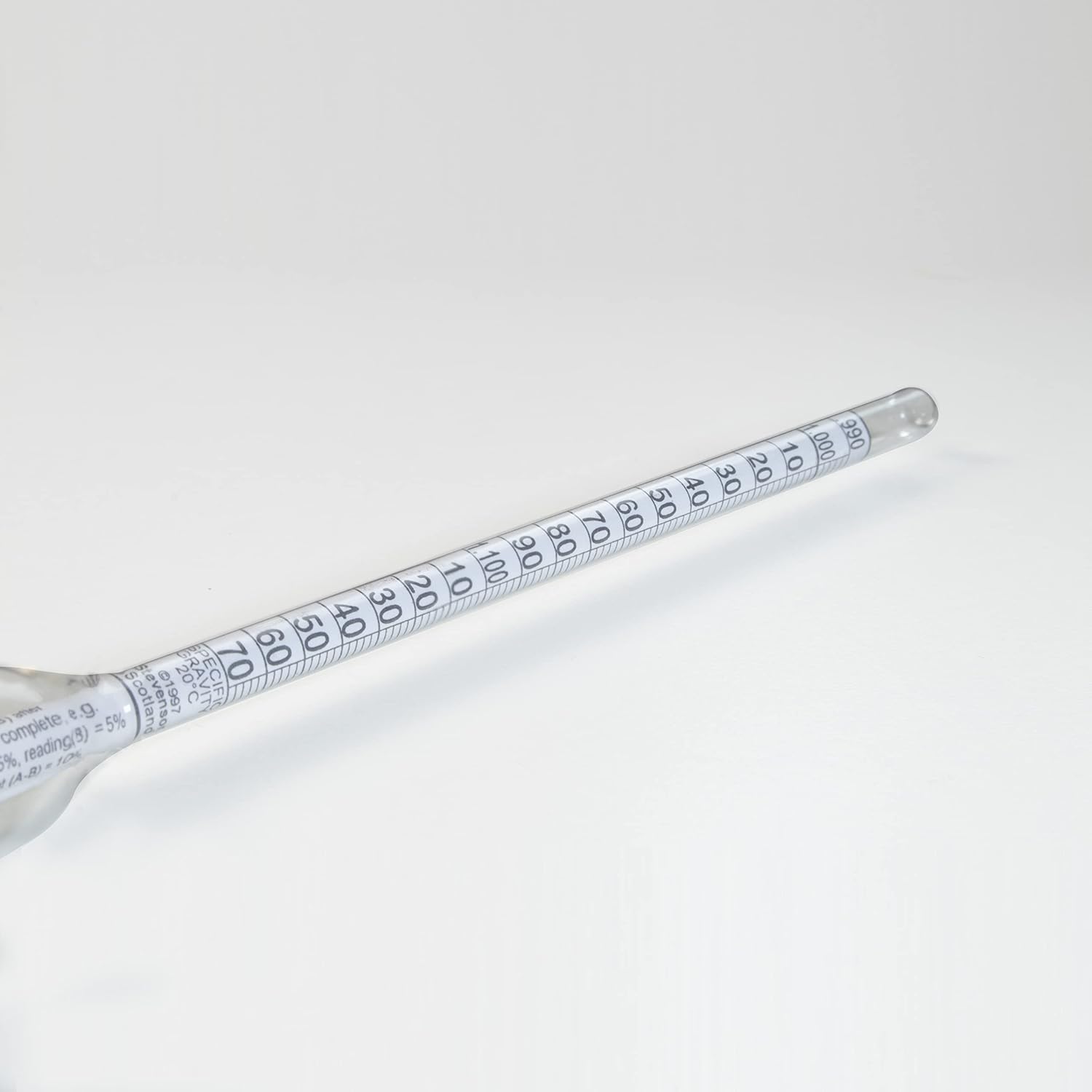
The design is as straightforward as it gets: a glass stem with a bulb at the bottom filled with ballast so it floats upright. Where it matters is the layout of the scales. This triple scale setup gives you a lot of information in a small space, and that’s both the strength and the weak point. You’ve got specific gravity on one side, sugar content in Brix/Plato on another band, and an alcohol estimation scale wrapped around. It’s handy, but the lines and numbers can feel a bit cramped if you’re trying to read it quickly.
In use, the most important thing is how easy it is to spot your reading at eye level. On this model, the specific gravity scale is clear enough, with bold marks at common points like 1.000, 1.040, 1.060, etc. For my pale ale, the original gravity read about 1.048, and final gravity settled at 1.010. It was easy enough to see and repeat over a couple of days. The smaller graduations between those main lines are thinner, and you do need to pay attention, but that’s normal for this type of tool.
The sugar (Brix/Plato) and alcohol scales are more of a bonus than something I stare at constantly. They’re useful if you’re used to those units or if you’re making wine or mead and want a quick idea of potential alcohol. But again, they share the same small label area, so don’t expect huge, bold numbers. If your lighting is bad above your fermenter, you’ll probably end up stepping near a window or turning on a brighter lamp to read it clearly.
One design detail I liked: the hydrometer is balanced well. It doesn’t tilt weirdly in the jar, and it doesn’t stick to the sides too much. A quick spin to knock off bubbles and it settles in the middle nicely. It feels like someone actually checked the calibration rather than cranking them out randomly. Not perfect lab gear, but for homebrew, the design is practical and usable, with the main drawback being the slightly busy scales on a small surface.
Glass build: feels decent but still breakable
This hydrometer is classic glass inside and out. The outer tube is glass, the inner scale is printed on paper, and the weight at the bottom is likely metal shot or similar. That’s standard for this type of tool. It gives you good buoyancy and fairly precise readings, but it also means you have to treat it like something that will break if you drop it or knock it hard against the side of your sink.
In my use, the glass felt thick enough to be reassuring without being chunky. I’ve handled cheaper hydrometers that feel almost like Christmas baubles, where you’re scared to even wipe them. This one has a bit more heft. I knocked it gently against the side of my trial jar a couple of times when I was distracted, and it didn’t crack or chip. That said, if you slam it or drop it onto a hard floor, it’s still going to shatter. So it’s not fragile junk, but it’s not indestructible either.
The plastic storage tube is actually a big part of why the materials feel acceptable. The tube takes the knocks in storage, not the glass. I’ve stored it horizontally and vertically, and tossed it in a brewing box with other gear, and the hydrometer is still perfectly intact. The end caps close firmly enough that dust doesn’t get in, and it doesn’t rattle loosely. I still wouldn’t sit on it or jam it under something heavy, but for normal home use, it’s fine.
One small detail: the paper inside hasn’t warped or discoloured after a few uses and rinses. Obviously, you’re not supposed to get water trapped inside the glass, and I didn’t, but with some cheap hydrometers you can see slight imperfections or misalignment on the inner scale. Here, the print is straight and clean. Overall, the materials are what you’d expect for the price: decent glass, a basic printed scale, and a protective tube that actually does its job. Nothing fancy, but solid enough if you’re not reckless.
How it holds up after a few batches
Durability is always the worry with glass tools. I’ve broken a hydrometer before by knocking it off the counter, and that’s annoying and a bit dangerous when you’ve got glass shards in the kitchen. With this Stevenson Reeves one, after a couple of batches and normal clumsy use, it’s still in one piece. I haven’t baby-sat it, but I also haven’t done anything stupid like letting it roll around loose on a stone worktop.
The main protection here is the plastic storage tube. I always rinse the hydrometer, dry it gently with a clean cloth or let it air dry, then slide it back into the tube and stick it in a drawer. The tube has taken a few hits when I’ve shoved the drawer closed or dropped other bits of kit on top of it, and the hydrometer inside is fine. The tube hasn’t cracked, and the caps still fit tight. As long as you actually use the tube and don’t leave the glass loose, I think it will last a good while.
One thing I did notice is that the printed scale still looks fresh after several rinses. No ink smudging or fading. Obviously, the inside of the glass never gets wet if you’re using it correctly, but with some bargain hydrometers, you can see slight moisture damage or misprints from the start. Here, everything still looks clean and aligned. The glass doesn’t show any scratches either, though I only wipe it with soft cloths or kitchen paper, not rough sponges.
I wouldn’t call it tough, because at the end of the day it’s a glass stick. If you’re the kind of person who drops things a lot, you might break it sooner or later. But for normal, careful homebrew use, it feels durable enough. I’d say its life expectancy is more about how careful you are than about any weakness in the product itself. Treat it like a wine glass, not like a spoon, and it should last you through many batches.
Accuracy, consistency and real-world use
Performance-wise, I mainly looked at three things: how fast it settles, how repeatable the readings are, and whether the numbers line up with other tools and my expectations. On all three, it did a pretty solid job. When you drop it into a 100 ml sample at the right temperature (around 20°C), it stops bobbing and gives a stable reading within a few seconds. I usually give it a gentle spin to shake off bubbles and then wait maybe 10–15 seconds. After that, the meniscus is stable and easy to read.
For repeatability, I tested it a bit more strictly. I took a sample from my fermenter, measured it, wrote down the value, then gently dried the hydrometer and measured the same sample again. The reading was the same each time, within half a point. I did this a few times on different days and got similar consistency. That’s enough to trust that if your gravity is dropping day after day, it’s actual fermentation, not just measurement noise.
Compared to a digital refractometer my friend lent me, the numbers also matched well, once we corrected the refractometer readings for alcohol. On the pale ale, the initial gravity and final gravity from this hydrometer were within 1–2 points of the corrected refractometer values, which is totally fine at homebrew level. You’re never going to be 100% lab precise in a kitchen, but this is close enough that your ABV estimate and fermentation tracking are reliable.
The only thing to keep in mind is temperature. The hydrometer is calibrated for 20°C, and your wort or must is rarely exactly that. If your sample is warmer or colder, you’re supposed to apply a small correction. In real life, I just try to let the sample sit a bit until it’s close to room temp. If you ignore temperature completely, you’ll be off by a couple of points sometimes, but again, for a home setup, that’s usually acceptable. Overall, for a simple glass tool with no power source, the performance is solid: fast enough, consistent, and accurate within the range that actually matters for brewing.
What you actually get in the box
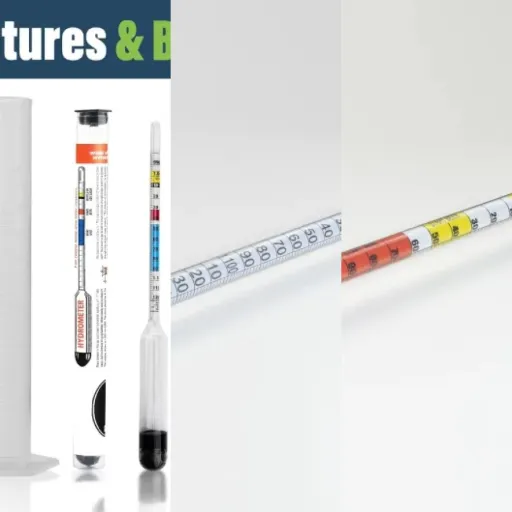
When you order this Stevenson Reeves S1310, don’t expect a big kit. You get one glass hydrometer and a clear plastic tube that doubles as storage and a bit of protection. That’s it. No trial jar, no instructions booklet beyond the basic label on the tube, no fancy extras. If you’re starting from scratch, you’ll need to buy a separate hydrometer jar or use a tall narrow cylinder you already have. The tube it comes in is for storage, not for taking readings.
The hydrometer itself is about 23 cm long, which is pretty standard. It’s clearly labelled with three different scales: specific gravity from 0.990 to 1.170, a Brix/Plato sugar scale, and an alcohol potential scale. The text and markings are printed directly on the paper inside the glass. The print is fairly clear, but if your eyesight isn’t great, you’ll probably want decent lighting or even reading glasses to check the exact numbers, especially around the 1.000 mark where the lines are close together.
The tube it comes in is actually more useful than it looks. It’s a stiff clear plastic cylinder with end caps, and it does a good job of protecting the hydrometer when it’s in a drawer or a brewing box with other bits of kit. I’ve tossed it in a crate with bottles, airlocks, and spoons, and it hasn’t cracked or popped open. I wouldn’t trust it to survive a serious drop from height onto concrete, but for normal storage it’s fine.
In terms of first impression, it feels like a simple, no-nonsense brewing tool. No gimmicks, no branding all over the place, just a glass float with useful scales. If you’re used to cheap no-name hydrometers that come in flimsy cardboard sleeves, this feels a bit more grown-up, but still very basic. It looks like it belongs in a homebrew kit, not in a lab, which is exactly what most people need.

Does it actually help you brew better?
This is where it matters: does this hydrometer actually help you manage fermentation and avoid bottle bombs or flat beer? In my experience with two batches, the answer is yes. It’s not magical, but it gives consistent readings that make sense, and that’s all you really need. For my 20L pale ale, I took an original gravity reading on brew day, then checked again on day 4, day 7, and day 10. The readings dropped steadily from around 1.048 to 1.010, and then stayed at 1.010 for two days in a row. That told me fermentation was basically finished and safe to bottle.
I cross-checked the day 7 and day 10 readings with my older cheap hydrometer. The difference between the two was tiny, about 1 point (for example 1.011 vs 1.010). That’s within normal tolerance and honestly doesn’t change anything in real life. I also used an online calculator, plugging in the starting and final gravity from this Stevenson Reeves hydrometer, and got an ABV of roughly 5%. Tasting the beer, that felt about right. So in terms of practical accuracy, it’s more than good enough for home use.
For the small mead batch, I mainly used it to check if fermentation had stalled. The airlock slowed down and I got nervous. The hydrometer readings over three days barely moved, stuck around 1.020, so I knew it had really slowed. That pushed me to check yeast health and temperature instead of just guessing. Without the hydrometer, I would have been flying blind and maybe bottled something that wasn’t finished. So as a decision tool, it clearly helped.
The alcohol calculation scale printed on it is more of a rough guide than something I rely on. It’s handy for a quick look, but you’ll still get better clarity by using a proper ABV calculator with your starting and final gravity numbers. The hydrometer doesn’t “tell you the ABV” automatically; it just gives the data. Some reviewers seem confused about that. As long as you accept that you still have to do a bit of math or use a website, the effectiveness of this thing is solid: it tracks fermentation progress and helps you decide when to rack or bottle with much more confidence than guessing by bubbles alone.
Pros
- Consistent and reasonably accurate readings across multiple batches
- Triple scale (SG, Brix/Plato, alcohol estimate) in one compact tool
- Comes with a sturdy plastic storage tube that actually protects the glass
Cons
- Glass construction is still easy to break if dropped or mishandled
- Scales can feel a bit cramped and hard to read in poor lighting
Conclusion
Editor's rating
After using the Stevenson Reeves Triple Scale Hydrometer (S1310) on a couple of real batches, my opinion is pretty straightforward: it’s a simple, reliable tool that does exactly what a homebrewer needs. It gives consistent readings, it’s easy enough to read once you get used to the scales, and the storage tube helps keep it alive between brew days. It won’t do the math for you, it won’t sync to your phone, but it will tell you whether fermentation is still going or has finished, which is the main job.
If you’re brewing beer, wine, or mead at home and you’re still guessing based on airlock bubbles or time alone, this is a clear step up. You can track gravity drops, spot stalls, and avoid bottling too early. It’s accurate enough for realistic ABV estimates when you use an online calculator. For the price, that’s good value. It’s best suited for people who are okay with basic manual tools and who will handle glass with a bit of care.
Who should maybe skip it? If you’re extremely clumsy with glass or you want instant digital readouts with no math, you might be happier with a refractometer or a digital hydrometer setup, even if it costs more. Also, if you already own a working, well-calibrated hydrometer, this isn’t going to change your life. But if you’re starting out or upgrading from a very cheap, sketchy model, this Stevenson Reeves S1310 is a solid, no-nonsense choice that will help keep your brews safer and more predictable.