
Summary
Editor's rating
Is it good value for money?
Simple design that focuses on readability
Glass hydrometer, plastic jar: pros and cons
How it holds up after several brew sessions
Day-to-day use when brewing beer and wine
What you actually get in the box
Does it actually give useful readings?
Pros
- Comes with a usable 100 ml plastic trial jar, so you can start measuring right away
- Clear, easy-to-read scales for specific gravity, sugar, and estimated ABV
- Good value for money for beginners and casual homebrewers
Cons
- Glass hydrometer is quite fragile and needs careful handling and storage
- Plastic trial jar feels cheap and may scratch or cloud over time

Specifications
View full product page →| Brand | Thermometer World |
A cheap way to stop guessing your homebrew strength
I picked up this Thermometer World home brew hydrometer with the 100 ml trial jar because I was tired of guessing if my beer had actually finished fermenting. Before this, I was going by bubbles in the airlock and gut feeling, which is a pretty lazy way to brew. I wanted something basic, not some fancy digital lab kit, just a simple hydrometer that tells me if my brew is done and roughly what strength it is.
After a few batches with it, I can say it’s exactly that: a straightforward tool that gives you numbers instead of guesswork. It’s not some high-end lab instrument, but for home use it’s more than enough. You get the hydrometer and a plastic trial jar, so you can start taking readings straight out of the box without having to buy extra bits. For the price, that’s basically all I was expecting.
I’ve used it on a couple of beer kits and one basic cider. In practice, it let me track fermentation properly: I could see the gravity dropping day by day, and I knew when it had actually stabilised. That alone already saved me from bottling too early. The alcohol percentage scale on the hydrometer is also handy if you don’t want to mess around doing calculations every time.
To be clear, it’s not perfect. The trial jar is plastic and feels a bit cheap, and you do need to handle the hydrometer carefully because it’s glass and thin. But overall, as an everyday brewer who just wants reliable readings without spending a lot, I found this kit pretty solid and easy to live with. It gets the job done without drama.
Is it good value for money?
For what you pay, this Thermometer World hydrometer kit offers good value for money. You’re getting both the hydrometer and a dedicated trial jar, which means you don’t have to hunt for a separate container or improvise with random kitchen glasses. That alone makes it more practical than buying a bare hydrometer on its own. Considering it sits near the top of the Amazon rankings for hydrometers and has a lot of positive reviews, it’s clearly hitting a sweet spot for casual brewers.
Compared to other cheap hydrometers I’ve seen, this one stands out mainly on readability and the fact that the included jar is actually usable. Some very low-cost options come with no jar at all or with something so flimsy it’s almost pointless. Here, you at least get a plastic jar that’s stable and the right size. The scales on the hydrometer are also clear and give you multiple bits of info (SG, sugar, estimated ABV), which saves you from buying separate tools or constantly using calculators.
That said, there are definitely more premium options out there if you’re willing to spend more. You can find hydrometers with sturdier glass, better storage cases, or more detailed instructions, and you can pair them with glass trial jars that feel more solid. If you brew very often or you’re very fussy about your equipment, you might see value in spending extra for that. But for someone doing kit beers, basic wines, or ciders at home, this kit hits a nice balance between price and usefulness.
In my case, the small investment has already paid off simply by preventing me from bottling too early and by giving me a realistic idea of my beer strength. It’s not fancy, but it does the key job it’s supposed to do. So overall, I’d rate the value as strong for beginners and casual brewers, and still acceptable for more experienced people who just want a backup or a no-nonsense tool they won’t cry over if it breaks.
Simple design that focuses on readability
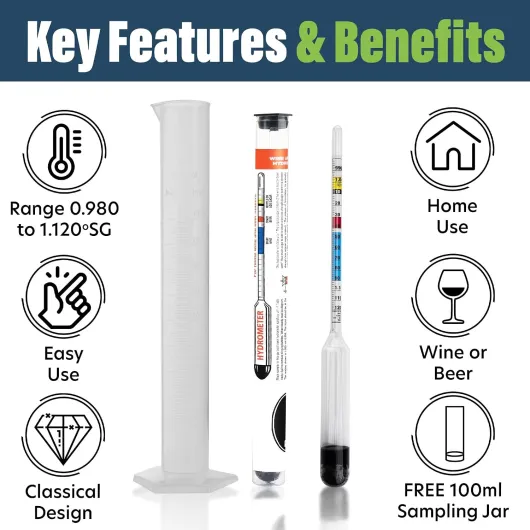
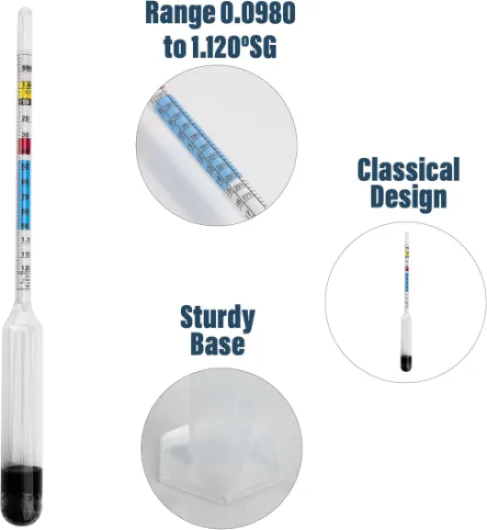
The design is pretty straightforward: a traditional glass hydrometer with multiple scales printed along the stem, and a clear plastic jar that’s tall enough to float it properly. What matters most here is how easy it is to read and whether it floats straight without doing weird stuff in the liquid. On both points, it’s decent. The hydrometer sits upright, doesn’t stick to the side of the jar, and the meniscus is easy enough to see so you can take a proper reading without guessing.
On the stem, you’ve got several scales: specific gravity, sugar content, and an estimated alcohol percentage. I found the specific gravity markings the most useful for tracking fermentation. The alcohol percentage scale is convenient for a quick idea of strength, especially if you don’t feel like calculating OG–FG every time, even if it’s not as precise as doing the math yourself. The colour contrast and font size are good enough that I could read it even with a bit of foam or haze in the sample.
The trial jar design is nothing fancy: just a clear plastic cylinder with a flat base. In practice, the base is stable enough on a flat counter, and I never had it tip over during use, even when I bumped the table slightly. The 100 ml size is a good compromise: it’s tall enough so the hydrometer doesn’t hit the bottom, but small enough not to waste too much beer or wine. If you regularly brew big batches, you might prefer a taller, heavier glass jar, but for casual brewing this one works fine.
Where the design feels a bit budget is in the overall feel of the plastic jar and the lack of any markings on it (like volume lines). It’s just a plain tube. Also, because the hydrometer is quite long and thin, it feels fragile when you’re handling it with wet hands. You need to be careful putting it in and taking it out of the jar. So design-wise, I’d say it’s functional and easy to read, but clearly built to hit a price point rather than impress anyone.
Glass hydrometer, plastic jar: pros and cons
The hydrometer itself is made of thin glass, which is normal for this kind of tool. That means it’s accurate enough for home use, but also means you have to treat it with respect. Drop it in the sink or tap it too hard against the side of the jar and it will crack or shatter. I’ve been using it for a while now and it’s still intact, but only because I’m careful. I always store it back in its tube as soon as I’m done. If you’re clumsy or brewing in a cramped space, just be aware this isn’t something you can throw around.
The trial jar is plastic, and you can tell. It’s light, slightly flexible, and doesn’t have that solid feel of glass. On the upside, this means it’s not going to smash if you knock it off the counter, which is honestly quite nice when you’re dealing with sticky wort or wine must. On the downside, plastic can scratch over time, and scratches can make cleaning a bit more annoying and affect how clearly you can see the hydrometer through it. After several uses and washes, mine still looks fine, but I can see it eventually getting a bit cloudy if you’re rough with it or use abrasive sponges.
In terms of heat resistance, I wouldn’t pour near-boiling wort into the plastic jar. This is more of a sampling jar for cooled or room-temperature liquid. I always let my sample cool a bit before testing anyway, partly because hydrometer readings are temperature-dependent, and partly because I don’t want to warp the plastic. For cold or room-temperature samples, the plastic holds up without any problem.
So from a materials point of view, the combo is pretty standard for the price: fragile but precise glass for the measuring part, cheap but practical plastic for the container. If you want something that feels more premium and solid in the hand, you’d probably go for a glass jar and maybe a slightly heavier hydrometer. But that also means more weight and more breakage risk. Here, they’ve clearly gone for low cost and basic practicality, and for casual homebrew use, that choice makes sense.
How it holds up after several brew sessions
Durability is where you really see that this is a budget-friendly kit. The hydrometer is thin glass, so the risk is obvious: one bad move and it’s gone. I’ve managed a few batches without breaking it, but that’s because I’m quite cautious. I always handle it over a soft towel or over the sink with care, and as soon as I’m done I rinse it, dry it gently, and slide it back into its cardboard tube. If you’re rough with your gear or have a cluttered brewing space, you’ll need to be extra mindful or you’ll be ordering a replacement sooner rather than later.
The plastic trial jar has held up fine so far. No cracks, no warping, and it hasn’t gone cloudy yet. I usually rinse it right after use with warm (not boiling) water and a bit of mild detergent, then let it air dry. I avoid using anything abrasive on it, because plastic scratches easily and scratched plastic is a pain to clean properly. If you treat it reasonably well, I can see it lasting a good while. If you throw it in a drawer with metal tools, expect scratches and maybe small cracks over time.
From what I’ve seen and from the general feel of the materials, I’d say this kit is fine for regular home use, but it’s not something you buy once for life. The hydrometer will last as long as you don’t drop it, which is basically the rule with all glass hydrometers. The jar will probably outlive the hydrometer because it’s plastic, but it may get a bit worn-looking after a couple of years if you brew often. For the price point, that’s acceptable to me. I don’t expect indestructible lab gear at this cost.
If you want something more robust, you’d be looking at heavier-duty hydrometers and possibly glass trial jars, but then you’re also increasing the cost and still dealing with breakable glass. Here, the durability is basically: respect it and it will be fine; treat it carelessly and it will break. That’s not a flaw of this specific model as much as it is the nature of this type of tool. I’m satisfied with how it’s holding up so far, knowing what I paid for it.
Day-to-day use when brewing beer and wine
Using this kit during actual brew days and fermentation checks is fairly painless. I usually sanitise the trial jar, pull a sample with a siphon or tap, and pour it in. The hydrometer sinks down, bobs a bit, and then settles. It takes maybe a few seconds to stop moving. The reading is stable, and it doesn’t stick to the sides of the jar, which I’ve had with some cheaper, badly weighted hydrometers before. As long as you don’t stir it around or bump the table, it stays where it should and you can read it calmly.
In terms of speed and practicality, it fits well into a normal brewing routine. You’re not adding much time: pull sample, measure, pour sample away (or taste it if you don’t mind flat sweet liquid), rinse, done. I’ve done back-to-back readings on the same sample just to see if it behaves consistently, and the float line was basically identical each time. That gives some confidence that you’re not dealing with a random number generator.
During fermentation, I usually check gravity every couple of days once the vigorous bubbling calms down. With this hydrometer, I was able to see clear progress: for example, a beer starting around 1.045 dropping to about 1.012 over several days, then flattening out. That helped me avoid the classic mistake of bottling too early just because the airlock looks quiet. For wine and cider, it’s the same story: you see sugar being eaten up and you know when things are pretty much done.
The only real performance limitation is related to the sampling volume and fragility. If you brew in very small 1–2 litre batches, losing 100 ml each time feels like a lot. And because the hydrometer is glass, you end up babying it a bit, especially when washing or handling it with wet hands. But in normal 5–20 litre homebrew batches, the performance is absolutely fine. It slots into the process smoothly and gives you the information you need without drama or overcomplication.
What you actually get in the box
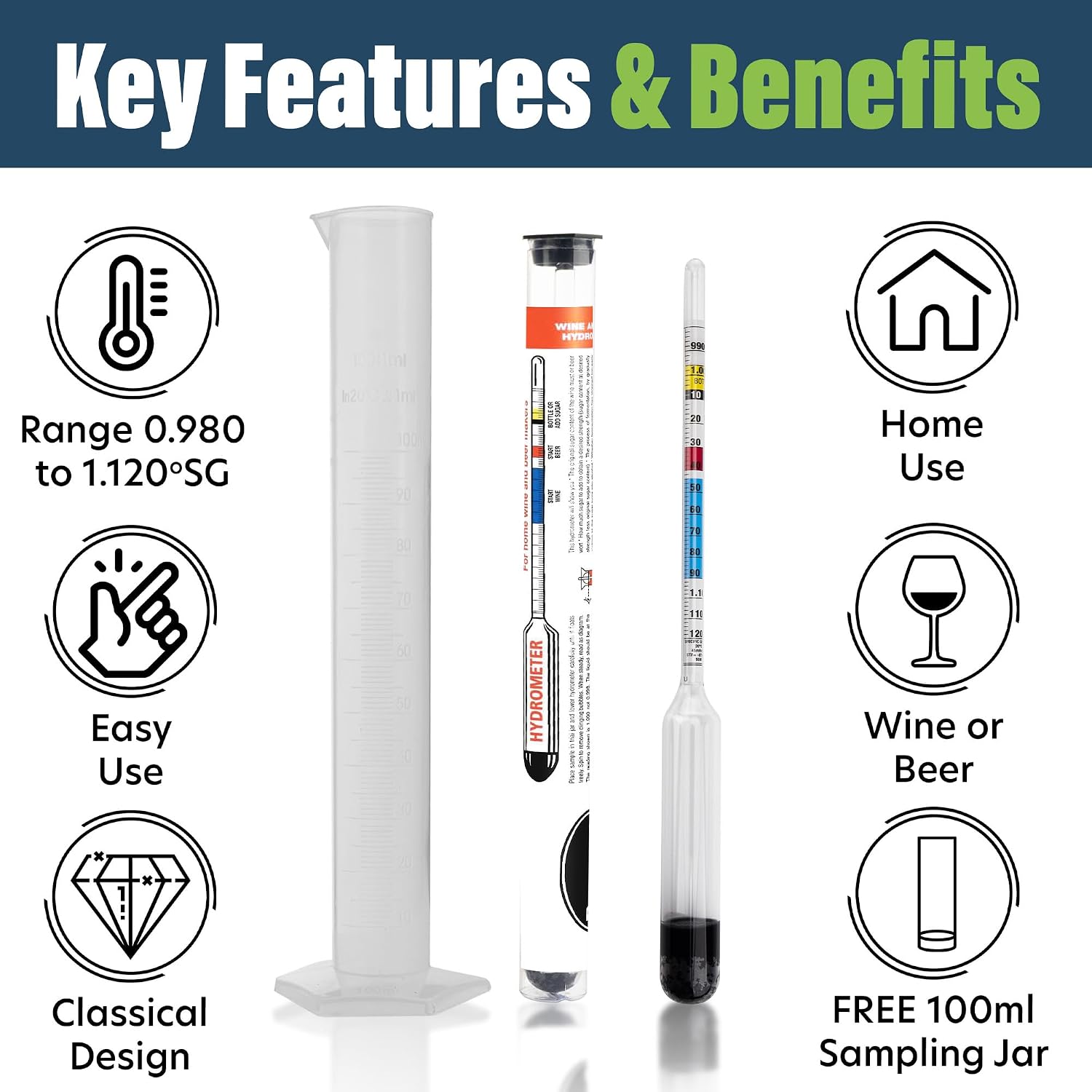
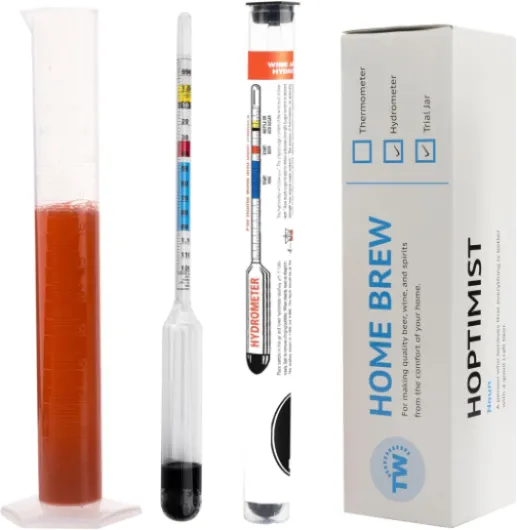
When you open the package, there’s not much mystery: you get one glass hydrometer and one transparent plastic trial jar of about 100 ml, plus the simple cardboard tube that protects the hydrometer. That’s it. No fancy manual, no complicated accessories. The tube itself doubles as storage, which is actually useful because this thing will break if you just throw it in a drawer. The hydrometer sits snugly in there, so you can put it away after each brew without stressing too much.
The hydrometer itself has clear markings: specific gravity scale, sugar content, and an estimated alcohol percentage scale. The print is easy enough to read under normal kitchen light, even when there’s condensation around. I didn’t have to squint or shine a torch on it, which is already better than some cheap ones I’ve seen. There are also suggested ranges printed for different types of drinks, which is quite handy when you’re just starting and you don’t know what numbers you should be aiming for.
The trial jar is a simple plastic cylinder with a flat base. It’s light, doesn’t take much space, and you can see through it clearly enough to read the hydrometer scale. It isn’t some lab-grade piece of gear, but it does the basic job: hold a small sample upright without tipping over. The 100 ml size is also decent because it means you’re not wasting half a bottle just to take a reading. For someone brewing small batches or kits, that matters more than you think.
Overall, the presentation is very no-nonsense: it looks like a basic tool, feels like a basic tool, and doesn’t pretend to be anything else. If you’re expecting a detailed user guide or premium packaging, you’ll be disappointed. But if you just want to open the box and start measuring your brew within five minutes, this kit is set up for exactly that. In my case, I read the markings, rinsed it, and was taking a gravity reading the same evening.
Does it actually give useful readings?
In practice, this hydrometer does what it’s supposed to do: it tells you how your fermentation is progressing and gives you a decent idea of the final alcohol content. I tested it across a few batches: two beer kits and one simple cider. Each time, I took an original gravity (OG) reading before pitching the yeast, then a few readings during fermentation, and finally a final gravity (FG) reading before bottling. The readings dropped in a logical way, and when the numbers stabilised over two days, fermentation was clearly done. No surprises, no weird jumps.
One thing I liked is that the scales are easy to understand, even if you’re new to brewing. You can look at the specific gravity, check the suggested range printed on the hydrometer, and see if your brew is roughly in the normal zone for that style. The alcohol percentage scale is a rough guide, but it’s good enough if you just want to know whether you’re around 4%, 5%, or 6% without doing calculations. On one of my beers, the hydrometer suggested about 5.5%, and judging from how that batch hit everyone after a couple of pints, I’d say it wasn’t far off.
Accuracy-wise, this is not lab equipment, but for home use it’s fine. I cross-checked one batch with an online ABV calculator using OG and FG readings from the same hydrometer, and the estimate matched the printed alcohol scale pretty closely. The most important part for me is that it’s consistent. If you take care to avoid bubbles, read at eye level, and keep temperature reasonably close to what the hydrometer is calibrated for, you get repeatable readings. That’s really all you need to know whether to leave the fermenter alone or start bottling.
On the downside, like any hydrometer, it’s a bit of a faff if you hate cleaning. You have to pull a sample, pour it into the jar, float the hydrometer, then clean everything afterwards. If you brew very small batches, giving up 100 ml of beer for a sample might feel painful. But that’s not really a flaw of this specific product, it’s just how hydrometers work. Overall, as a tool to stop guessing and start measuring, this one is effective and straightforward.
Pros
- Comes with a usable 100 ml plastic trial jar, so you can start measuring right away
- Clear, easy-to-read scales for specific gravity, sugar, and estimated ABV
- Good value for money for beginners and casual homebrewers
Cons
- Glass hydrometer is quite fragile and needs careful handling and storage
- Plastic trial jar feels cheap and may scratch or cloud over time
Conclusion
Editor's rating
If you’re brewing at home and still relying on bubbles in the airlock or “it looks done” to decide when to bottle, this Thermometer World hydrometer kit is a simple upgrade that actually changes how you brew. It gives you clear numbers for specific gravity and a rough alcohol percentage, and the included trial jar means you can start using it straight away without extra purchases. It’s not fancy, but it’s straightforward, readable, and practical enough for regular use.
This kit is well suited for beginners and casual homebrewers doing beer kits, cider, or basic wines. The printed ranges and ABV scale make it less intimidating, and you don’t need to be a chemistry nerd to understand what’s going on. If you want lab-grade precision or bulletproof materials, you’ll probably want to look at more expensive gear with thicker glass and maybe a glass jar. Also, if you’re very clumsy or brewing in tight, messy spaces, the fragile glass hydrometer might stress you out.
Overall, I’d say it’s a pretty solid, good-value tool: it does exactly what most homebrewers need, with no real gimmicks. It’s not perfect, the materials feel budget, and you do need to treat it carefully, but in day-to-day brewing it gives consistent, useful readings and helps you avoid obvious mistakes. For the price, I’m happy with it and would recommend it to anyone starting out or looking for a simple replacement.