
Summary
Editor's rating
Value for money: worth it if you care about readings more than looks
Design focused on range and readability, not looks
Glass everywhere: good for readings, fragile in real life
Storage box that actually protects the fragile stuff
Day-to-day performance: setup, reading, and cleanup
What you actually get in the box
How accurate is it really for home distilling?
Pros
- Three separate hydrometers with narrower ranges make readings clearer and easier to read accurately
- Complete kit with cylinder, thermometer, brush, cloth, and conversion chart in a protective storage box
- Accuracy is solid for home use, with consistent readings when temperature is taken into account
Cons
- All-glass construction is fragile and requires careful handling, especially the tall cylinder
- Not suitable for measuring sugary liqueurs or wines, only alcohol-water mixtures
- Cylinder is not weighted and can feel unstable on less-than-perfect surfaces

Specifications
View full product page →| Brand | Notimin |
A simple alcohol meter kit for people who actually use their still
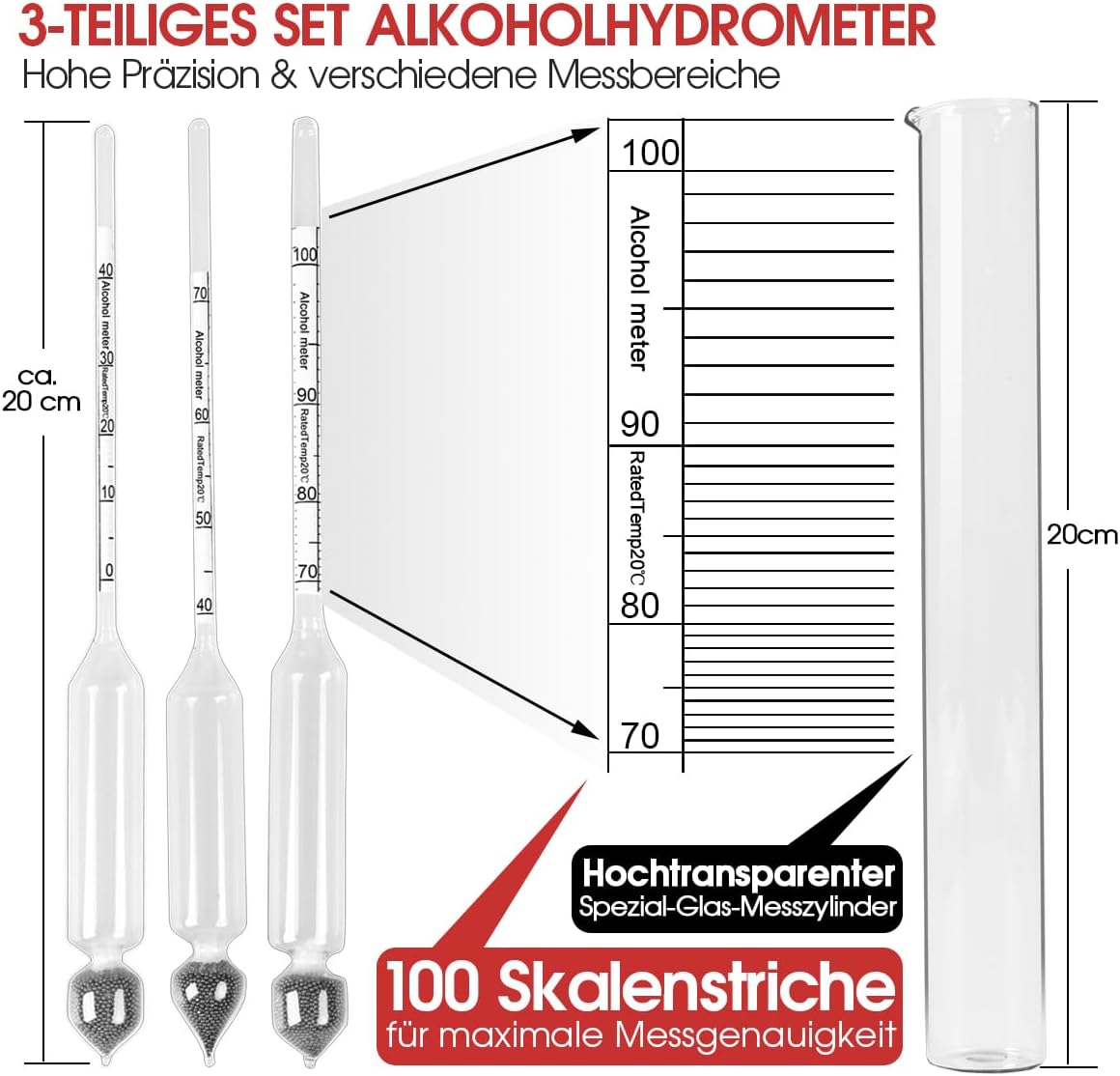
I picked up this Notimin 3-pack alcohol hydrometer set because I got tired of guessing the strength of my homemade spirits. I’d been using one single 0–100 hydrometer before, with a very cramped scale, and it was always a bit of a guessing game. This kit caught my eye because it splits the measurement into three ranges (0–40, 40–70, 70–100 vol%), and a lot of home distillers say that’s more practical if you care about accuracy.
Over a few weekends I used it on neutral spirit from my reflux still, some rougher pot-still runs, and a couple of liqueurs just to see what would happen. I’m not a lab tech, just a hobby guy who wants to know if the bottle on the shelf is closer to 35% or 45%. So my expectations were pretty simple: I wanted something that is reasonably accurate, readable without squinting, and not a total pain to store and clean.
Right away, the set felt more like a functional tool than a fancy gadget. The box is basic but practical, the glass looks standard borosilicate, and there’s a thermometer plus a printed temperature correction chart in German. Nothing fancy, but at least it’s all in one place. I’ve had hydrometers arrive in the past rattling around in flimsy cardboard, so the dedicated box here was already a small step up.
After a few uses, my overall impression is that this kit is pretty solid for home use. It’s not lab-grade, it’s not perfect, and there are a few annoyances I’ll get into. But if you just need to check spirit strength in a home bar or during distillation, it does the job reliably enough. You do have to understand its limits: it’s meant for clear spirits (water + alcohol), not sweet stuff, and you’ll break something if you treat it roughly. With that in mind, here’s how it actually performs in day-to-day use.
Value for money: worth it if you care about readings more than looks
In terms of value, I’d say this Notimin kit is good value for money if you’re into home distilling or you regularly dilute strong spirits. You’re getting three hydrometers, a cylinder, a thermometer, a cleaning brush, a cloth, and a conversion chart, all in a storage box. Buying all of that separately would probably cost more, and it wouldn’t be as neatly organised. The Amazon rating around 4.4/5 with a lot of reviews lines up with my experience: most people seem to think it does the job well enough.
Compared to cheaper single-range hydrometers, the big advantage here is accuracy in the range you actually use and better readability. If you only need a rough idea and don’t care if you’re at 40% or 45%, a single cheap hydrometer might be enough. But if you actually want to fine-tune your cuts or bottle at a certain strength, the split ranges make that much easier. That’s where the extra cost starts to make sense.
There are more expensive, lab-grade options out there with finer scales and maybe better calibration, but those usually don’t come with a cylinder or thermometer, and you pay a lot more for small accuracy gains that most home users won’t really use. For a hobbyist, this kit sits in a nice middle ground: more complete and more usable than the cheapest gear, without going into pro-level pricing.
The main risk to the value is breakage. If you’re clumsy or your setup is cramped, you might end up replacing a hydrometer or the cylinder at some point, which obviously hurts the value. But that’s true of any glass hydrometer. If you handle it with reasonable care and appreciate the fact that it’s glass, the price feels fair for what you get. Not a bargain of the century, but a solid, sensible purchase for regular home use.
Design focused on range and readability, not looks
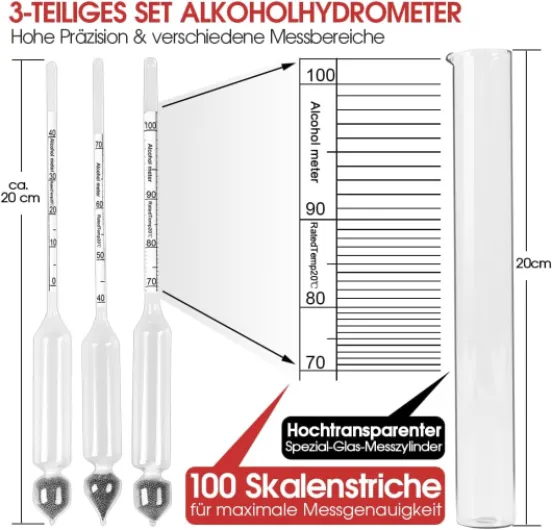
Design-wise, this set is very straightforward. Each hydrometer has a dedicated range, and that’s the main design choice that matters. Splitting 0–100 vol% into three tools means each one has a longer scale for its range. In practice, that makes it easier to read 1% steps and see small changes. On my older all-in-one hydrometer, 40% and 42% were almost on top of each other; here, they’re clearly separated. If you’re trying to cut a distillation run or dilute to a specific strength, that’s actually useful.
The markings on the paper scales are black on white, with decent contrast. I can read them in normal kitchen light without going under a lamp. No colour coding for the different ranges though, which would have been handy. You have to look at the scale or remember which is which. After a few uses you recognise them by length, but the first times you’ll probably double-check the scale before dropping one into your sample.
The cylinder is tall and narrow, which is what you want to minimise the sample volume. With my usual pour, I need around 150–200 ml to get the hydrometer floating properly without touching the bottom. The base of the cylinder is flat enough that it doesn’t wobble on the counter, but I still keep my hand near it when I’m working, because a small nudge could easily tip the whole thing. No rubber base or weight, so don’t use it on a cluttered or sloped surface.
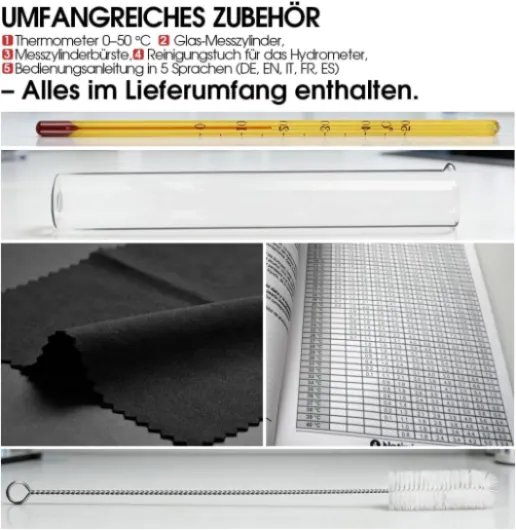
One design point I did like is the thermometer included. It’s simple glass, reads from 0–40 °C, and it’s just the right size to dip into your sample. That, combined with the chart, makes temperature correction easy enough. It’s not digital or fancy, but at least it’s in the box so you don’t have to dig around for another thermometer. Overall, the design is functional: no gimmicks, no pretty colours, just a kit that focuses on making readings readable and keeping the parts together in one box.
Glass everywhere: good for readings, fragile in real life
The whole kit is basically glass and a bit of plastic. The hydrometers are classic thin glass tubes with a weighted bulb at the bottom, filled with what looks like shot or sand. The cylinder is borosilicate glass, which handles temperature changes better than cheap glass, but it’s still glass: if you knock it over on a hard surface, chances are it’s done. This is normal for this type of tool, but you do need to treat it with some care.
In terms of finish, the glass edges on my set were smooth, no sharp bits or chips. The hydrometers looked straight, no bubbles in the glass that would make you nervous. I inspected the joins where the bulb meets the stem and didn’t see any visible cracks or weird glue marks. So from a basic quality point of view, the materials feel decent for the price, not fancy but not sloppy either. It matches what you expect from a mid-range home hydrometer kit.
The thermometer is also glass, with a simple printed scale. One Amazon reviewer mentioned receiving half a thermometer, so clearly quality control on shipping can fail sometimes. Mine arrived intact and has survived a few uses without any signs of stress. Still, this is not something you want to leave rolling around a metal sink or a cluttered workbench. I keep both the hydrometers and thermometer in the provided box when they’re not in use, and I only take out the exact piece I need.
The only plastic part really is inside the box (inserts and supports) plus the brush handle. The brush bristles are stiff enough to clean the cylinder without scratching it. The cloth included is basic fibre fabric, okay for wiping down the glass. Nothing premium, but it’s handy to have it ready in the kit. Overall, the materials are exactly what you’d expect: mostly glass because that’s how hydrometers work. Just be aware that if you’re clumsy or work in a cramped space, you might break something sooner or later.
Storage box that actually protects the fragile stuff
The packaging is more practical than pretty, and that’s fine for this kind of tool. The outer box is a simple cardboard sleeve, but inside you get a rigid fitted box that holds each piece in its own slot. The three hydrometers lie in foam-like channels, the cylinder has its space, and the thermometer slides into a cut-out. This makes a big difference if you plan to store the kit in a drawer or move it around occasionally.
Compared to some hydrometers I’ve bought in the past that came wrapped in a bit of bubble wrap, this is clearly safer. I’ve had one previous hydrometer arrive cracked straight out of the shipping box because it was rattling around too much. With the Notimin set, everything was snug, and nothing showed signs of impact. Of course, you can still break it if you throw the box around, but for normal handling it’s pretty secure.
The insert isn’t luxury quality, but it’s functional. The foam/plastic isn’t falling apart, and after several times taking things in and out, it still holds shape. The box closes well enough that dust doesn’t get in easily, which matters if you don’t use the kit every week. I like having everything in one place: hydrometers, cylinder, thermometer, chart, and cloth all together. It saves time when you’re in the middle of a distillation session and don’t want to hunt for missing pieces.
One thing to note: the chart is just a folded paper; if you’re not careful, it could get torn or stained. I ended up slipping it into a plastic sleeve and keeping it in the box lid. That’s a small DIY fix, but it helps. Overall, the packaging is practical and protective, not pretty. For a glass-heavy kit, that’s exactly what matters. It feels like they actually thought about storage instead of just throwing the tools into a random cardboard box.
Day-to-day performance: setup, reading, and cleanup
In practice, using this kit is pretty straightforward. I pour the sample into the cylinder, making sure I have enough volume so the hydrometer doesn’t touch the bottom. Then I gently lower in the right hydrometer for the expected range and let it settle. It takes maybe 10–20 seconds to stop bobbing and give a stable reading. The meniscus (the curved surface of the liquid) is easy enough to read if you look at eye level. After a few uses, the whole process becomes routine.
Performance-wise, the main thing I noticed is that the hydrometers are relatively consistent. I repeated the same sample a few times on different days and got the same reading within about 1% each time, as long as the temperature was similar. That’s enough for home blending and bottling. I also like that I don’t need to handle tiny, cramped scales; the wider range per hydrometer really does make a difference when you’re trying to be precise without going nuts.
Cleanup is simple but you have to be gentle. I rinse the cylinder and hydrometer with warm water right after use, then run the brush through the cylinder if anything is sticking. The cloth helps to dry the outside, but I mostly let everything air dry to avoid dropping it. It’s not a fast process if you’re doing many measurements in a row, but it’s manageable. Just don’t rush, or you’ll likely chip or crack something.
The only performance downside for me is the general fragility and the fact you need a reasonably flat, stable surface to work. If you’re distilling in a cramped shed or on a shaky table, you’ll be nervous every time you put the cylinder down. Also, because the cylinder isn’t weighted, a small bump can make it wobble. I ended up putting a rubber mat under it to reduce the risk. Apart from that, performance is steady: it’s not fast like a digital meter, but for traditional glass hydrometers, it does the job reliably.

What you actually get in the box
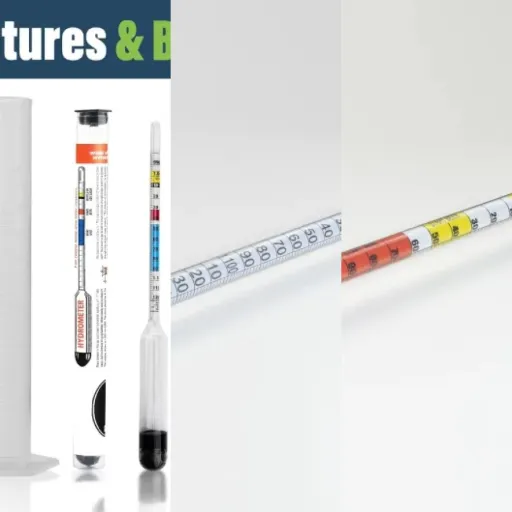
When you open the Notimin kit, you don’t get anything fancy, but you do get a complete set. Inside the box there are three hydrometers, each covering a different range: 0–40 vol%, 40–70 vol%, and 70–100 vol%. There’s also a glass measuring cylinder, a cleaning brush for the cylinder, a simple cloth, a thermometer, and a printed temperature/concentration conversion chart. The chart is in German, but the scale is numeric and easy enough to understand once you’ve looked at it twice.
The hydrometers themselves are standard glass floats with paper scales inside. The scale is clear, with 1% increments, and you can actually read the numbers without pressing your nose to the glass. Compared to my old single 0–100 hydrometer, the main difference is the longer, more spread-out scale in the range you’re actually using. So if you’re measuring around 40%, you use the 0–40 or 40–70 one and you’re not stuck guessing between tiny marks smashed together.
The glass cylinder is a basic borosilicate tube without graduations. It’s tall enough for the hydrometers to float freely, which is what matters. No volume markings means you can’t really use it for precise volume measuring, but for hydrometer readings that doesn’t matter much. The brush is just a small bottle brush that fits the cylinder, nothing special but useful to avoid crust and dust building up inside.
The storage box is probably the underrated part here. Everything has its slot, and it’s rigid enough that I don’t feel like the hydrometers are going to snap if I put the box in a drawer carefully. It’s still glass, so you can’t throw it around, but compared to hydrometers shipped loose in bubble wrap, this is a lot more reassuring. Overall, the presentation is very practical: it looks like a tool kit, not a gift box, which is fine by me.
How accurate is it really for home distilling?
On effectiveness, this kit does what it’s supposed to for home spirits. I tested it with distilled water at about 20 °C, and the 0–40 hydrometer sat right on 0 vol%, which is reassuring. Then I tried it with high-proof neutral spirit that I know is roughly 95% (from a previous lab-tested batch), and the 70–100 hydrometer floated just under the 100 mark, which is in line with what I’d expect. So we’re in the right ballpark, and for home use, that’s good enough.
In day-to-day use, the three separate ranges are actually useful. When I’m diluting a neutral spirit down to bottling strength, I use the 40–70 hydrometer and aim for around 40%. The scale is spread enough that I can comfortably hit within 1% without feeling like I’m guessing. With my old single 0–100 hydrometer, I always felt like I was somewhere between two lines. Here, reading is just less stressful. For cuts during distillation, the 70–100 one helps me track the high-proof output early in the run.
Where it’s less effective is anything with sugar. If you drop this into a sweet liqueur or something like sloe gin, the reading will be off because the hydrometer is only calibrated for alcohol + water. I tried it anyway on a homemade liqueur just out of curiosity, and the reading was clearly unrealistic. That’s not a fault of this particular kit; it’s just how alcohol hydrometers work. But if you’re hoping to measure final ABV on sugary drinks, this isn’t the right tool.
For temperature correction, the thermometer and chart are fine once you get used to them. I usually measure, check the temperature, then quickly consult the chart to adjust. It adds an extra step, but it’s manageable. People who want super precise lab-grade numbers might find this too rough, but for a home bar or hobby still, it’s accurate enough to know if you’re at 38% or 45%, which is what most of us actually need.
Pros
- Three separate hydrometers with narrower ranges make readings clearer and easier to read accurately
- Complete kit with cylinder, thermometer, brush, cloth, and conversion chart in a protective storage box
- Accuracy is solid for home use, with consistent readings when temperature is taken into account
Cons
- All-glass construction is fragile and requires careful handling, especially the tall cylinder
- Not suitable for measuring sugary liqueurs or wines, only alcohol-water mixtures
- Cylinder is not weighted and can feel unstable on less-than-perfect surfaces
Conclusion
Editor's rating
Overall, the Notimin 3 Pack Alcohol Hydrometer set is a practical, no-nonsense kit for people who actually use a still or regularly mix and dilute spirits at home. The three separate hydrometers with different ranges make readings clearer and easier to interpret than the usual single 0–100 tool. Accuracy is good enough for home use, especially if you pay attention to temperature and use the included thermometer and chart. The glass cylinder, brush, and storage box round it out into a complete package that you can keep organised in one place.
It’s not perfect. Everything is glass, so you need to be careful, and the cylinder isn’t weighted, so it’s a bit wobbly if your surface isn’t stable. The temperature chart is in German, which might annoy some users, and if you’re trying to measure sugary liqueurs, this is simply not the right type of instrument. But for clear spirits—vodka, neutral, brandy, distillates—it does exactly what you expect: it tells you the strength within about 1%, consistently.
If you’re a casual drinker who just buys bottles from the shop, this kit is overkill. If you’re a home distiller, someone who makes their own infusions, or you just like to know what’s really in your glass, it’s good value and a sensible upgrade from a single cheap hydrometer. There are fancier options out there, but for a reliable, straightforward tool set that gets the job done without fuss, this one is easy to recommend within its price range.