
Summary
Editor's rating
What it does to the final taste (and what it doesn’t)
Is it worth the money or just fancy sugar?
Bag, brick, or somewhere in between
Dextrose, maltodextrin and light dry malt: what that means in your glass
Fermentation behavior and overall brewing experience
What you actually get in the bag
Does it actually make your kit beer better?
Pros
- Noticeably better body and head retention compared to using plain sugar
- Very easy to use for beginners: just replace the sugar in any standard kit
- Helps reduce that thin, slightly cidery taste common in cheap kit brews
Cons
- More expensive per batch than buying dextrose, maltodextrin and DME separately
- Flavor improvement is modest compared to using 100% light dry malt extract
- Occasional reports of the contents arriving as a hard brick that needs breaking up

Specifications
View full product page →| Brand | Coopers |
A cheap way to make kit beer suck less
I picked up the Coopers DIY Brew Enhancer 2 because I was tired of that thin, cidery taste you often get when you just dump a kilo of table sugar into a beer kit. I’ve brewed a bunch of basic kits over the years, mostly with sugar or dextrose, and the result is drinkable but often feels a bit like alcoholic soda. So I wanted to see if this bag actually makes a noticeable difference, or if it’s just a fancy way of selling sugar at a higher price.
I’ve now used Brew Enhancer 2 on two different 23L kits: one standard lager-style kit and one pale ale kit (both non-Coopers). In both cases I swapped my usual 1kg of sugar/dextrose for one full bag of this stuff, followed the same fermentation temps, same yeast, same bottling routine. That way I could really see if the body, mouthfeel and head retention were any better, or if it was just marketing talk.
In practice, the main thing I was looking for was: does the beer feel less watery, and does it avoid that cheap homebrew “cider” edge? I wasn’t expecting craft brewery quality in a tin, just something closer to a proper session beer I’d actually be happy to share with friends. I also paid attention to fermentation speed, how the yeast behaved, and whether it caused any weird off flavors.
Overall, it does what it says in a basic way: the beer feels fuller and less harsh than with plain sugar. It’s not magic powder, but for a kit brewer who doesn’t want to think too hard, it’s a simple step up. There are probably cheaper DIY ways to get the same result, but if you want plug-and-play convenience, this isn’t a bad option at all.
What it does to the final taste (and what it doesn’t)
Flavor-wise, the key thing is: this doesn’t add strong new flavors, it mainly fixes problems. With sugar-only brews, you often get that thin, slightly cidery finish, especially with cheap kits and warm fermentations. With Brew Enhancer 2, the beer I got was a bit rounder and less sharp. The finish was cleaner, and there was a bit more malt presence, but it’s still very much in the basic kit beer territory.
On the lager kit, the taste was pretty neutral, which is what you want for that style. The enhancer didn’t introduce any weird sweetness or odd flavors. If anything, it made the beer taste more balanced. The bitterness from the kit’s hopped extract didn’t feel as harsh, likely because the extra body and malt character helped support it. After three to four weeks in the bottle, the beer was smooth enough that I could easily drink a few without thinking, "yeah, that’s homebrew." It still didn’t have the depth you get from all-malt recipes, but for a simple kit, I was fine with it.
On the pale ale kit, the difference was more noticeable. The hops came through a bit nicer because the beer wasn’t as thin, and the light dry malt added just enough grainy character to keep it from tasting hollow. The bitterness felt more integrated instead of sitting on top of a sugar wash. Still, if you’re expecting complex malt layers, you’ll be disappointed. This is an upgrade, not a miracle. The basic character of the kit dominates; the enhancer just makes it less rough.
If you’re sensitive to that "homebrew twang," this product helps reduce it but doesn’t completely erase it. Temperature control, good yeast, and giving the beer enough time in the bottle matter just as much. I’d say the taste improvement is real but modest. For someone moving from sugar to this, you’ll probably say, "yeah, that’s better." For someone already using full malt extract or grain, you’ll see it as a watered-down compromise. It does its job, but it won’t suddenly turn a budget kit into something you’d pay pub prices for.
Is it worth the money or just fancy sugar?
On the value side, this is where opinions split a bit. If you look at it strictly as ingredients, you’re basically paying for a pre-mixed combo of cheap components: dextrose, maltodextrin, and light dry malt. Buying those separately in bulk and mixing your own could be cheaper per batch, especially if you brew regularly. One Amazon reviewer even called it a marketing ploy and moved on to all-malt kits and Bulldog brews, which is a fair take if you’re already going down the more serious brewing route.
However, if you’re the typical kit brewer who just wants something quick from Amazon or the local shop, the value is not bad. The price usually sits a bit above a bag of sugar but below or around a full kilo of pure DME, depending on where you shop. For that extra few dollars compared to sugar, you get noticeable improvements in body and head retention and a small bump in flavor. For an occasional brewer who does a few kits a year, that’s a reasonable trade-off. You’re paying for convenience and simplicity, not for top-tier ingredients.
Where it makes less sense is if you already understand basic brewing and want to push your beer further. In that case, a full kilo of light dry malt or moving to two-can all-malt kits gives a bigger quality jump for not that much more money per pint. Once you’ve tasted a good all-malt kit, you’ll probably only use Brew Enhancer 2 when you’re being lazy or when it’s on sale. It’s a step up from sugar, but not the final destination.
So, value for money is decent but not outstanding. It’s good for beginners and casual brewers who don’t want to mess with multiple ingredients. If you’re on a tight budget and don’t mind a slightly thinner beer, sticking with sugar is cheaper. If you care more about flavor and don’t mind spending a bit more or doing a bit more work, going all-malt is the better long-term deal. This sits comfortably in the middle: convenient, reasonably priced, but not the best bang for your buck if you’re willing to learn a bit more.
Bag, brick, or somewhere in between
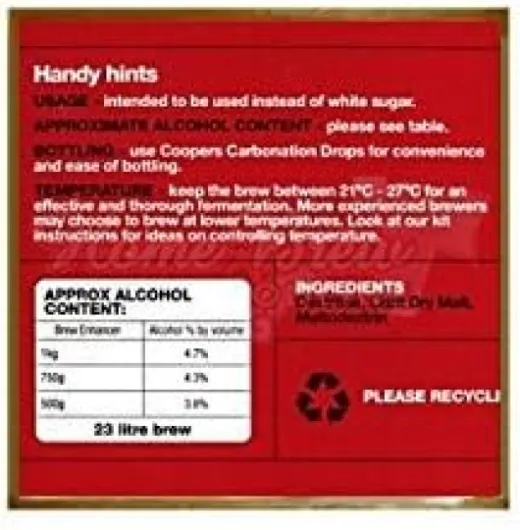
The packaging is pretty straightforward: a plastic pouch with the Coopers logo, ingredient list, and simple instructions. No scoop, no resealable zip, nothing fancy. You’re clearly meant to use the whole bag in one go for a standard 23L batch, so the lack of reseal isn’t a big deal unless you’re doing smaller experimental batches. The bag itself feels sturdy enough, not super thin, and it survived shipping without tearing or leaking.
One thing worth mentioning is that some buyers have reported the contents arriving as a solid brick. That’s likely due to humidity or storage conditions during shipping. My bag was fine – the powder was loose and easy to pour. But if you do get a brick, it’s more annoying than catastrophic. You can just crush it by hand or with a rolling pin before pouring. It still dissolves in hot water; it just takes a bit more effort. For a product that’s basically sugar and malt powder, this kind of clumping is pretty normal if it’s stored in a damp place.
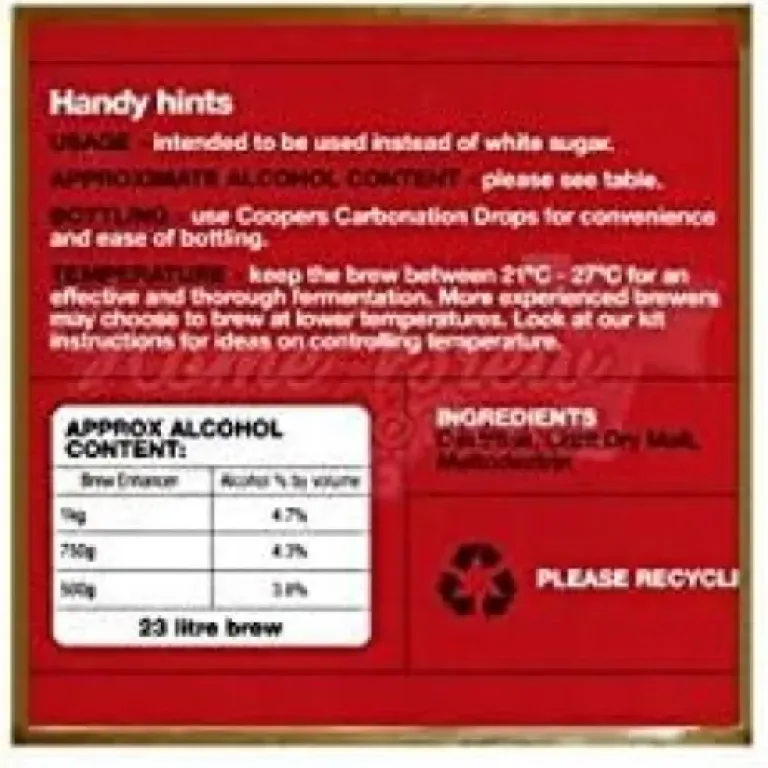
The print on the bag is clear enough: you get the basic composition (dextrose, maltodextrin, light dry malt), a short usage explanation, and that’s about it. No detailed brewing tips, no troubleshooting guide. For beginners, it might have been nice to see a quick note about fermentation temperatures or conditioning times, but most people buying this will already have a kit with instructions anyway. The bag doesn’t take up much space, and you can easily stack a few if you’re planning multiple brews.
Overall, packaging is functional but nothing special. It protects the product, tells you what’s inside, and gets out of the way. The only real downside is the occasional brick issue mentioned in reviews, but that’s more of an annoyance than a deal-breaker. If you want something fancier or more reusable, you’re in the wrong hobby segment – this is clearly aimed at people who just want to open, pour, and brew without thinking too much about the bag it came in.
Dextrose, maltodextrin and light dry malt: what that means in your glass
The core of this product is the ingredient balance. Coopers Brew Enhancer 2 combines dextrose (fully fermentable), maltodextrin (not fermentable), and light dry malt (fermentable and flavorful). In practice, that mix is supposed to hit three goals: give the yeast an easy food source (dextrose), keep the beer from feeling watery (maltodextrin), and add some actual malt character (LDM). On paper, it’s a pretty logical combo for someone stepping up from straight sugar.
When I brewed with it, the dextrose did exactly what you’d expect: fermentation kicked off quickly, airlock activity started within about 12 hours at 20–21°C, and the gravity dropped down nicely over a week. The yeast clearly liked it, similar to when I use pure dextrose. I didn’t get any extra off smells beyond the usual "young beer" whiff. Once the beer was done and conditioned for 3–4 weeks, that classic homebrew “cider” edge was noticeably lower compared to my old sugar-based batches, but not 100% gone. So the claim about avoiding cidery flavors is half-true: it helps, but it doesn’t magically fix a cheap kit or poor temperature control.
The maltodextrin part is where you actually feel the difference. Because it doesn’t ferment, it stays in the beer and gives a thicker mouthfeel. You don’t taste it as a flavor, it’s more of a texture thing: the beer feels less like fizzy water with alcohol and more like an actual pint with some weight. The downside is, as one Amazon reviewer pointed out, those grams don’t turn into alcohol. If you’re chasing maximum ABV from a cheap kit, this mix isn’t the most efficient way to do it. Personally, I’d rather have a slightly lower ABV beer that doesn’t feel thin.
The light dry malt is the part I wish there was more of. You do get a bit more malt taste and better color compared to only using sugar, especially in pale ales and ambers. But if you’ve ever brewed with 1kg of pure DME, you’ll notice this mix doesn’t bring the same depth. It’s more like a mild upgrade than a big jump. That said, for someone who doesn’t want to measure or store big bags of DME and maltodextrin separately, this all-in-one approach is convenient and hard to mess up.
Fermentation behavior and overall brewing experience
From a performance point of view, Brew Enhancer 2 behaves very predictably. When I brewed with it, it dissolved fairly easily in hot water with the kit’s malt extract. I did notice you need to stir a bit more than with plain sugar to avoid small clumps, but nothing dramatic. Some Amazon reviews mention getting a brick-hard bag; mine was free-flowing, so it probably depends on storage and humidity. If you get a solid block, just break it up by hand before adding it to the fermenter and it should still be fine.
Fermentation kicked off quickly in both my tests. The dextrose gives the yeast an easy start, so the lag time was short, similar to using pure brewing sugar. I had active airlock bubbling within 12 hours at about 20–21°C, and fermentation was mostly done in 5–6 days, with a stable final gravity after about a week. The presence of maltodextrin doesn’t affect fermentation speed since it doesn’t ferment; it just stays in the beer to add body. I didn’t notice any extra krausen mess or blow-off issues compared to my usual sugar or DME batches.
In terms of clarity, the beers cleared up as expected after a couple of weeks in the bottle. The maltodextrin doesn’t seem to cause haze problems at normal kit levels. Carbonation was normal using standard priming sugar in bottles. Head retention was slightly better, which matches the product’s claims. No weird gushers, no stuck fermentations, nothing unusual. It’s basically as easy to use as sugar but gives a nicer end result.
Overall, performance is solid and beginner-friendly. If you can brew a kit with sugar, you can brew it with this without changing anything in your routine. More advanced brewers might find it a bit "dumbed down" since you can mix your own ratios of dextrose, maltodextrin, and DME for cheaper, but for someone who just wants to rip open one bag and pour, it’s convenient and reliable. It does exactly what a kit enhancer should do: make the process no more complicated while nudging the beer quality up a notch.
What you actually get in the bag
The product is basically a premixed bag of three things: dextrose, maltodextrin, and light dry malt (LDM). Coopers doesn’t hide that, and if you dig around homebrew forums, people more or less confirm the ballpark: a big chunk of fermentable sugar (dextrose), some non-fermentable stuff for body (maltodextrin), and a bit of actual malt to give you some proper beer character. So you’re not buying anything fancy here, you’re just paying for a balanced mix that saves you the hassle of buying three separate ingredients.
The bag I got was around 1kg (label says 940 g, which matches the spec). It’s a simple plastic pouch with Coopers branding, basic instructions on the back, and that’s it. No overcomplicated charts or brewing science lessons. It literally tells you to replace the sugar in your kit recipe with this bag, dissolve it in hot water with the malt extract, top up to volume, pitch yeast. If you’ve done any kit brew before, you’ll be up and running in a couple of minutes.
Compared to buying pure dry malt extract (DME) on its own, this is more of a compromise product. DME alone gives you better malt flavor and less sugar bite, but it can be pricier and isn’t always in stock in supermarkets or general stores. Brew Enhancer 2 sits in the middle: easier to find with Coopers kits, still familiar for beginners, and the instructions are written in the same simple style as the kits. It’s clearly aimed at people who don’t want to tweak recipes, they just want the kit to taste a bit more like real beer.
From a presentation point of view, it’s very no-nonsense. What you see is what you get: a generic white-ish powder mix in a bag. No scoops, no fancy resealable top, no extras. If you’re used to more advanced homebrew ingredients, it feels basic. But for kit brewers, that’s probably fine. You open it, pour it, and you’re done.
Does it actually make your kit beer better?
In terms of effectiveness, I tested Brew Enhancer 2 the simple way: same kit brand, same fermentation temperature, same yeast, one batch with 1kg plain sugar and one batch with one bag of this stuff. The differences were noticeable but not dramatic. The beer with Brew Enhancer 2 had better body, a creamier head that stuck around a bit longer, and a smoother overall taste. The sugar-only batch felt sharper and more like alcoholic soda water, especially in the first few weeks of conditioning.
On my lager-style kit, the enhancer did a decent job of taking the edge off that typical kit twang. After four weeks in the bottle, the beer was still clearly a kit beer, but it was more drinkable and less harsh than the sugar version. The head retention was the main visible improvement: the foam didn’t just vanish after two sips. Mouthfeel was also better; it didn’t feel as watery. If you’re used to pub lagers, this still won’t fool you, but it’s closer to something you wouldn’t be embarrassed to serve at a BBQ.
On the pale ale kit, the difference was a bit more obvious. The malt character was slightly stronger and the bitterness felt more balanced because there was actually some malt backbone behind it. Again, this is not suddenly turning a 10-dollar kit into craft beer, but it pushes it one notch up. I’d say compared to plain sugar, this mix gives you a clear, practical improvement, especially if you care about body and head retention more than chasing high alcohol content.
Where it falls short is when you compare it to using 1kg of pure light dry malt extract. In that case, the DME-only beer had richer malt taste and a more "proper" beer profile. Brew Enhancer 2 sits in the middle: better than sugar, not as good as full DME, but easier and usually cheaper than going full malt every time. For beginners or lazy brewers, it gets the job done and makes your first few batches less disappointing. If you’re already fiddling with hops and specialty grains, you’ll probably outgrow this pretty fast.
Pros
- Noticeably better body and head retention compared to using plain sugar
- Very easy to use for beginners: just replace the sugar in any standard kit
- Helps reduce that thin, slightly cidery taste common in cheap kit brews
Cons
- More expensive per batch than buying dextrose, maltodextrin and DME separately
- Flavor improvement is modest compared to using 100% light dry malt extract
- Occasional reports of the contents arriving as a hard brick that needs breaking up
Conclusion
Editor's rating
Coopers DIY Brew Enhancer 2 is basically a simple upgrade for kit brewers still using plain sugar. It gives you better body, nicer head retention, and a slightly cleaner, more malt-forward taste. It doesn’t turn a budget kit into craft beer, but it does make those first few batches more drinkable and less obviously “homebrew.” Fermentation is straightforward, the yeast loves it, and you don’t need to change your brewing routine at all – you just swap sugar for this bag.
Who is it for? Mainly beginners and casual brewers who want an easy way to make their kit beer taste a bit closer to what they’d buy in a shop, without learning about malt ratios or buying multiple ingredients. If you’re already into all-malt kits, partial mash, or full-grain brewing, this will feel like a half-measure and not great value. In that case, a full kilo of light dry malt or a two-can all-malt kit is a better move. But if you’re still at the stage of “tin of goo + one bag of something,” this is a decent step up from sugar with minimal effort.
In short: pretty solid, convenient, and honest about what it does. It improves kit beer enough to notice, but it’s not magic powder. Good if you want better results with zero extra thinking; less convincing if you’re ready to take your brewing a bit more seriously or squeeze maximum value from each batch.