
Summary
Editor's rating
Is it worth the money compared to plain sugar?
Basic bag that does the job (but could be smarter)
Just sugar and glucose – nothing fancy, but that’s the point
Real-world use: speed, consistency, and small annoyances
What you actually get in the bag
Do they actually carbonate properly?
Pros
- Very easy to use: clear dosing (2 drops per 500 ml) with no weighing or calculations
- Consistent, reliable carbonation with clean flavour and no extra sediment
- Saves time and reduces hassle on bottling day, especially for small or occasional batches
Cons
- More expensive per batch than using loose brewing sugar or table sugar
- Fixed tablet size limits fine control over carbonation levels for different beer styles
- Non-resealable bag; tablets need transferring to another container to store properly after opening

Specifications
View full product page →| Brand | Muntons |
Carbonation for lazy bottlers (like me)
I picked up these Muntons Carbonation Drops for one simple reason: I’m lazy when it comes to bottling. Measuring out priming sugar for every batch, dissolving it, sanitising extra gear… I’ll be honest, it’s the part of homebrewing I like the least. So when I saw these sugar tablets that promise to handle carbonation just by dropping them into the bottle, I figured they were worth a try, even if they cost a bit more than a bag of plain sugar.
I used them on two small batches: a basic pale ale (about 18 litres) and a sweet cider kit (around 10 litres). That gave me a decent mix of 500 ml bottles and a few 330 ml ones to see how consistent the carbonation was. I followed the instructions: 2 drops per 500 ml bottle, 1 per 330 ml bottle, nothing fancy. No extra sugar, no tweaks.
Over the next couple of weeks, I stored the bottles at room temperature, around 20–21°C, and checked a few test bottles at 1 week, 2 weeks and 3 weeks. I wanted to see if they carbonated as well as my usual bulk-priming with brewing sugar. I also paid attention to flavour: does it taste any different from using normal sugar or spray malt, or is it basically the same thing in tablet form?
Overall, they did what they’re supposed to do: they carbonate the beer and cider without drama. But they’re not magic, and they’re definitely not the cheapest route. If you like convenience and don’t mind paying a bit extra per batch, they make sense. If you’re brewing a lot or brewing on a tight budget, old-school sugar measuring is still the way to go.
Is it worth the money compared to plain sugar?
On value, this really comes down to what you’re paying for: convenience, not raw ingredients. If you compare the price per gram to a bag of brewing sugar or even basic table sugar, these drops are obviously more expensive. You’re basically buying pre-measured doses and the time saved from not doing priming calculations or mixing a sugar solution. For one or two batches here and there, that trade-off can feel reasonable. If you’re brewing all the time, it starts to look pricey.
For my 18-litre pale ale batch, the whole bag was almost gone using the standard 2-drops-per-500-ml rule. With bulk priming, I’d usually use pennies’ worth of sugar. Here, I used a product that costs several times more for the same end result: carbonated beer. The difference isn’t huge in absolute terms, but if you’re brewing every month, it adds up over a year. So I’d say the value is decent but not spectacular if you brew occasionally, and weaker if you’re a heavy user.
Where the value makes more sense is for beginners or people who hate the bottling math. If you’re just starting out and you’re worried about over-priming and creating bottle bombs, paying a bit more for a simple “drop two in and you’re safe” solution isn’t crazy. It removes one variable from the process and lets you focus on not messing up fermentation. The peace of mind and time saved might be worth the extra cost for that group.
Personally, I’d use these again for small experimental batches or when I’m short on time and can’t be bothered with weighing sugar. For my regular brewing, I’ll stick to bulk priming because it’s cheaper and gives me more control. So in terms of value, I’d rate these as good for convenience, average for cost-efficiency. If you know what you’re paying for and that lines up with your priorities, you’ll probably be fine with the price. If you’re very budget-focused, you’ll see them as a bit of a luxury shortcut.
Basic bag that does the job (but could be smarter)
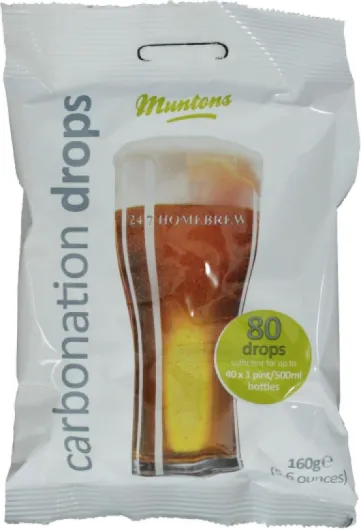
The packaging is nothing fancy: a simple plastic bag with a printed label. It’s light, compact, and it arrived intact with no crushed tablets inside, so from a practical standpoint it’s fine. The bag is easy to open with scissors, and the tablets pour out without sticking together when the pack is fresh. For storage before opening, no issues at all. It’s small enough to tuck into a brewing box or cupboard without taking up much space.
Where it falls short is after you open it. There’s no resealable strip, no zip lock, nothing. Once you cut it open, you’re left with a floppy plastic bag that doesn’t close properly. For a product that a lot of people will use over several bottling sessions, that’s not ideal. Sugar and glucose attract moisture, so if you leave the bag half-open in a humid environment, the tablets can start to clump or soften. I solved this by tipping them into a clean, dry jar with a lid, but that’s extra faff that could have been avoided with a basic zip seal.
The information on the pack is clear enough: dosage instructions, ingredients, and basic branding. There’s no detailed carbonation chart or anything like that, but given the target audience, it’s probably fine. It’s clearly written for people who want “2 drops per 500 ml and forget about it”, not for those who are obsessing over grams per litre and CO₂ volumes.
From an environmental angle, it’s just another plastic bag that will end up in the bin. Not great, not horrific, just standard. If they ever moved to a small cardboard box with a paper liner or a resealable pouch, that would feel a bit more thought-through. As it stands, the packaging is functional but a bit half-baked for repeat use. It protects the product, but you’ll probably want your own container if you don’t use the whole bag in one go.
Just sugar and glucose – nothing fancy, but that’s the point
The ingredient list on these Muntons Carbonation Drops is as short as it gets: sugar and glucose. That’s it. No artificial sweeteners, no preservatives, no extra flavourings. For brewing, that’s actually what I want. You’re giving the leftover yeast a clean, fermentable sugar source so it can produce CO₂ in the bottle. In that sense, these are basically compressed brewing sugar, shaped into tablets for dosing.
Compared to using household granulated sugar, the main difference is how they behave in the bottle, not what they are. Household sugar can sometimes leave a faint taste if you use a lot or if the beer is young. With these drops, I didn’t pick up any off flavours that I could blame on the tablets themselves. The pale ale tasted like any other batch I’d primed properly, and the cider stayed clean and crisp. If there’s a difference versus plain sugar, it’s very minor and you’d probably only notice if you’re very picky.
One thing I like is that they dissolve reasonably fast. I added them to the bottles first, then siphoned the beer on top. You can see a bit of fizz as they start to dissolve, but nothing violent. After a couple of minutes, there’s no visible tablet left. I didn’t get any hard sugar chunks at the bottom of the bottles when I opened them later, which was a concern I had before trying them. So from a practical point of view, the formulation works fine.
If you’re the type who likes to tweak carbonation levels per style (e.g. lower for English ales, higher for wheat beers), the simplicity of the ingredients doesn’t change the main limitation: each tablet is a fixed dose. You can’t easily do 1.5 tablets. You’re stuck with 1 or 2 unless you start chopping them, which is messy. So the ingredients are clean and functional, but the format still pushes you toward a one-size-fits-most approach to carbonation.
Real-world use: speed, consistency, and small annoyances
In actual use on bottling day, these drops are mainly about saving time and hassle. Normally, I’d boil water, dissolve a measured amount of sugar, cool it, then gently mix it into the bottling bucket. With the Muntons drops, I skipped all of that. I just sanitised the bottles, tossed in the tablets, and filled them. On a 20-litre batch, that probably saved me 20–30 minutes and one extra thing to clean, which, at the end of a brewing session, is pretty welcome.
In terms of speed, it’s basically as quick as grabbing a tablet, dropping it in, and moving on. The only small slowdown is making sure you don’t miscount. I caught myself a couple of times wondering, “Did I put one or two in this bottle?” so you still need to pay attention. But compared to weighing sugar for each bottle, it’s way faster and less messy. No sugar spilling on the counter, no sticky spoons.
The main performance compromise is fine control. If you want different carbonation levels for different styles, these drops are a blunt tool. You can’t easily do 1.3 tablets or 1.7 tablets. Chopping them in half is possible but awkward, and you end up with crumbs and inconsistent sizes. For general kits and casual brewing, it’s fine. For more serious recipes where you care about exact CO₂ volumes, I’d still go back to weighing sugar or using a priming calculator.
Another performance point: storage and humidity. The bag isn’t airtight once opened, so the tablets can pick up moisture if you leave them in a damp place. I noticed a slight softening of a few tablets after a couple of weeks in a warm kitchen drawer. They still worked, but they were a bit tacky. Moving them into a sealed jar fixed that. So they perform well, but you need to treat them like any other sugar product: keep them dry, and they’ll behave as expected.
What you actually get in the bag
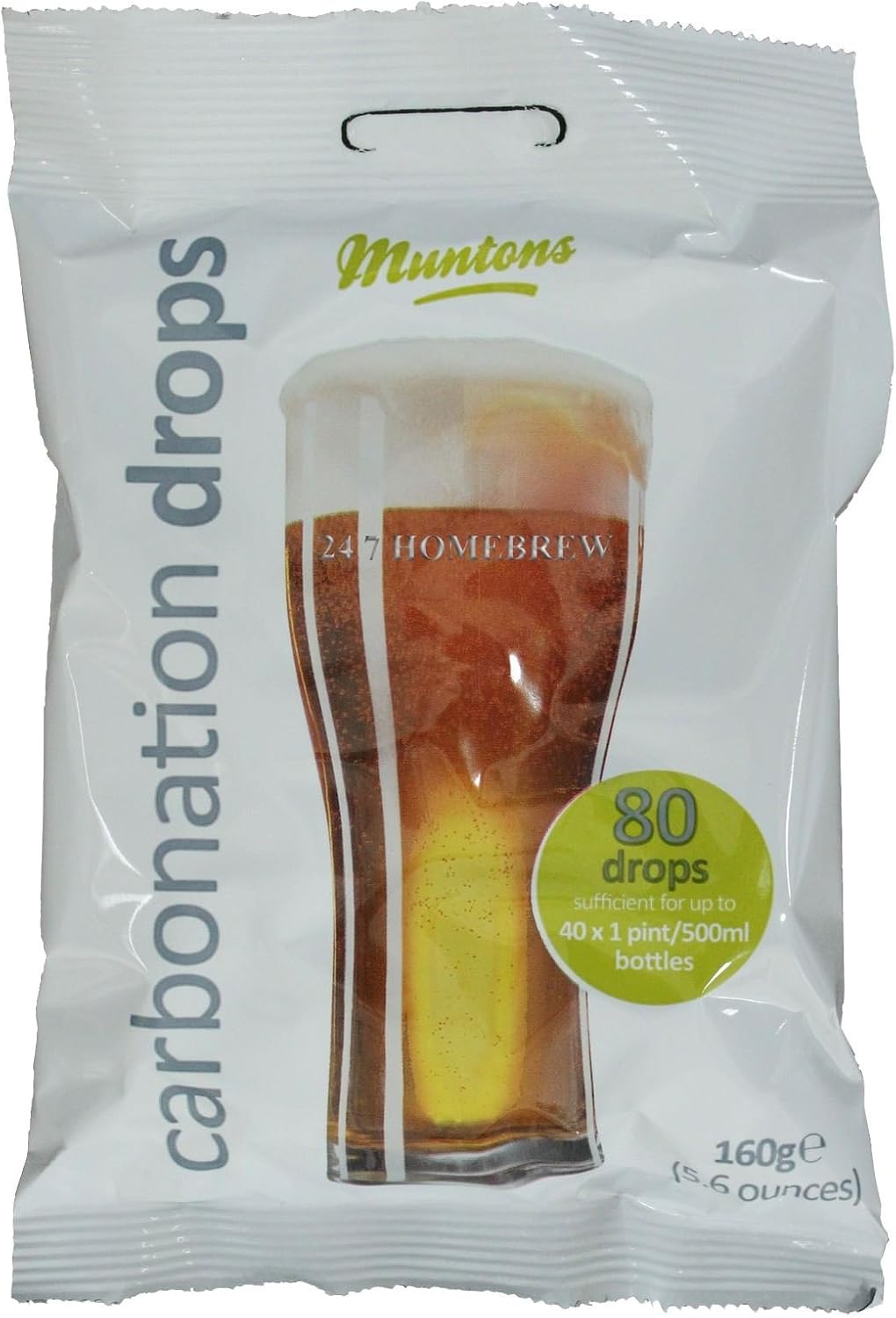
The product is very straightforward: you get one 160 g bag with roughly 80 white sugar tablets inside. No fancy tin, no dispenser, just a plastic bag with a label. The tablets are about the size of a large pea, maybe a bit bigger, and they’re slightly rounded. They’re not individually wrapped, so once you open the bag, you’ll probably want to seal it with a clip or move them into a jar to keep them dry and away from dust.
The instructions on the pack are clear: 2 drops for a 1 pint / 500 ml bottle, 1 drop for smaller bottles. That’s it. No carbonation tables, no messing with grams per litre. It’s aimed at the casual homebrewer who just wants something simple. The ingredients list is short and honest: sugar and glucose. No weird additives, no flavourings. So in terms of what you’re putting in your beer, it’s basically just brewing sugar in tablet form.
In practice, I found the count per bag to be roughly accurate. My bag had 81 tablets, so close enough to the promised 80. For a typical 20-litre batch bottled into 500 ml bottles, you’re looking at around 40 bottles, which means 80 drops. So one bag conveniently covers about one standard batch if you follow the 2-drops-per-500-ml rule. That’s probably not an accident.
To sum it up, the presentation is basic but practical. It’s clearly aimed at function, not looks. If you like things that look nice on a shelf, this won’t impress you. If you just want a bag of sugar tablets that you can toss into bottles without thinking too hard, it fits the bill. No surprises, no hidden nonsense, just a simple product that’s fairly transparent about what it is.

Do they actually carbonate properly?
On effectiveness, I’d say these drops are pretty solid, with a few quirks you should know about. I used them exactly as instructed: 2 drops in each 500 ml beer bottle and 1 drop in each 330 ml bottle. After two weeks at room temperature, the pale ale had a firm hiss when opened and a decent head. It wasn’t over the top, but it was in the right range for a standard ale. The cider, on the other hand, felt a bit more lively, with a sharper fizz – closer to what you’d expect from a sparkling cider.
Consistency between bottles was good. I didn’t get any totally flat bottles or any unexpected gushers, which is often what people worry about when they change priming methods. The carbonation level was slightly higher than what I usually get when I bulk-prime with brewing sugar, but not dramatically so. If you like your beers a bit on the fizzy side, you’ll probably be happy. If you prefer more gentle carbonation for some styles (like stouts or English bitters), 2 drops per 500 ml might be a bit much, and 1 drop might be slightly low. That’s the downside of fixed doses.
One nice thing: there was no extra sediment compared to my normal method. The yeast cake at the bottom of the bottle looked about the same. No weird sugar sludge, no undissolved chunks. Pouring carefully, I could still get a clear glass of beer with just a thin layer of yeast left behind, so the drops don’t seem to mess with clarity or create extra gunk.
In practice, the drops do what they’re meant to do: they carbonate your beer and cider in a predictable way. They don’t fix fermentation mistakes, they don’t turn a bad beer into a good one, and they don’t give you ultra-precise control like weighing sugar by the gram. But if your main goal is to avoid faffing around with priming sugar calculations and still end up with reliably fizzy bottles, they get the job done without drama.
Pros
- Very easy to use: clear dosing (2 drops per 500 ml) with no weighing or calculations
- Consistent, reliable carbonation with clean flavour and no extra sediment
- Saves time and reduces hassle on bottling day, especially for small or occasional batches
Cons
- More expensive per batch than using loose brewing sugar or table sugar
- Fixed tablet size limits fine control over carbonation levels for different beer styles
- Non-resealable bag; tablets need transferring to another container to store properly after opening
Conclusion
Editor's rating
Muntons Carbonation Drops are basically the “easy mode” for bottle priming. They’re just sugar and glucose pressed into tablets, and they do what they claim: drop them into your bottles and you get consistent, reliable carbonation for beer and cider. In my tests, both the pale ale and cider turned out well-carbonated, with no flat bottles, no gushers, and no strange flavours. The drops dissolve cleanly, don’t add extra sediment, and take a chunk of hassle out of bottling day.
They’re not perfect, though. You pay noticeably more per batch compared to using loose sugar, and you lose some control over fine-tuning carbonation levels. The packaging is also basic, with no resealable closure, so you’ll want your own container if you don’t use the whole bag at once. For heavy brewers or people who like to dial in carbonation by style, standard priming methods still make more sense.
I’d say these drops are best for casual homebrewers, beginners, or anyone who hates the priming step and is happy to pay a bit extra for simplicity. If you mostly brew kits and just want fizzy beer without thinking too hard, they’re a pretty solid option. If you’re brewing often, on a budget, or chasing precise carbonation for different styles, you’ll probably see them as a handy backup rather than your main solution.