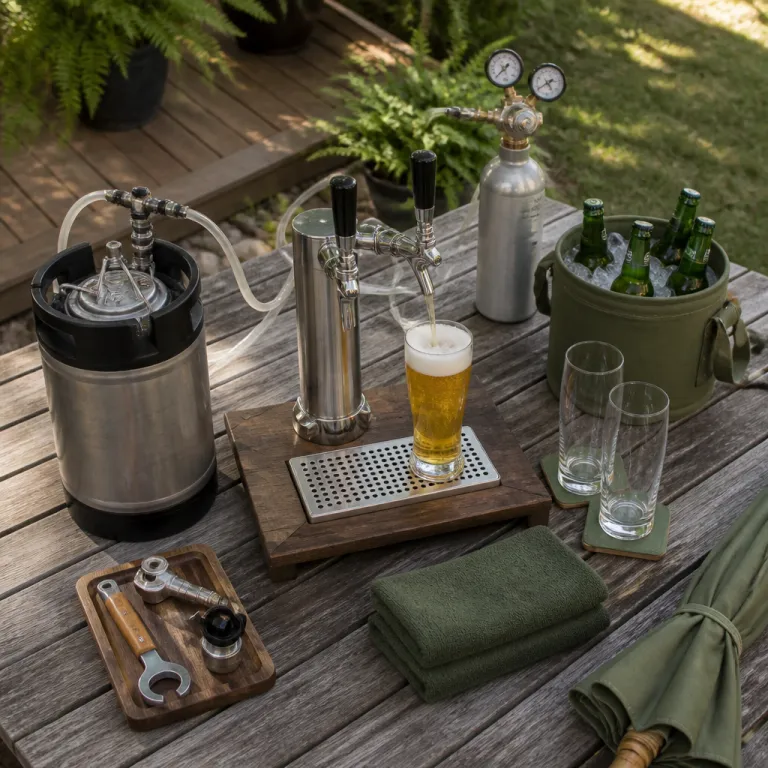
Why outdoor draft beer feels so good (and why it goes wrong so often)
The magic of a fresh pour in the open air
There is something quietly perfect about a pint poured under the sky. The same beer that tastes good at your kitchen table suddenly feels brighter, more refreshing and more social when you are on the patio or in the backyard. Fresh air, natural light and the sound of people talking all change how you experience aroma, carbonation and bitterness.
Outdoors, your senses are more engaged. Sunlight shows off the beer’s color and clarity. A light breeze carries hop aromas differently than a closed room. Even the way you move around the space – grilling, chatting, playing games – makes that draft pour feel like part of the whole moment, not just a drink in your hand.
Why outdoor pours so often disappoint
For all that potential, outdoor draft beer goes wrong surprisingly often. Warm beer lines, half-empty CO2 cylinders and poorly balanced systems turn what should be a crisp, lively pint into a foamy, flat or off-tasting mess.
Common problems include :
- Beer warming up in lines or kegs before it reaches the glass
- Incorrect pressure settings causing wild foam or lifeless pours
- Dirty faucets and lines adding off-flavors or strange aromas
- Improvised setups that work for one party but fail the next
The good news : every one of these issues can be fixed with a bit of planning. Choosing the right system for your space and budget, keeping beer properly chilled and learning the basics of clean, low-foam draft design will do most of the work for you.
If you want to sharpen your palate while you dial in your outdoor setup, try running structured beer flights at home. Understanding what a great pour should taste like makes it much easier to spot – and solve – problems in your backyard draft system.
Choosing the right outdoor draft system for your space and budget
Start with how you actually entertain
Before looking at shiny taps, think about how you use your outdoor space. Do you host big parties a few times a year, or small, regular gatherings ? Do guests serve themselves, or do you prefer to pour for everyone ? Your answers will shape the size of your system, how many taps you need, and whether a permanent bar or a portable setup makes more sense.
Permanent bar vs portable draft station
Permanent outdoor bars work well if you have a covered patio or built-in counter. You can integrate a kegerator or undercounter fridge, run beer lines through the bar, and keep everything ready to pour at a moment’s notice. This suits people who entertain often and want a “real bar” feel outside.
Portable systems – like kegerators on casters or jockey boxes – are better when space is tight, you rent your home, or you only tap kegs occasionally. You can store the unit in a garage or shed, roll it out when needed, and still get that fresh draft experience.
Matching system type to budget and ambition
If you are just starting out, a single-tap kegerator or converted fridge is usually the most cost-effective route. As you get more serious, you might add extra taps, a dedicated back bar fridge, or even a small walk-in area for multiple kegs. For many home setups, a reliable back bar drinks fridge becomes the cold heart of the system, keeping kegs and glassware at serving temperature.
Keep in mind that your choice here will affect how you handle cooling, line length, and foam control later on, as well as how flexible your layout is for future upgrades.
Keeping beer cold outside : coolers, kegerators, glycol and air cooled options
Why warm beer ruins the party
Outside, your biggest enemy is heat. As beer warms up in the keg or lines, CO2 comes out of solution, creating foam and flat pours. Even if you nailed your system choice earlier, poor temperature control will undo everything. Aim to keep beer around 3–5 °C from keg to faucet, with as little temperature swing as possible.
Ice-and-cooler setups that actually work
For casual backyard gatherings, an ice-filled tub or chest cooler around the keg is often enough. Pack ice tightly around the sides, not just on top, and top up melted ice with cold water to improve contact. If you are using a picnic tap, keep the line coiled in the ice bath too, so beer does not warm up between keg and glass.
Jockey boxes take this a step further. The keg can sit nearby in the shade while beer runs through stainless coils or a cold plate buried in ice. This chills beer right before it hits the faucet, which is ideal for longer runs or hotter days. They are also perfect if you plan to host events or even a small craft beer festival at home.
Outdoor kegerators and advanced cooling
For a permanent patio bar, an outdoor-rated kegerator is the most convenient option. It keeps the keg cold and protected, and with good insulation you can run short beer lines to a tower on your counter. In more complex builds, glycol-cooled systems circulate chilled glycol around the beer lines, keeping every centimeter cold. Air-cooled towers are simpler but need short, well-insulated runs and shade to stay effective.
Building a clean, low foam draft system : lines, pressure, faucet and foam control
Get your draft line length and diameter right
Foam problems outside often start with the beer line. Warm weather amplifies any mistake in length, diameter or routing. For most home patio setups, 3/16" ID vinyl beer line is the standard because its natural resistance helps balance pressure and reduce foam. Too short a line and beer rockets out of the faucet ; too long and the pour crawls and goes flat.
As a rule of thumb, many backyard systems run between 1.8 and 2.4 metres of 3/16" line per tap, then adjust from there. If you are running longer distances from a garage kegerator to an outdoor tower, you may need a mix of 3/16" and 1/4" line to keep flow and resistance in balance.
Dial in CO₂ pressure for outdoor conditions
Pressure that works indoors can be wrong once the keg sits in a warmer environment or a different fridge from your indoor system. Start with the brewery’s recommended serving pressure for the beer style, then fine tune based on your actual line length and temperature.
- If you see foam bursts at the start of each pour, your pressure may be too high or the line too short.
- If beer tastes flat after a few hours, you may be under-carbonating or venting too often.
Make small changes (0.5–1 PSI at a time) and give the keg time to stabilise before judging the result.
Choose faucets and habits that fight foam
Forward-sealing faucets are a smart choice outdoors because they resist sticking and bacterial build-up between parties. Whatever faucet you use, always open it fully in one quick motion and avoid “feathering” the handle, which shreds CO₂ out of solution and creates foam.
Rinse glasses with cold water before pouring, keep soap residue away from your glassware and never dunk the faucet into the beer. Clean lines and faucets regularly, especially after hot weekends.
Real world outdoor setups : from backyard bar to mobile jockey box station
Compact patio kegerator corner
For many people, the easiest starting point is a small kegerator tucked into a patio corner. Think of a weather-resistant undercounter unit or a freestanding kegerator rolled against a wall under a pergola. Keep the run of beer line as short as possible between keg and faucet, and match your gas pressure to the temperature you are actually running outside.
Use a simple two-tap tower for variety, and add a drip tray that drains into a small container so you are not constantly wiping the floor. If your climate is hot, shade is non-negotiable ; a basic shade sail or umbrella can make the difference between crisp pours and foamy, over-warm beer.
Built-in backyard bar with outdoor-rated lines
If you are ready for a more permanent setup, build your draft system into a fixed bar. Place the kegs and gas in a cooled cabinet or outdoor-rated fridge behind the bar, then run insulated beer lines up to a tower on the counter. Keep those lines as straight and gently sloped as possible to avoid trapped gas pockets.
Plan your gas manifold so you can serve different styles at different pressures. A simple two-regulator setup lets you keep lagers and more highly carbonated beers happy at the same time. Make sure every connection is accessible for cleaning and leak checks ; hidden fittings behind sealed walls are a maintenance headache waiting to happen.
Mobile jockey box station for parties
For renters or anyone who hosts occasional big gatherings, a jockey box on a folding table is hard to beat. Ice down the coils, keep the kegs in tubs of ice nearby, and run your gas from a small cylinder with a reliable regulator. This approach shines when you want multiple taps without committing to permanent construction.
Label each faucet clearly, keep extra ice on hand, and bring a backup picnic tap in case a shank or faucet misbehaves mid-party.