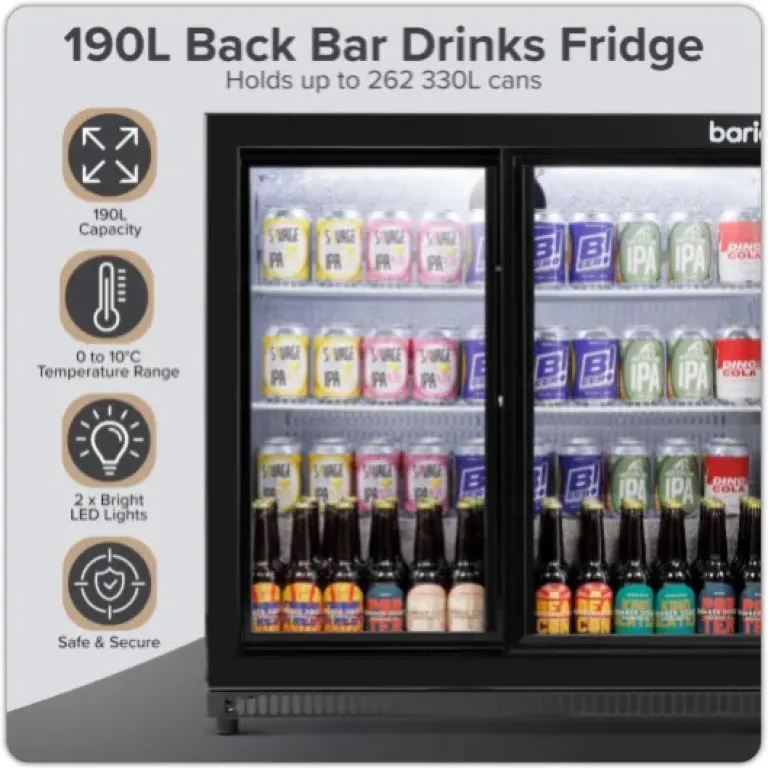

Summary
Editor's rating
Value for money: good capacity without paying for a big brand logo
Design: sliding doors that actually make sense behind a bar
Build and materials: feels decent, not premium
Durability and reliability: feels solid, but time will tell
Performance: keeps drinks cold, but don’t expect magic
What you actually get with the Baridi DH273
Effectiveness in real life: how it handles day-to-day use
Pros
- Large 193L capacity (up to ~262 x 330ml cans) with flexible wire shelving
- Sliding double-glazed glass doors give easy access and decent insulation
- Good balance of build quality and price for home bars and light commercial use
Cons
- Basic temperature control and no digital or smart features
- Sliding door runners could be a potential weak point under heavy, rough use

Specifications
View full product page →| Brand | Baridi |
A big back-bar fridge without the fancy branding
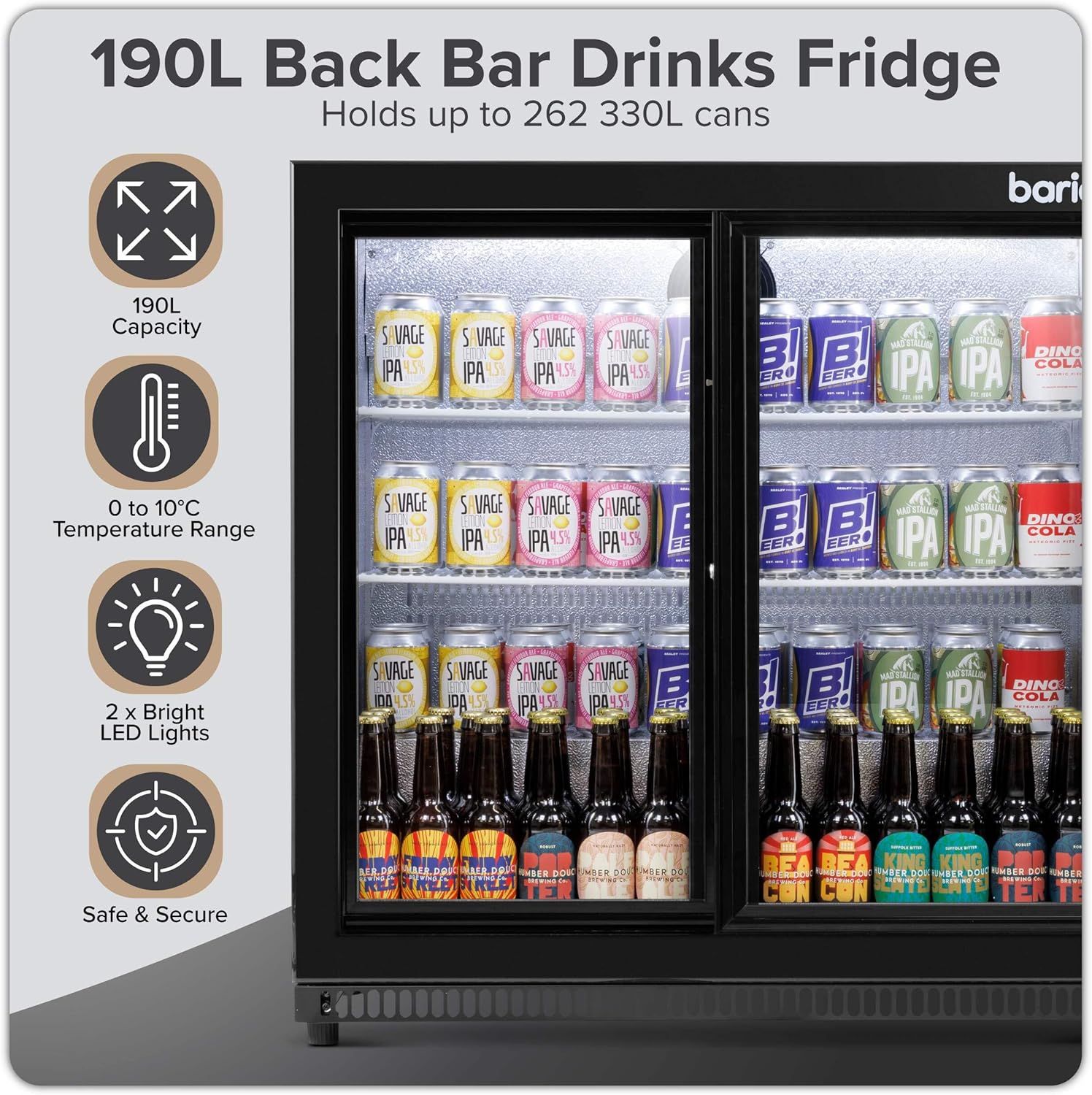
I’ve been using the Baridi Back Bar Drinks Fridge (model DH273) for a little while now in a home bar / games room setup. It’s not a big-name brand like Husky or Polar, so I went in a bit cautious, especially for something that’s basically on 24/7. But I wanted sliding doors, a decent capacity, and something that didn’t look cheap through the glass. This one ticked those boxes on paper: 193L capacity, double-glazed glass, and black finish.
In practice, I’ve been using it more like a mix between a home bar and a small commercial setup. Weeknights it’s barely used, but on weekends it can get hammered with people constantly opening the doors for beers and soft drinks. That’s usually where the cheap fridges struggle: they either can’t keep up with cooling or the doors start feeling flimsy. So I paid attention to those points from day one.
What stood out first was the space. The advertised 262 x 330ml cans is realistic if you’re willing to play Tetris with the shelves. I don’t run it at full capacity, but it easily handles a mix of bottles and cans for a party. It’s not some compact under-counter fridge; it’s a proper back-bar unit, so you do need the space and a solid surface.
Overall, my first impression was: no frills, pretty solid, and clearly built more for function than style. It’s not perfect – noise and lack of fine temperature control might bother some people – but if you just need a workhorse to keep drinks cold and visible behind the bar, it does the job without fuss. I’ll break down the good and the annoying bits in more detail below.
Value for money: good capacity without paying for a big brand logo
On value, I’d say this fridge sits in a pretty solid spot. You’re getting 193L of usable space, double sliding glass doors, and a proper bar-style layout for less than some of the big commercial names. If you compare it to well-known bar fridge brands, you often pay extra just for the badge and maybe slightly better hardware. Here, you skip the fancy branding and get a straightforward unit that does the core job: keep a lot of drinks cold and visible.
Where you feel the price difference is in the lack of extras. No inverter, no digital display, no multi-zone cooling, no smart features. If you don’t care about that stuff and just want a reliable beer fridge for your bar or man cave, then it’s good value. You’re paying for capacity and functionality, not bells and whistles. The fact it can hold up to 262 cans means you don’t need multiple small fridges, which also saves space and hassle.
The small downsides – like potential wear on the sliding door runners, basic controls, and typical compressor noise – are acceptable trade-offs at this price, at least for me. If I were running a high-end cocktail bar and wanted something ultra-robust and brand-backed with on-site service contracts, I’d probably spend more on a fully commercial unit. But for a home bar, a garden bar, or a small cafe that just needs a good back bar fridge, this makes financial sense.
So overall, in terms of value: nothing flashy, but fair for what you get. You’re buying a big, functional drinks fridge that looks decent and performs well enough, without burning a hole in your wallet for features you might never use. If that’s what you’re after, it’s a strong option in the mid-range back bar fridge category.
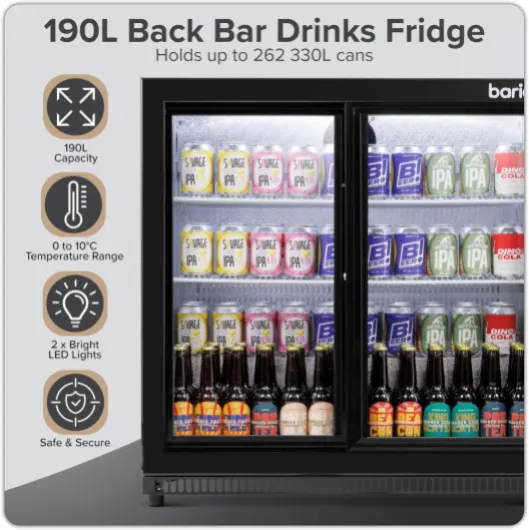
Design: sliding doors that actually make sense behind a bar
The overall design is very functional. The main thing here is the double sliding doors. For a back bar or a tight space, that’s a big advantage over hinged doors. You don’t need extra clearance to swing doors open, and people can walk past behind the bar without constantly bumping into anything. In my setup, the fridge sits under a counter with limited room in front, and sliding doors are just easier to live with when multiple people are grabbing drinks.
The look is pretty simple: black matte exterior, solid sides, and double-glazed glass doors at the front. It’s not flashy. If you’re building a sleek designer bar, you might find it a bit plain, but for a normal home bar or a small venue, it fits in fine. The glass is clear enough that you can see the labels easily, which is the whole point of a back bar fridge. The internal light helps, though it’s more functional than atmospheric. You’re not getting a fancy LED color show; it’s just bright enough so you can see what’s inside.
One thing I noticed is that the doors slide fairly smoothly, but you can tell it’s not top-of-the-line hardware. There was a user review mentioning a problem with a runner on one of the doors, and I can see how that could happen if it takes a knock or gets used heavily in a busy bar. The upside is that the company seems to have handled that well by sending a whole new door. On mine, the runners feel okay so far, but I do handle them reasonably gently. If you’ve got staff or guests slamming them all night, I’d keep an eye on that area over time.
From a practical angle, the design works: flat top for storage, sliding doors, and decent visibility. It doesn’t try to be stylish furniture; it’s more like a solid tool. If you care more about clean looks than brand logos, you’ll probably be happy. If you want something that screams premium, this isn’t it, but at this price point I wouldn’t expect that anyway.
Build and materials: feels decent, not premium
In terms of build, the Baridi DH273 sits in that middle zone: it doesn’t feel flimsy, but it also doesn’t feel like heavy-duty top-tier commercial gear. The cabinet is sturdy enough once in place, and the black matte finish hides fingerprints and minor scuffs pretty well. The overall weight (about 51.7 kg) gives it a bit of confidence – it’s not some ultra-light tin box that rattles if you breathe on it. Once it’s installed, it feels solid and doesn’t wiggle around.
The glass doors are double-glazed, which is good for insulation and also makes them feel more robust than single-pane cheap units. They don’t flex when you slide them, and the seals around the edges seem decent. Over time, dust and grime will collect in the tracks, like with any sliding-door setup, so you’ll want to clean those now and then to keep the movement smooth. The wire shelves are standard bar-fridge quality: not luxury, but strong enough for rows of bottles and cans. You can bend wire shelves if you really overload them with glass bottles, but under normal use they hold up fine.
The lock is basic but useful if you’ve got kids around or if it’s going in a shared space. Don’t expect a bank vault – it’s enough to stop casual grabbing, not a determined thief. The plastic parts inside (shelf supports, bits of trim) look and feel like typical appliance plastic. Nothing fancy, but no obvious weak points either. The compressor type is listed as rotary/scroll with R600a refrigerant, which is pretty standard these days. No inverter tech here, so again, straightforward and simple.
Overall, I’d say the materials are good enough for home and light commercial use, but if you’re running a very busy bar with doors sliding hundreds of times a night, you might want to spend more on a higher-end commercial brand. For a garden bar, home pub, cafe, or smaller venue, this level of build quality is perfectly acceptable and feels like fair value for what you pay.
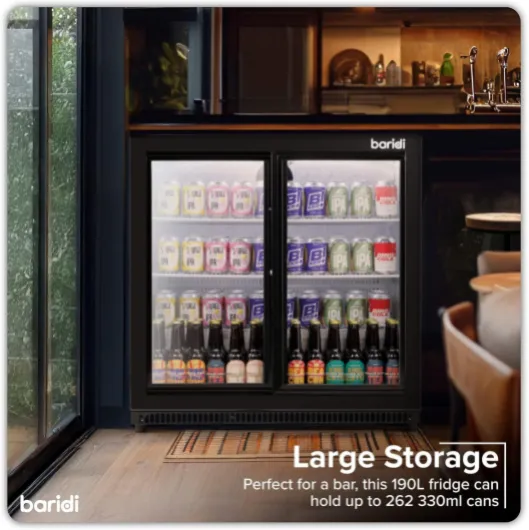
Durability and reliability: feels solid, but time will tell
Durability is always the big question with lesser-known brands. From what I’ve seen so far, the DH273 feels solid enough for home and light commercial use, but I wouldn’t label it as heavy-duty pro gear. The cabinet and doors feel sturdy, and the weight gives it a stable base. I haven’t had any issues with rattling panels or loose parts, which is usually a bad sign on cheaper units. Everything still lines up correctly after moving it into place and loading it up.
The potential weak point is the sliding door mechanism. One Amazon review mentioned a problem with a runner on one door, and I can see why that part would be under stress if people are rough with it or if the tracks get dirty. To their credit, the manufacturer apparently sent out a whole new door, which is decent support. On mine, the doors still slide smoothly, but I do make a point of not slamming them and occasionally wiping out the tracks. If you’re putting this in a busy bar where staff are rushing around, I’d say that’s the area most likely to show wear first.
The compressor and cooling system use R600a, which is standard and has been reliable in many fridges I’ve used. There’s no inverter, so the tech is simple, which can actually be a plus for durability – fewer electronics to fail. As long as you give it proper ventilation and don’t block the vents, it should run fine. Like any back bar fridge, it’s going to be on pretty much all the time, so dust build-up around the compressor is something to watch and clean periodically.
Overall, I’d rate durability as good for the price bracket, with the caveat that this is best suited to home bars, garden bars, and smaller venues rather than a packed nightclub that’s open every night. If you treat it as a workhorse but not as an indestructible tank, I think it will hold up reasonably well. The few user reviews out there are very positive so far, but long-term reliability will depend a lot on how and where you use it.
Performance: keeps drinks cold, but don’t expect magic
On the performance side, the DH273 does what it’s supposed to: it keeps a lot of drinks cold and ready to serve. The stated temperature range is 0–10°C. In reality, with mine set to a mid setting and loaded with a mix of cans and bottles, the drinks come out nicely chilled, around the level you’d expect in a pub fridge. It’s not an ultra-precise lab fridge, but for beer and soft drinks it’s perfectly fine. After loading it up from room temperature, it took a few hours to get everything down to a decent serving temperature, which is pretty normal for this size.
Where it matters is during busy periods. With people opening and closing the doors constantly, the compressor kicks in more often, but the temperature inside stays stable enough. The double-glazed doors help a bit with insulation, so you don’t lose all the cold every time someone slides the door open. I haven’t had any issues with warm spots or noticeably warmer drinks on one side. The air circulation inside seems okay for a basic wire-shelf setup, especially if you don’t overpack it to the absolute limit.
Noise-wise, you do hear the compressor when it’s running. It’s not silent. In a bar or games room, it fades into the background with music or people talking, but in a very quiet living room it might annoy you. It’s the usual humming and occasional click you get from standard compressor fridges. If you’re very sensitive to noise, just be aware it’s more “commercial fridge” than “whisper-quiet kitchen appliance.” I personally don’t mind it, but I wouldn’t put it next to a TV in a silent room.
Energy-wise, the double-glazed doors and insulation help, but it’s still a 193L compressor fridge that stays on all the time. Don’t expect it to sip power like a tiny wine cooler. For a back bar or garden bar that gets used often, the trade-off makes sense. In short: cooling performance is solid for the price and size, as long as you accept the normal noise and running costs of this kind of unit.
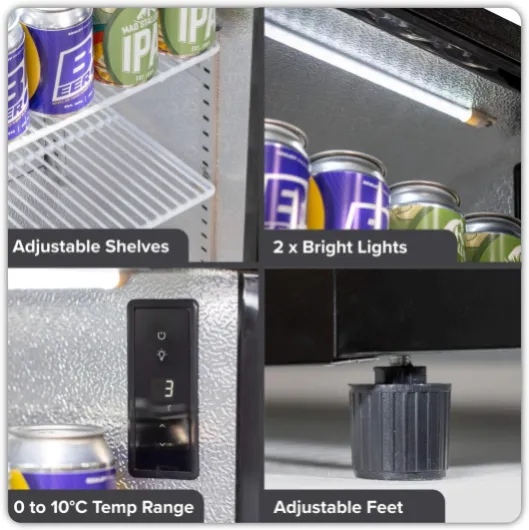
What you actually get with the Baridi DH273
Out of the box, the Baridi DH273 is straightforward. You get the fridge, the wire shelves, a couple of keys for the lock, and the usual basic paperwork. No fancy extras, no smart features, no app, nothing like that. It’s a simple compressor-based drinks fridge, 193L capacity, double sliding glass doors, and a black matte finish. It’s freestanding, so you just plug it in and let it settle before switching on. I let mine sit upright for a few hours to be safe, since it’s a compressor unit.
The brand is Baridi, made by Dellonda in China. So it’s clearly not trying to be a premium commercial brand, but it doesn’t feel like the bottom-of-the-barrel cheap stuff either. The stated temperature range is 0 to 10°C, which is pretty standard for a back bar fridge. You don’t get a fancy digital control panel with loads of options; it’s more basic than that. It’s meant for bars, restaurants, cafes, home bars and similar, and that’s exactly how it feels: a work appliance, not a designer piece of furniture.
Inside, the layout is classic: wire shelves, glass doors, internal light, and a compressor at the back. The claimed capacity of up to 262 standard 330ml cans is believable if you stick mostly to cans. Once you start mixing in taller bottles, wine, or odd-shaped craft beer bottles, you’ll use fewer shelves or adjust the spacing, but that’s normal. This isn’t a wine cooler; it’s a general drinks fridge.
In day-to-day use, the presentation is very straightforward: it sits under or behind a bar, keeps drinks visible, and that’s pretty much it. If you like gadgets and smart features, this will feel old-school. If you just want a big cold box with glass doors, that’s exactly what you’re getting. For me, that simplicity is actually a plus, as there’s less to break or fiddle with, but it does mean you’re not getting any fancy temperature automation or app notifications or anything trendy like that.
Effectiveness in real life: how it handles day-to-day use
Day-to-day, the fridge is effective at one core job: keeping a lot of drinks cold and visible. I use it mostly for beer, cider, soft drinks, and some mixers. With a typical weekend load, everything stays nicely chilled, and guests can see what’s available at a glance. The sliding doors make it easy for people to help themselves without blocking the whole bar area. That part works exactly how I wanted: quick access, no doors swinging out into people.
One thing to note is the lack of fancy adjustable digital controls. There’s no inverter, no smart mode, just a basic compressor and a simple temperature control. So if you like to fine-tune your drinks to a specific degree, this isn’t that kind of appliance. For me, I just set it to a fairly cold setting and leave it. Beer and soft drinks come out at a good drinking temperature, so I don’t really need more precision. But it’s something to keep in mind if you’re picky about exact temps.
As for internal organization, the wire shelves are flexible enough to rearrange for taller bottles or more cans. If you’re mixing wine bottles, tall tonic bottles, and cans, you’ll need to play around with shelf heights a bit, but that’s normal. Once you’ve found a layout that works, it’s easy to keep things organised. The capacity feels generous; I haven’t yet had a party where I thought, “this fridge is too small,” which is exactly what I wanted for a home bar.
In short, it’s effective in a very straightforward way: it cools a lot of drinks, keeps them visible, and lets multiple people grab stuff without chaos. No fancy features, but no real nonsense either. The weak spots are mainly on the fine-control side (no advanced temperature options) and the usual maintenance (keeping tracks clean, defrosting if needed), but nothing that makes it a pain to use regularly.
Pros
- Large 193L capacity (up to ~262 x 330ml cans) with flexible wire shelving
- Sliding double-glazed glass doors give easy access and decent insulation
- Good balance of build quality and price for home bars and light commercial use
Cons
- Basic temperature control and no digital or smart features
- Sliding door runners could be a potential weak point under heavy, rough use
Conclusion
Editor's rating
The Baridi DH273 is a no-nonsense back bar fridge that focuses on the basics: big capacity, sliding glass doors, and reliable cooling. It’s not a flashy designer piece, but it fits nicely into a home bar, garden bar, or small venue and quietly gets on with the job. The 193L capacity and wire shelves make it easy to stock up for parties, and the visibility through the double-glazed doors is exactly what you want behind a bar. Cooling performance is solid, and while the compressor isn’t silent, the noise level is perfectly acceptable in any normal social setting.
It’s not perfect. The temperature control is basic, there’s no fancy digital interface, and the sliding door runners are the part I’d watch over time, especially in a very busy commercial environment. But for the price, the overall build and performance feel fair, and user feedback so far is very positive, with good comments on customer service when issues did pop up. If you want a large drinks fridge for your bar area and don’t care about big-brand logos or smart features, this is a practical, good-value choice. If you need ultra-quiet operation, advanced controls, or heavy-duty commercial durability, you might want to look at higher-end units and be ready to pay more.