
Summary
Editor's rating
Taste: classic Guinness, slightly closer to pub quality
Value for money: worth it only for certain drinkers
Can and device combo: clever, but a bit locked-in
Battery and device hassle: the hidden side of these cans
Packaging and delivery: fine product, but shipping can be rough
Performance: pour quality and consistency at home
What you actually get with these cans
Pros
- Pour and head are closer to a good pub pint than standard widget cans
- Creamier mouthfeel and slightly smoother overall drinking experience
- Fun for match nights and hosting, with a bit of a “pub at home” feel
Cons
- Requires a separate Nitrosurge device, which adds cost and hassle
- Cans are more expensive than regular Guinness Draught cans
- Needs proper chilling and a charged device, so not great for spontaneous drinking

Specifications
View full product page →| Brand | GUINNESS THE 1759 |
Pub pint without leaving the sofa?
I bought these Guinness Draught Nitrosurge cans out of curiosity more than anything else. I already drink standard Guinness Draught cans with the widget, and I like them well enough, but I kept seeing people rave about this Nitrosurge device and the special cans. So I grabbed a 4-pack and borrowed a mate’s Nitrosurge gadget for a couple of weekends to see if it was really any better than the usual stuff in the supermarket.
First thing to understand: these cans are useless without the Nitrosurge device. There’s no widget inside, nothing. On their own, they’re just expensive cans of flat stout. Once you accept that, the question becomes simple: is the combo of cans + device actually close enough to a proper pub pour to justify the extra cost and faff?
Over roughly two weeks, I used the cans for a few match nights and a quiet Friday evening. I did the full thing properly: cans in the fridge for over 24 hours, device fully charged, and the classic two-part pour into a clean pint glass. I also did side‑by‑side tests with regular widget cans to see if the difference was real or just marketing.
Overall, I’d say the Nitrosurge setup is pretty solid. It’s not magic, but the pour and head are genuinely closer to what you get in a decent pub. The downside is the price and the fact you’re locked into this specific can format. If you’re just an occasional Guinness drinker, this is probably overkill. If you’re the type who plans football evenings around your pints, then it starts to make more sense.
Taste: classic Guinness, slightly closer to pub quality
On the taste side, there are no big surprises: it’s recognisably Guinness Draught. You get the usual roasted malt, a bit of bitterness, some coffee notes and a light chocolate thing in the background. If you already like Guinness, you’ll feel at home immediately. If you find Guinness a bit bland compared to heavy craft stouts, this won’t change your mind. It’s still that lighter, easy-drinking stout rather than a thick dessert beer.
Where I did notice a difference versus the standard widget cans is in the texture and how the taste comes across. With the Nitrosurge pour, the mouthfeel is a bit creamier and smoother, and the bitterness feels a bit better balanced. It’s not night and day, but side by side I found the Nitrosurge pint just a touch more rounded, like the flavours blended together more cleanly. The standard can felt slightly sharper and thinner after switching back and forth a few times.
That said, we’re not talking about a totally new beer here. If you handed this to someone who drinks Guinness occasionally, they might not even notice it’s from a different can system; they’d just say “nice pint of Guinness”. The difference is more obvious if you’re picky and drink it regularly. For me, the main gain is the texture and head, not some huge change in flavour. The coffee and chocolate hints are there, but they’re not stronger or weaker than in normal Guinness; they just feel a bit smoother to drink.
So in terms of taste, my view is simple: it’s standard Guinness, slightly improved by a better pour. If you already think Guinness is decent but not very exciting, this won’t suddenly make it special. If you already enjoy it and want a more pub-like experience at home, then the taste and mouthfeel together make more sense, especially during a match when you’re actually paying attention to the pint in your hand.

Value for money: worth it only for certain drinkers
Talking about value, you have to look at two costs: the price of the cans and the price of the Nitrosurge device itself. The cans on their own are definitely more expensive per pint than standard Guinness Draught widget cans. You’re paying for the format and the tech, not for a stronger beer or special ingredients. Then you add the one-off cost of the device, which isn’t cheap either. So you’re committing to a system that is clearly pricier than just grabbing a normal 4-pack from the supermarket.
For me, the value question comes down to how often you actually drink Guinness at home and how much you care about the pub-style pour. If you’re only having one or two cans a month, honestly, I’d say stick with the regular widget cans. They’re cheaper, simpler, and still taste fine. The improvement from Nitrosurge is nice, but not life-changing for a casual drinker. On the other hand, if you regularly watch football with friends and you’re the one sorting drinks, the Nitrosurge setup starts to feel more justified, because you’ll actually use it often enough to spread that device cost out.
Compared to going to the pub, the value is not terrible. A decent pint of Guinness in a bar is usually going to be more expensive than what you’re paying per Nitrosurge can, even at these higher prices. So if you’re swapping three or four pub nights a month for home evenings, you’ll probably come out ahead anyway. But that only holds if you were going to drink Guinness either way, not if you’re just buying this for the novelty and then barely touching it.
My honest take: good value for heavy Guinness fans, average value for everyone else. The product is clearly aimed at people who really like the ritual and look of a pub pint. If that’s you, you’ll probably feel the extra spend is acceptable. If you just want a dark beer in the fridge without hassle, this is overcomplicated and overpriced for what it is.
Can and device combo: clever, but a bit locked-in
Design-wise, the interesting part is not just the can, but how it works with the Nitrosurge device. The can itself looks fine: black, gold harp, Guinness branding, and a slightly taller shape. Nothing fancy, but it matches the brand. The real trick is that there’s no widget inside. All the nitrogen action is triggered by the ultrasonic device you stick on top. So the can is basically a container designed around that gadget rather than a self-contained product like normal Guinness cans.
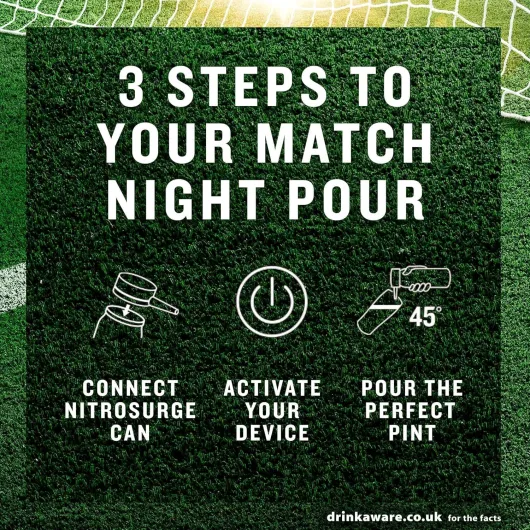
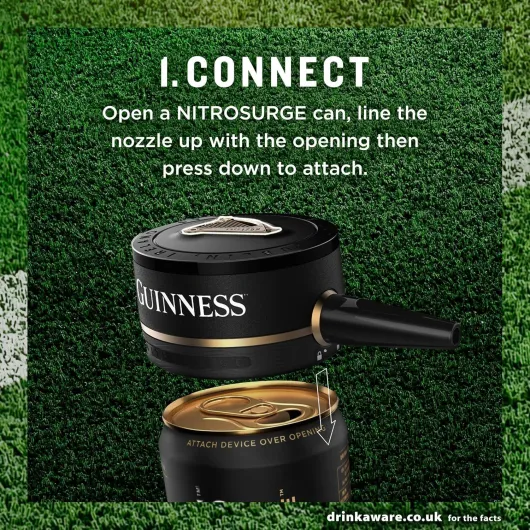
The way it works is pretty straightforward once you’ve done it twice. You open the can, line up the device nozzle with the opening, and press it on firmly. Then you tap the power button, tip the whole thing, and pour slowly into a glass. You stop halfway, let it settle, then finish the pour. It looks a bit silly at first, like you’re pouring beer with a mini power tool, but you get used to it. The beer surges and settles nicely, with a tight, creamy head that does look closer to a pub pour than the usual widget cans.
From a practical point of view, the design has one clear upside and one clear downside. The upside: very consistent head and pour, as long as the can is really cold and the device is charged. I didn’t have any weird foamy disasters or flat pours once I followed the instructions. The downside: you’re completely stuck with this format. The device only works with these cans, and these cans don’t work properly without the device. So if you run out of Nitrosurge cans but still have the gadget, it’s useless, and vice versa.
Compared to standard Guinness cans, I’d say the design is smarter but also more annoying if you’re a casual drinker. The widget cans are simple: open, pour, done. With Nitrosurge, you’ve added another step, a battery to charge, and a specific can you have to buy. If you enjoy the ritual and want that closer-to-pub look in the glass, the design makes sense. If you just want to crack a can after work, this system feels like a bit of a faff.
Battery and device hassle: the hidden side of these cans
The cans themselves obviously don’t have a battery, but they’re completely tied to the Nitrosurge device, which does. That means the overall experience depends a lot on how often you remember to charge it. In my case, I charged the device fully once before a weekend, poured six pints over two evenings, and the battery handled that fine. It didn’t die on me mid-pour, which was my main concern. So in terms of pure battery life, it’s good enough for a few sessions before you need to plug it in again.
The annoying part is more about planning. On one match night, I suddenly realised the device was almost dead because I’d left it on after the last session. I still managed to squeeze out a couple of pints, but I was watching the little light nervously. That’s the kind of thing you obviously never deal with with regular cans. So while the battery life itself is okay, the simple fact that you now have “one more gadget to charge” is a bit of a downside if you’re already juggling phones, controllers, etc.
Charging is straightforward: USB cable, plug it in, leave it. It’s not fast or slow in any dramatic way; I just left it charging for a few hours and it was fine. There’s no fancy dock or anything, so you just need somewhere to put it without losing it. The device is small enough that it could easily end up in a drawer and be forgotten until your next planned Guinness night.
Overall, I’d say the battery side of this system is acceptable but mildly annoying. It works, it lasts long enough, but it’s another layer of faff compared to a simple can. If you’re the sort of person who charges things regularly and likes gadgets, you’ll be fine. If you’re forgetful or just want zero maintenance, this will feel like an unnecessary complication just to drink a beer.
Packaging and delivery: fine product, but shipping can be rough
On the packaging side, the cans themselves arrived in a basic cardboard outer, with the 4-pack held together in a simple internal wrap. Nothing fancy, but that’s standard for supermarket beer. The issue is more about how Amazon or the courier handles them. One of the common complaints I’d seen in reviews was that the cans sometimes arrive loose in the box, rattling around. In my case, they were slightly jostled but not dented, so I got off lightly. Still, when you’re paying a premium per can, you don’t really want them arriving looking like they’ve done a tour of every depot in the country.
Practically, the packaging is just about adequate, but not much more. There’s no extra padding, no dividers between cans, and if the outer box takes a hit, the cans will feel it. I didn’t have any leaks or major damage, but I wouldn’t be shocked if someone unlucky opened theirs to find a bent or leaking can. For a product that relies on perfect carbonation and a clean pour, that’s not ideal. A slightly sturdier internal tray would make a big difference.
Storage-wise, once you’ve got them, the 4-pack is easy enough to fit in the fridge. The cans are tall but slim, so they sit fine in the door or on a shelf. Just remember you need them properly chilled, so don’t leave them in a warm cupboard and expect good results. The outer cardboard is recyclable, so at least there’s not a ton of plastic waste involved, which is a small plus.
My overall feeling on packaging: it does the job but feels cheap for the price. The product itself is positioned as a more premium, techy version of Guinness, but the way it’s shipped doesn’t really match that. If you’re ordering online, just be aware there’s a small risk of dents or scuffs, and check the cans when they arrive rather than waiting until match day and discovering a problem when it’s too late.
Performance: pour quality and consistency at home
When I talk about performance here, I mainly mean: how well does this system actually pour, and is it consistent from can to can? Over about eight pints poured across a couple of weeks (some mine, some shared with friends), the consistency was genuinely good. Every time I followed the steps – cold can, charged device, slow two-part pour – I got a thick, creamy head and a proper surge. No random gushers, no sad flat pours.
The key detail is temperature and patience. The cans really do need a good long chill. I left mine for over 24 hours in the fridge, and the pours were spot on. One evening I tried a can that had only been in the fridge for about 4–5 hours, and the difference was obvious: the head was looser, and the beer felt a bit less smooth. It was still drinkable, but it lost that “pub-style” look. So in practice, you can’t just buy these warm and expect to use them the same day and get the best result.
In terms of speed, the whole process takes slightly longer than a normal can. Between attaching the device, doing the first pour, letting it settle, and topping up, you’re looking at maybe a minute or so per pint. Not a big deal, but if you’re pouring for several people during half-time, it’s something to keep in mind. On the plus side, every pint looks good in the glass, which is nice when you’ve got friends over and you don’t want to hand someone a sad, half-foamy mess.
Compared to regular widget cans, I’d say the performance is better if you care about the look and texture, but it demands more discipline. The widget cans are more forgiving if the fridge is a bit warm or you pour too fast. Nitrosurge rewards you for doing it properly, but punishes you slightly if you rush it. For me, that’s fine on match nights when I’m in the mood to fuss with it a bit; on a random Tuesday, I’d probably just reach for a normal can.
What you actually get with these cans
In the pack I got, you simply have 4 x 558 ml cans and that’s it. No device, no glass, no extras. The listing says very clearly that the Nitrosurge device is sold separately, but it’s easy to skim over that and be annoyed later, so I’ll repeat it: if you don’t already own the Nitrosurge device, don’t buy these cans yet. They’re designed to work only with that gadget, and they don’t behave like normal Guinness cans at all.
Each can is slightly taller than a standard 440 ml Guinness can, so you do feel you’re getting a proper pint once it’s poured. It’s 4.1% alcohol, so same strength as normal Guinness Draught, nothing surprising there. The front of the can clearly says Nitrosurge and looks a bit more techy, which at least makes it obvious they’re not the regular widget ones. That’s useful if, like me, you tend to just grab black Guinness cans from the cupboard without paying attention.
In practice, the presentation is simple: this is Guinness positioning this as a kind of “home pub” format for match days and hosting. The pack is light, easy to store in the fridge door, and the vegan logo is there if that matters to you. You’ll probably finish the four cans in one or two evenings if you’re sharing with someone, so it’s not some big bulk buy. It’s more like a treat or a special-occasion option.
My main takeaway on presentation: it’s clear and honest about what it is, but it also means you need to be organised. You have to own the device, keep it charged, and chill the cans properly. If you just want something you can grab and crack open without thinking, these are not that. They are more of a “planned pint” product than a spontaneous one.
Pros
- Pour and head are closer to a good pub pint than standard widget cans
- Creamier mouthfeel and slightly smoother overall drinking experience
- Fun for match nights and hosting, with a bit of a “pub at home” feel
Cons
- Requires a separate Nitrosurge device, which adds cost and hassle
- Cans are more expensive than regular Guinness Draught cans
- Needs proper chilling and a charged device, so not great for spontaneous drinking
Conclusion
Editor's rating
After a couple of weeks using these Guinness Draught Nitrosurge cans with the device, my opinion is pretty straightforward: the system works well, and the pints you get are noticeably closer to a good pub pour than normal widget cans. The head is creamier, the texture is smoother, and the whole thing feels a bit more like a treat. If you already enjoy Guinness and you like the idea of making match nights at home feel more like being at the bar, it does what it promises.
But it’s not perfect. You’re tied to a specific gadget that needs charging, you have to buy these dedicated cans that cost more than the standard ones, and you need to plan ahead with chilling. On a busy day when you just want to crack a quick beer, this setup feels slightly over the top. Taste-wise, it’s still the same Guinness: decent, easy-drinking stout, but not suddenly more complex or rich than before. The improvement is mainly in the pour and mouthfeel, not in some new flavour experience.
So who is this for? It’s for people who drink Guinness fairly often, enjoy the ritual, and don’t mind a bit of extra faff for a better-looking pint. It’s also good if you host friends for football and want something that feels a bit more special than a basic can. Who should skip it? Casual stout drinkers, people who hate gadgets, or anyone just looking for the cheapest way to get Guinness at home. For them, the standard widget cans are still the more sensible choice.