
Summary
Editor's rating
Is it worth the money or just a fancy party trick?
Retro bar vibe with a geek twist
AAA batteries for a tiny screen: overkill or practical?
Wood, cast iron and a mesh bag: feels decent in the hand
Built to survive a busy fridge door (with one weak spot)
Does it actually open bottles well and catch the caps?
What you actually get out of the box
Pros
- Opens bottles easily one-handed and feels solid thanks to cast iron opener and thick wood base
- Magnetic catcher and mesh bag reliably collect caps without them falling on the floor
- Customizable e‑ink screen adds a fun personal touch for gifts or home bars and barely uses battery once set
Cons
- Mesh cap bag feels like the least durable part and may wear out faster than the rest
- You partly pay for the Bluetooth/e‑ink feature even if you don’t care about tech or never customize it

Specifications
View full product page →| Brand | ZONSUSE |
A wall opener with a screen… for beer?
I picked up the ZONSUSE wooden bottle opener mainly out of curiosity. A wall-mounted opener with a magnetic cap catcher, that I get. But adding a Bluetooth e‑ink screen you can customize? That sounded a bit gimmicky, so I wanted to see if it’s just a toy or actually useful in a normal kitchen/bar setup. I’ve had it on my fridge and then in the garage for a bit, opening a mix of beer and soft drink bottles.
In daily use, I focused on three things: does it open bottles easily, does it really catch the caps properly, and is the magnet/adhesive strong enough so it doesn’t fall off the fridge the first time you pull too hard. The customizable screen and the whole Bluetooth/battery side were more of a bonus for me, but I still tested that part because it’s a big argument in the product description.
Overall, it’s a pretty solid little gadget that actually gets used, not one of those joke gifts that lives in a drawer. It’s not perfect, there are a couple of details that could be better, especially around the instructions and the slightly techy side. But in practice, it does the main job: you walk up, you pop a bottle with one hand, and the cap doesn’t end up on the floor.
If you’re thinking about getting it as a gift for someone who drinks bottled beer or collects caps, it’s a decent option. Just be aware: the tech part (Bluetooth and screen) will appeal more to someone who likes to tinker a bit. If you just want a simple opener with a catcher and don’t care about a display, there are more basic models that will do the same for less.
Is it worth the money or just a fancy party trick?
On the value side, you have to be clear about what you’re paying for. As a basic wall opener with a cap catcher, there are cheaper options out there that do the core job just as well. Here, you’re paying extra for the customizable e‑ink screen and the slightly more playful design. If you ignore the tech part completely, then yeah, it’s a bit pricey compared to a simple metal opener screwed into a plank with a tin bucket under it.
Where it starts to make sense is if you’re looking for a gift or something a bit more personal for a home bar, boat, or man cave. Being able to put a logo, a joke, or a QR code on the front gives it that "this was actually thought about" feeling when you give it to someone. Plus, the fact that people on Amazon are giving it 4.6/5 with over 2,000 reviews lines up with my experience: it’s not a cheap throwaway gadget, it’s something people actually use and like.
In daily use, the convenience of having a fixed opener with a catcher is honestly underrated. No more hunting for a bottle opener in a drawer and no more caps rolling under the fridge. If you drink bottled beer regularly or host barbecues, you end up using it a lot more than you think. So even if part of the price goes into the gimmick, at least the base product is practical and not just decoration.
If you’re on a tight budget and just want something that opens bottles, I’d say go for a simpler model. If you’re fine spending a bit extra for something that’s both functional and a bit fun to customize, then the price feels reasonable. I’d rate the value as good but not outstanding: you’re getting a solid product with a quirky extra, but you are paying a small premium for that extra compared to basic openers.
Retro bar vibe with a geek twist
Design-wise, it’s a mix of classic bar opener and small tech gadget. The wood base has that rustic, slightly country-bar look. It’s not luxury furniture grade, but it looks decent on a fridge or in a garage. The metal opener is a standard wall opener shape, cast iron style with a powder-coated finish, so visually it fits the “home bar” theme. What breaks the classic look is the small e‑ink screen on the front, which makes it look a bit like a badge or a mini digital sign.
The mesh bag at the bottom is practical but not fancy. It’s hand‑woven style, which fits the rustic side, but you can tell it’s more about function than style. When it’s full of caps it actually looks kind of cool, like a little trophy bag. When empty, it just hangs there and some people might find it slightly odd-looking on a clean kitchen fridge. In a man cave, garage, or garden bar, it blends in better.
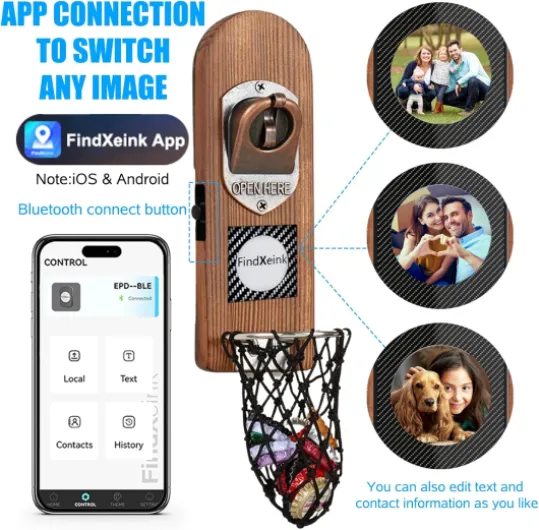
I liked that you can customize the screen with whatever you want: I tried a simple black-and-white logo, then a QR code that links to my Wi‑Fi guest network, just for fun. The resolution is not super sharp like a phone screen, but for a small logo, text, or a simple picture, it’s fine. It’s a quirky touch and gives you room for jokes (“Beer Tax Station”, “Dad’s Bar”, etc.) or something actually useful like contact info if you put it on a boat or in a rental place.
In terms of layout, the opener is at a good height relative to the catcher: caps drop straight down into the net. I didn’t have caps bouncing off or flying out unless I opened the bottle very aggressively. The magnets are hidden, so from the front you don’t see any hardware. Overall, the design is practical and a bit playful. It’s not a design object you’d show off in a fancy kitchen, but in a normal home bar or on a beer fridge, it fits the role just fine.
AAA batteries for a tiny screen: overkill or practical?
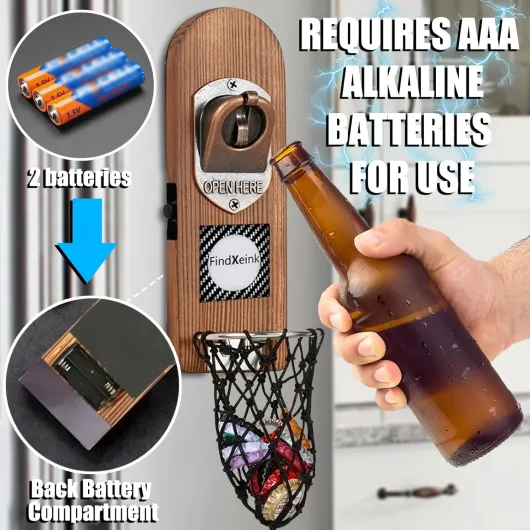
The battery side is simple but worth talking about because it’s what powers the whole customizable display idea. The opener uses 2× AAA alkaline batteries (not included with mine). You pop them into the compartment behind the screen. There’s no built-in rechargeable battery, no USB port, nothing fancy—just standard disposables. On one hand, that’s a bit old-school; on the other hand, AAA batteries are easy to find and cheap.
The brand claims that thanks to the e‑ink technology and the 15‑minute auto-sleep, the battery should last a long time. Based on how e‑ink works, that’s believable: the screen only really uses power when you change the image. Once it’s set, it just sits there. In the couple of weeks I used it, the battery indicator (when I checked through the app) didn’t move in any noticeable way, but that’s too short to judge long-term. Realistically, if you set your image once and forget it, the same pair of batteries should last many months, possibly longer.
Where it’s a bit less nice is the user experience around the batteries. There’s no clear low-battery warning on the opener itself, so if the screen stops reacting or Bluetooth stops working, you kind of have to guess that it’s the batteries. Also, if you’re the type who hates dealing with disposable batteries, this will annoy you a bit. Personally, I’d have liked a small USB-C port to charge it once a year, but that would have pushed the price up.
In practice, though, the battery is not something you think about daily. You put in a pair of AAA, set your image, and you’re done. If the batteries die in a year or two, the opener part still works fine—only the screen becomes a dumb blank rectangle until you swap them. So the battery is more about keeping the gimmick alive than about the main function. For me, that’s acceptable: the opener never becomes useless, even if you ignore the tech side entirely.
Wood, cast iron and a mesh bag: feels decent in the hand
The materials are pretty straightforward: a thick wood base, a zinc alloy/cast iron opener with a powder-coated finish, a woven mesh bag, plus magnets and the e‑ink module. The wood plate feels smooth, no sharp edges or splinters on my unit. It doesn’t have a strong smell, which is good, and it doesn’t feel like cheap particle board. It’s not rock-hard hardwood, but for something that just sits on a fridge, it’s more than enough.
The metal opener itself is the part that matters most, and it feels solid. It’s not flimsy stamped metal; it has some weight to it and doesn’t flex when you pry off a cap. I opened about 40–50 bottles over a couple of weeks, some with slightly thicker craft beer caps, and there’s no visible wear or bending. The powder coating also held up: no chips or rust spots so far, even after a few sessions where wet hands and a bit of condensation were involved.
The mesh bag is the more "budget"-feeling component. It does the job, but you can tell it’s not industrial fishing net quality or anything. The weave is tight enough that caps don’t fall through, and the seams held up with a bunch of caps inside. I tugged it a few times to see if the stitching would give, and it stayed in place. It’s not something I’d overload with heavy objects, but for metal caps it’s fine. If you’re rough with it, I could see it fraying over time, but after a couple of weeks I didn’t see any damage.
The magnets on the back are strong enough to hold the whole thing plus a full bag of caps on a standard fridge door. I tried pulling a bottle sideways to see if it would slide, and it stayed put as long as I didn’t yank like a maniac. The e‑ink screen and battery compartment feel like typical gadget plastic: not premium, not cheap toy level either. You won’t be touching that part much once it’s set up. Overall, the materials are pretty solid for the price range, with the only slightly weaker link being the long-term durability of the mesh bag, which I’d keep an eye on over months of heavy use.
Built to survive a busy fridge door (with one weak spot)
For durability, I tried to treat it like it would be treated in a normal home: frequent use on weekends, some rough openings during parties, and the occasional bump when someone closes the fridge door a bit too hard. The wood panel and metal opener held up well. No cracks, no loosening screws, and the opener didn’t start wobbling. The powder-coated metal still looks the same as day one. Given that it’s zinc alloy/cast iron, I don’t expect rust anytime soon unless you leave it outside unprotected in the rain for a long time.
The magnets on the back also seem solid. I moved it between two different fridges and a metal cabinet, and they stayed firmly glued to the wood. Even with a half-full cap bag swinging around, the opener didn’t slide down the surface. I think if you put it on a very thin or slightly curved metal sheet, you might get some movement, but on a normal fridge door or metal panel, it’s fine. The included double-sided stickers are more questionable in the very long term; those always depend on how clean the surface is and how much moisture there is around.
The e‑ink screen is protected enough for indoor use. It’s not covered by thick glass, but it’s recessed a bit, so you’d have to deliberately hit it with something hard to damage it. I wiped it a couple of times with a damp cloth and had no issues. I wouldn’t leave this opener fully exposed on an outdoor wall in the rain, though. The brand says it’s suitable for any weather and season, but electronics + batteries + water is never a great combo. Under a covered patio or in a sheltered garden bar, it should be alright.
The only part I’m slightly cautious about long-term is the mesh cap bag. After filling and emptying it several times, it’s still fine, but the fabric and stitching are clearly the most fragile components. If someone pulls on it hard, or if it gets caught on something, I can see it tearing. The good news is that if it ever dies, the opener still works and you can improvise a different catcher (small box, jar, or even another bag). So overall, durability is pretty solid where it matters: the opener and wood base feel like they’ll last years; the bag is the consumable part.
Does it actually open bottles well and catch the caps?
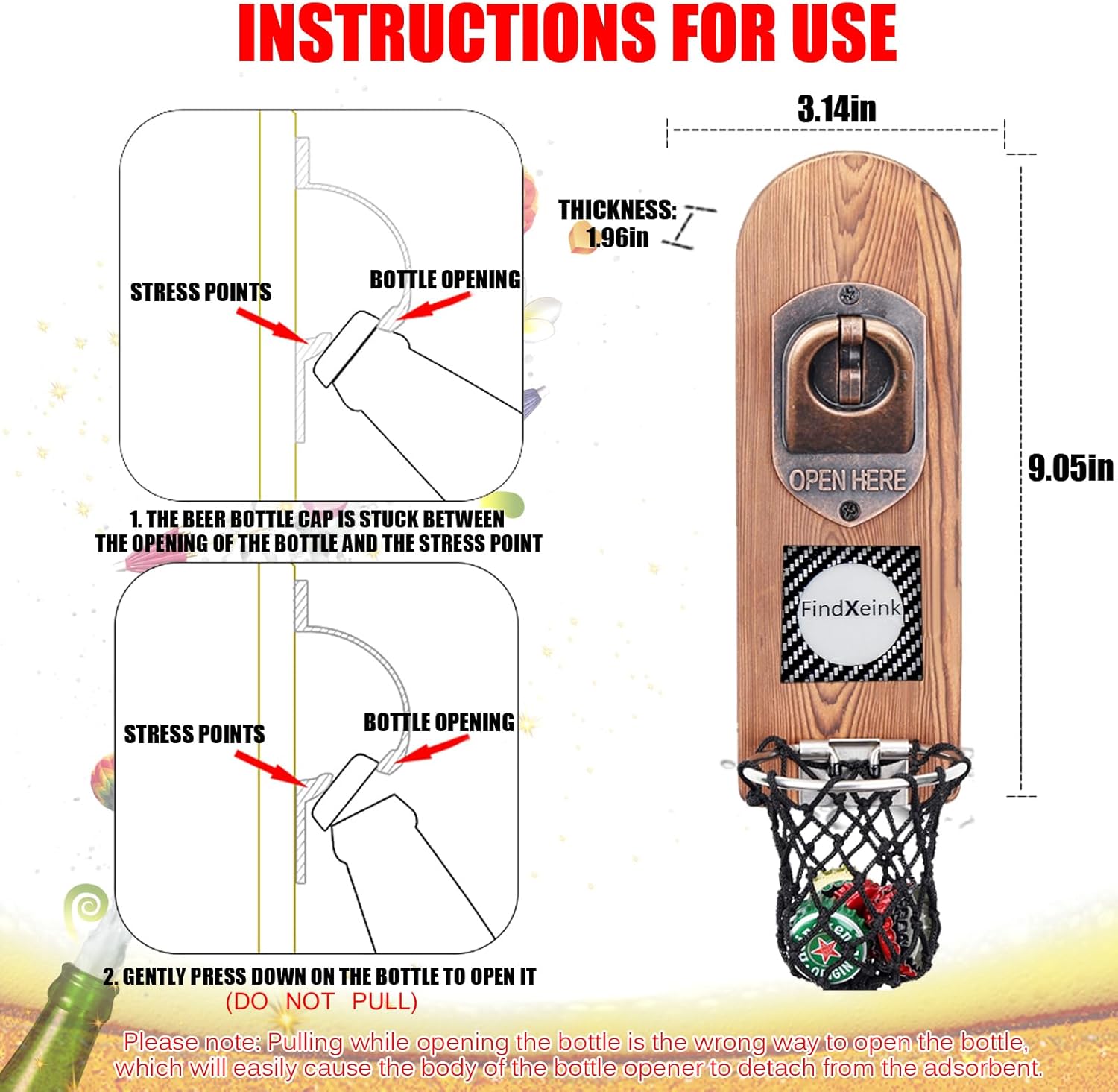
On the core job—opening bottles—this thing does the job properly. The leverage is good, and you can open a bottle one‑handed without thinking about it. The bite on the cap is firm, and I didn’t have issues with it slipping or only half-opening. I tried both standard lager bottles and some slightly odd-shaped craft beer bottles, and it handled them all. One Amazon reviewer said they can open a bottle in each hand using this, and honestly, that’s believable: the opener doesn’t move much when you pull on it.
The magnetic catcher and mesh bag combo works better than I expected. The magnet in the opener area grabs the cap as it comes off, so it doesn’t fly away. Then gravity does the rest and the cap drops into the mesh bag. In practice, almost all caps ended up in the bag. The only times I had one bounce out were when I pulled the bottle away too fast or at a weird angle. For normal use, caps fall straight in. I liked that the caps stay mostly intact, which is handy if you’re the type who collects them.
As for the Bluetooth/e‑ink performance, it’s decent but not flawless. Pairing took me a couple of minutes the first time because the instructions are a bit light, but once paired, sending a new image is quick. You long‑press the left button, connect through the app (or whatever method they provide), choose your image/text, and it updates. The refresh is not instant like a phone; the screen does that typical e‑ink flash, then shows the new image. It’s not something you’ll be changing every day, but for setting a logo or a funny message, it works.
I didn’t notice any weird behaviour with the sleep mode: after 15 minutes, it just stops talking to Bluetooth to save the battery, but the image stays as is. From a performance point of view, the tech part is more of a "set and forget" thing than a feature you constantly interact with. Overall, on performance, I’d say: as an opener and cap catcher, it’s solid; as a customizable gadget, it’s fun but slightly nerdy and not essential for everyone.
What you actually get out of the box
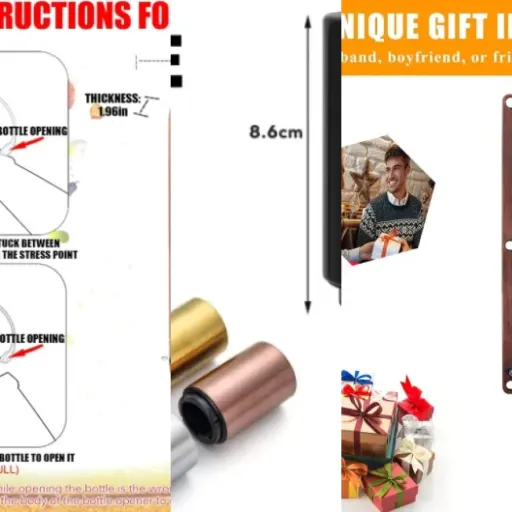
Out of the box, the ZONSUSE opener is one piece: a wooden back plate with the metal opener fixed at the top, the e‑ink screen on the front, and the mesh bag cap catcher attached at the bottom with a removable buckle. On the back there are strong fridge magnets, and the box also includes two clear double-sided stickers if you want to stick it on glass or a smooth non-metal surface. No tools are needed unless you want to screw it somewhere yourself (screws are not included).
The size is roughly what you’d expect for a wall opener: big enough to feel solid but not so big that it dominates the fridge door. The mesh bag folds flat, so when it’s empty it doesn’t stick out much. Once you start filling it with caps, it hangs out a bit more, but nothing excessive. I had about 30 caps in it before it started to look crowded; you can probably push it further, but at that point I’d empty it.
The product page talks a lot about the customizable screen, and yes, it’s there and it works. You need 2× AAA batteries (not included in my case), and you activate Bluetooth by long‑pressing the left button. The screen then pairs with your phone so you can send a picture, text, or a QR code. After 15 minutes of inactivity, the screen goes to sleep to save battery, but the picture stays visible. It’s basically like an e‑book reader screen: no backlight, just a static image that doesn’t use power once set.
Documentation is basic. It explains the Bluetooth and battery part enough to get going, but it’s not super detailed. If you’re used to pairing Bluetooth gadgets, you’ll manage; if not, you might need a couple of tries. Overall, the presentation is more practical than fancy: it’s clearly intended as a usable home bar tool, not just a joke gadget, even if the customizable image does give it a bit of a toy vibe at first glance.
Pros
- Opens bottles easily one-handed and feels solid thanks to cast iron opener and thick wood base
- Magnetic catcher and mesh bag reliably collect caps without them falling on the floor
- Customizable e‑ink screen adds a fun personal touch for gifts or home bars and barely uses battery once set
Cons
- Mesh cap bag feels like the least durable part and may wear out faster than the rest
- You partly pay for the Bluetooth/e‑ink feature even if you don’t care about tech or never customize it
Conclusion
Editor's rating
After using the ZONSUSE wooden bottle opener for a while, my take is pretty straightforward: as a practical opener with a cap catcher, it works well and feels solid. The metal opener has good leverage, the magnets are strong enough for a fridge, and the mesh bag does its job of catching caps without them ending up everywhere. For day-to-day use in a kitchen, garage, or garden bar, it gets the job done with zero fuss.
The whole Bluetooth e‑ink screen side is a nice extra if you enjoy gadgets or want to personalize it as a gift. It’s not essential, but it’s fun to add a logo, joke, or QR code. The battery system is simple (AAA batteries) and doesn’t get in the way, since the opener works fine even if the screen is dead. The only real weak spot is the mesh bag’s long-term durability, and the fact that if you don’t care about the tech part, you’re partly paying for a feature you won’t really use.
If you want a no-nonsense opener and don’t care about custom displays, you can find cheaper options. If you’re looking for a gift for a beer lover or cap collector, or something a bit more personal for your bar area, this one makes sense. It’s not perfect, but it’s a solid, fun piece of kit that actually sees use instead of gathering dust in a drawer.