Summary
Analysis score
Average of the criteria rated below
Value for money: machine, kegs and credits
Design and footprint: kitchen-friendly but with quirks
Unboxing experience and delivery context
Build, reliability and long-term prospects
Cooling, pouring and day-to-day performance
What the Philips PerfectDraft 5000 actually offers
Pros
- Chills 6L kegs to around 3°C in roughly 12 hours and keeps beer fresh for up to 30 days
- Simple, front‑loading design with LED temperature indicators and easy keg changes
- Generally positive user feedback (4.5/5) highlighting ease of use and good perceived value with keg return credits
Cons
- Drip tray reported as too small, with spills potentially reaching the counter or floor
- Overall value and convenience heavily depend on local keg delivery and return services

Specifications
View full product page →| Brand | Philips |
Home draft beer without the hassle?
The Philips Home Draft Beer Machine 5000 series (PerfectDraft HD3760/90) targets a simple promise: fresh draft beer at home, kept cold at 3°C for up to 30 days, in a compact 6-litre format. It sits in that middle ground between cheap countertop gadgets and full pub-style kegerators. On paper it focuses less on geeky features and more on convenience: quick cooling, easy keg swaps, and clear LED indicators for temperature.
Public reviews are broadly positive, with a 4.5/5 average from a few dozen buyers. Comments often highlight that it “does what it says” and praise its ease of use and perceived value once you factor in keg returns and promotional credits. This is not a niche brewer’s toy; it is clearly aimed at people who want a straightforward way to pour decent draft lager or IPA in their kitchen or living room without playing bartender or technician.
The machine weighs about 9.9 kg and runs on 220 V, with an advertised energy efficiency class A. Capacity is fixed at 6 litres per keg, which should roughly match a small gathering or a week or two of casual evening pints for one or two people. Philips also pushes the breadth of compatible beers as a selling point: lagers, IPAs, wheat beers and more, provided they are in the right keg format.
It is not perfect, though. Some buyers point to details like the small drip tray, logistics for returning empty kegs, and promotional offers that did not go as smoothly as expected. In my opinion, this positions the PerfectDraft 5000 as a solid but not flawless solution: technically convincing for home draft, with a few practical annoyances you need to accept if you want the convenience of branded 6L kegs.
Value for money: machine, kegs and credits
Value with a draft machine like the PerfectDraft 5000 is not just about the upfront price of the appliance. You have to look at the whole package: machine cost, keg prices, return credits and how often you actually drink beer at home. The listing does not show a fixed price here, but given its position in the market and the Philips branding, it clearly sits above entry‑level gadgets and below professional pub systems. The 4.5/5 average rating from 64 reviews suggests that, for most buyers, the balance between cost and enjoyment is acceptable.
One reviewer explicitly states that the machine “works out to be excellent value for money when you return empty kegs and get credits and offers”. That is a key part of the equation: each 6L keg has a cost, but the ecosystem around PerfectDraft often includes discounts or credits when you send empties back. If that system runs smoothly where you live, your per‑pint cost can come down to something quite competitive compared with pub prices, especially if you drink regularly. On the other hand, if keg collection is unreliable—as the same reviewer mentions with Yodel stopping collections—your value drops, because you lose out on credits and have more hassle dealing with empties.
Another aspect is how often you drink. The machine keeps beer fresh for up to 30 days, so even moderate drinkers can finish a 6L keg without waste. If you only drink occasionally and take two or three months to finish 6L, the economics get worse because you are not using that 30‑day window efficiently. For someone who has a few pints a week or hosts friends regularly, the cost per use looks much more rational. Comments like “a better at-home drinking experience with a good range of different beers” show that buyers factor in the convenience and the pleasure of draft beer, not just strict price per litre.
In my opinion, the Philips PerfectDraft 5000 offers good but not unbeatable value. You pay for a branded ecosystem and convenience. If you live in an area well served by keg deliveries and returns, and you enjoy beer often enough to keep the kegs rotating, the machine and its running costs make sense. If you are outside the main service zones or only drink a pint once in a blue moon, you might be better off with bottled or canned beer in a standard fridge. The machine itself seems solid, and several buyers simply call it “good quality” and “great”, which supports the idea that you are not overpaying for a flimsy gimmick, but you do need to use the ecosystem as intended to really feel the value.

Design and footprint: kitchen-friendly but with quirks
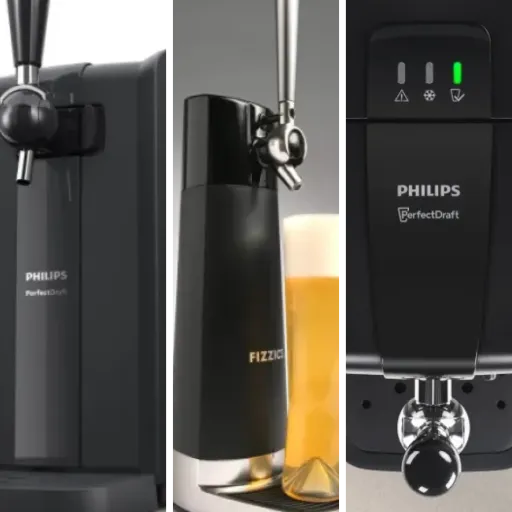
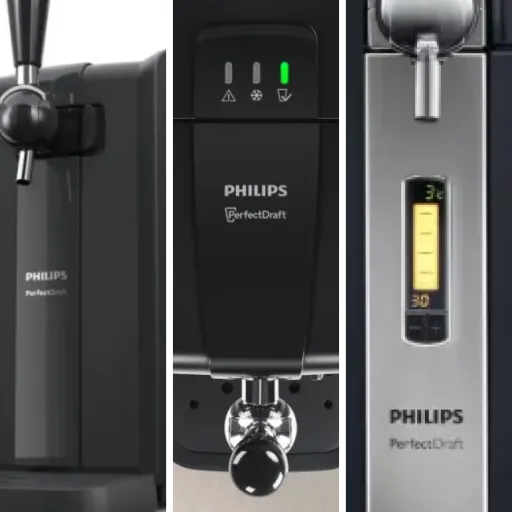
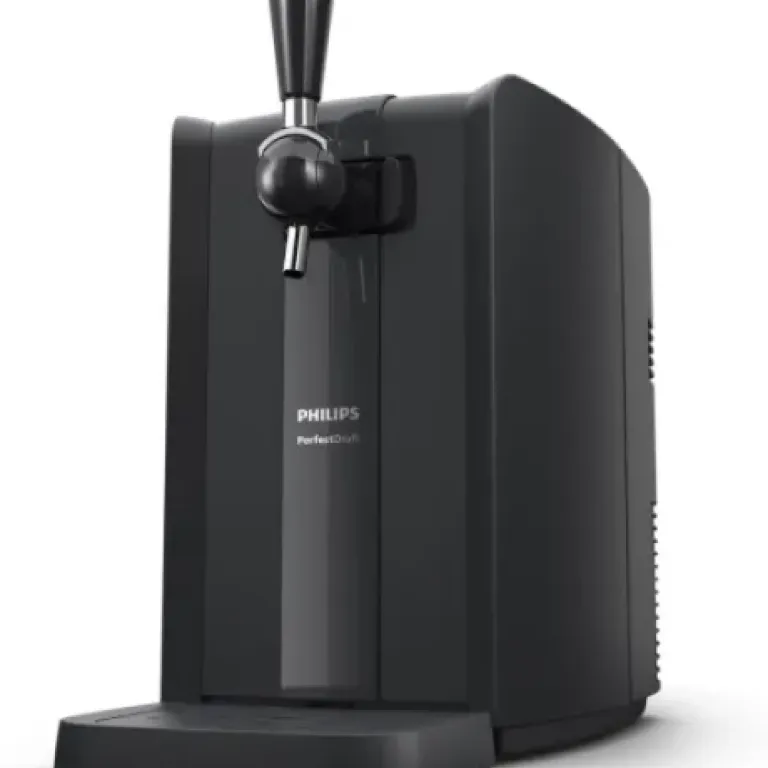
On the design front, the PerfectDraft 5000 goes for a fairly neutral look: black colour, compact tower-style body, and a visible tap that makes it clear this is a beer machine without screaming for attention. At roughly 49.3 cm deep, 26.1 cm wide and 44.3 cm high, it will take a noticeable chunk of countertop, but the narrow width helps it fit between other appliances. The almost 10 kg weight suggests there is proper insulation and a compressor inside, not just a cosmetic shell.
The double front doors are a key design element. Instead of loading kegs from the top, you open the front, slide the 6L keg in, connect it, and close the doors. Several reviewers praise the ease of changing kegs, which indicates that the internal layout and access are reasonably well thought out. For a kitchen or home bar, that front-loading approach is practical: you can park the machine under a cabinet without worrying about top clearance every time you swap kegs.
The LED indicators are another part of the design. They show the beer’s serving temperature and confirm when it has reached the advertised 3°C. There is no mention of a large touch screen or complex menu system, which in my opinion is not a bad thing. For a draft machine, a simple light-based interface is often more reliable and less distracting than a full-blown display that can fail. The overall aesthetic is that of a sturdy appliance rather than a decorative gadget.
There is one repeated criticism, though: the drip tray. A buyer explicitly complains that the tray is too small and that spills can end up on the floor. That is a design compromise: making the machine narrower and cleaner-looking probably left less room for a deeper tray. If you are careful when pouring, it may not bother you, but if you expect heavy use during parties, you might want to place an extra mat under the machine. In my opinion, aside from that tray issue, the design seems coherent: compact enough for most counters, visually discreet, and clearly prioritising easy keg access and a straightforward pour.
Unboxing experience and delivery context
The listing itself is very light on packaging details. It confirms that the product weight is 9.94 kg and that the included components consist of the draft beer machine only. There is no explicit breakdown of protective materials, internal layout of the box or extra accessories like cleaning brushes or spare hoses. For a nearly 10 kg appliance with refrigeration internals, it is safe to assume there is substantial foam or cardboard bracing inside, but that is an inference, not something buyers describe in detail.
Where things get more concrete is around delivery and logistics. The product page states that certain items cannot be delivered outside mainland UK, and that eligibility is only confirmed at checkout once you enter an address. That means availability is somewhat regional, and you should not assume it will ship to every location. A reviewer who bought the machine around the Christmas period notes that it “came quickly given the Christmas rush”, which suggests that, at least in that case, packaging and carrier handling were adequate, because there is no complaint about damage or missing parts.
Another angle related to packaging is the ecosystem of keg returns. One buyer explains that they used to rely on Yodel to collect empty kegs in exchange for credits and offers, but that this collection service seems to have stopped, making the whole experience less convenient. While this does not describe the cardboard box of the machine itself, it shows that the overall experience of owning the PerfectDraft involves not just receiving the appliance, but also shipping full and empty kegs over time. If that loop is smooth in your area, you get a nice cycle of deliveries and credits; if it is not, you end up storing empty kegs longer than expected.
In my opinion, there is nothing in the comments that hints at systematically poor packaging or frequent transport damage. The main thing to watch is not the initial box, but the ongoing logistics: checking whether your address is eligible, which carrier is used, and how easy it is to send empties back. If you are in mainland UK and within the core service zones, the experience should be straightforward. Outside those zones, you may have to accept higher friction or rely on local resellers for kegs and returns.

Build, reliability and long-term prospects
Durability is always tricky to judge early in a product’s life. This model first appeared in mid‑2024 and has only a few dozen published reviews so far, so there is not yet a huge history of multi‑year ownership. That said, some indicators can be pulled from the specs and the tone of the comments. At almost 10 kg, the PerfectDraft 5000 clearly contains a real refrigeration system and solid casing rather than a flimsy plastic shell. Philips is also a long‑standing brand in small kitchen appliances, which usually means access to spare parts and service for a reasonable period.
Among the reviews, there are no recurring complaints about early failures, leaks or major defects. People focus instead on usability, keg logistics and small design details. Phrases like “good quality product” and “value for money” from verified buyers point more toward a sense of solidity than disappointment. The device is energy class A, suggesting decent insulation and components that are not overly stressed, which can help with longevity if you keep it running with a keg inside most of the time.
One reviewer mentions issues around keg collection and a welcome offer not being honoured, but this is linked to the distribution and service ecosystem (delivery, returns, promotions), not the build quality of the machine itself. That distinction matters: you might run into frustration with logistics or promos, yet still have a technically reliable appliance. There are also no patterns of broken taps or cracked doors in the comments, which are typical weak points on cheaper draft machines.
In my opinion, on paper the PerfectDraft 5000 looks like a reasonably robust kitchen appliance, not a disposable gadget. The heavy build, simple LED interface and lack of overly complex moving parts play in its favour. Still, it is early days for this specific HD3760/90 variant, so anyone expecting 10+ years of use is betting on Philips’ general track record rather than a long trail of reviews. If you treat it like a fridge—kept upright, not moved constantly, and cleaned sensibly—it should hold up, but as with any compressor-based device, repairs outside warranty could be costly if something critical fails.
Cooling, pouring and day-to-day performance
The performance claims of the PerfectDraft 5000 revolve around three main points: cooling speed, serving temperature, and beer freshness over time. Philips states that the machine chills beer from room temperature down to 3°C in about 12 hours. For a 6L keg, that is a realistic timeframe: you put in a warm keg in the evening and it should be ready by the next day. The internal fridge section is rated for 2–8°C, but the headline is that stable 3°C serving temperature, signalled by the LED indicators.
In the Amazon reviews, people don’t go into technical detail, but the overall 4.5/5 rating and comments like “does what it says” and “cold, high quality beer” suggest that, in practice, the machine reaches and maintains a satisfying temperature for most users. One reviewer mentions that their husband “absolutely loves this” and calls out the quality of the beer, which indirectly points to consistent cooling and pouring. There are no recurring complaints about lukewarm beer or unstable temperature mentioned in the public comments, which is a good sign.
The other big claim is up to 30 days of freshness once a keg is tapped. That figure is reasonable for a sealed pressurised keg system with constant refrigeration. It means that, on paper, you can enjoy a few pints per week without worrying that the last glass will be flat or off. While no reviewer breaks down their usage week by week, the absence of complaints about stale beer over time hints that the promise holds up for typical home consumption.
Finally, pouring performance: there is not much technical information about pressure control or foam management, but reviewers calling it a “great machine” and “good quality product” that is “easy to use” implies that the pour is predictable enough for casual users. In my opinion, this machine is tuned to offer stable, cold pours with minimal fuss, not barista-level control. If you want detailed adjustments of carbonation and pressure, this will feel basic. But for most people who just want cold draft beer ready in the kitchen, the performance looks solid and consistent, with the only notable downside being that small drip tray that can let spills reach the floor if you are not careful.

What the Philips PerfectDraft 5000 actually offers
The Philips PerfectDraft 5000 HD3760/90 is a countertop draft beer machine designed around 6-litre kegs. The brand highlights five core promises: quick cooling from room temperature to 3°C in about 12 hours, 30 days of freshness once the keg is tapped, easy keg changes thanks to double front doors, LED indicators for temperature, and a wide beer selection in compatible kegs. The stated temperature range of the integrated fridge section is 2–8°C, but the flagship value is that 3°C serving temperature.
Physically, it is a fairly substantial appliance at 49.3 x 26.1 x 44.3 cm and 9.94 kg. That is roughly the footprint of a compact coffee machine, but deeper and heavier because there is real refrigeration hardware inside. Energy efficiency is rated class A on the A–G scale, which is reassuring if you plan to leave a keg inside for weeks at a time. The machine runs on 220 V, so it is clearly aimed at European-style mains power.
The box content is minimal: according to the listing, you get the draft beer machine itself, and that is it. No separate mention of extra accessories like spare tap handles or cleaning kits, so you should assume the basics only. On the usage side, Philips emphasises that you simply open the front double doors, slide in a 6L keg, connect it, and let the machine chill the beer. The LED interface then shows when the beer has reached the target temperature.
From the published comments, the overall concept seems to work for its audience: buyers often say it is easy to use, looks good on the counter, and pairs well with the keg return system and associated credits. In my opinion, this is very much a “plug-and-pour” appliance rather than a tinkerer’s project. If you want to pick a keg, chill it overnight and then just pour beers for a month, the feature set is aligned with that scenario. If you are looking for granular control over pressure or temperature curves, this is not the product’s goal.
Pros
- Chills 6L kegs to around 3°C in roughly 12 hours and keeps beer fresh for up to 30 days
- Simple, front‑loading design with LED temperature indicators and easy keg changes
- Generally positive user feedback (4.5/5) highlighting ease of use and good perceived value with keg return credits
Cons
- Drip tray reported as too small, with spills potentially reaching the counter or floor
- Overall value and convenience heavily depend on local keg delivery and return services
Conclusion
Analysis score
The Philips PerfectDraft 5000 (HD3760/90) positions itself as a practical way to get fresh, cold draft beer at home without diving into complex kegerator setups. On paper it delivers the essentials: 6L kegs chilled to 3°C in about 12 hours, up to 30 days of freshness, and a compact, front‑loading design that fits on most kitchen counters. The 4.5/5 average from public reviews backs up the idea that, for most buyers, it simply gets the job done: easy to use, cold beer on tap, and a decent range of compatible lagers, IPAs and wheat beers.
It is not without flaws. The drip tray is clearly undersized according to at least one buyer, so you may want extra protection under the machine during heavy use. The overall value depends heavily on the keg return and credit system working smoothly in your area; when carriers stop collecting empties, the convenience and economics take a hit. And since this specific model is still relatively new, there is not yet a long track record on multi‑year durability, even if the build and brand are reassuring.
In my opinion, this machine suits people who drink beer regularly enough to rotate 6L kegs within a month and who have access to the PerfectDraft keg ecosystem with returns and offers. For them, it offers a straightforward, reliable way to pour draft beer at home with minimal fuss. Those who drink only occasionally, or who live in areas with patchy keg logistics, might find that the cost and constraints outweigh the benefits and would be better served by sticking to bottles or cans in a normal fridge.